


LAWRENCE — Research appearing in ACS Nano, a premier journal on nanoscience and nanotechnology, reveals the ballistic movement of electrons in graphene in real time.
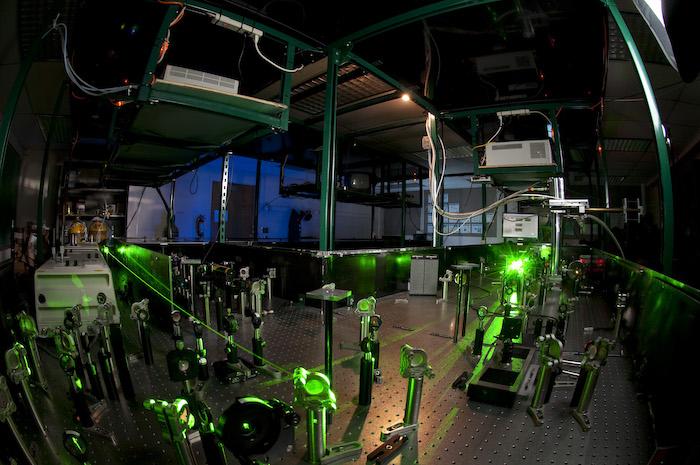
Credit: University of Kansas
LAWRENCE — Research appearing in ACS Nano, a premier journal on nanoscience and nanotechnology, reveals the ballistic movement of electrons in graphene in real time.
The observations, made at the University of Kansas’ Ultrafast Laser Lab, could lead to breakthroughs in governing electrons in semiconductors, fundamental components in most information and energy technology.
“Generally, electron movement is interrupted by collisions with other particles in solids,” said lead author Ryan Scott, a doctoral student in KU’s Department of Physics & Astronomy. “This is similar to someone running in a ballroom full of dancers. These collisions are rather frequent — about 10 to 100 billion times per second. They slow down the electrons, cause energy loss and generate unwanted heat. Without collisions, an electron would move uninterrupted within a solid, similar to cars on a freeway or ballistic missiles through air. We refer to this as ‘ballistic transport.’”
Scott performed the lab experiments under the mentorship of Hui Zhao, professor of physics & astronomy at KU. They were joined in the work by former KU doctoral student Pavel Valencia-Acuna, now a postdoctoral researcher at the Northwest Pacific National Laboratory.
Zhao said electronic devices utilizing ballistic transport could potentially be faster, more powerful and more energy efficient.
“Current electronic devices, such as computers and phones, utilize silicon-based field-effect transistors,” Zhao said. “In such devices, electrons can only drift with a speed on the order of centimeters per second due to the frequent collisions they encounter. The ballistic transport of electrons in graphene can be utilized in devices with fast speed and low energy consumption.”
The KU researchers observed the ballistic movement in graphene, a promising material for next-generation electronic devices. First discovered in 2004 and awarded the Nobel Prize in Physics in 2010, graphene is made of a single layer of carbon atoms forming a hexagonal lattice structure — somewhat like a soccer net.
“Electrons in graphene move as if their ‘effective’ mass is zero, making them more likely to avoid collisions and move ballistically,” Scott said. “Previous electrical experiments, by studying electrical currents produced by voltages under various conditions, have revealed signs of ballistic transport. However, these techniques aren’t fast enough to trace the electrons as they move.”
According to the researchers, electrons in graphene (or any other semiconductor) are like students sitting in a full classroom, where students can’t freely move around because the desks are full. The laser light can free electrons to momentarily vacate a desk, or ‘hole’ as physicists call them.
“Light can provide energy to an electron to liberate it so that it can move freely,” Zhao said. “This is similar to allowing a student to stand up and walk away from their seat. However, unlike a charge-neutral student, an electron is negatively charged. Once the electron has left its ‘seat,’ the seat becomes positively charged and quickly drags the electron back, resulting in no more mobile electrons — like the student sitting back down.”
Because of this effect, the super-light electrons in graphene can only stay mobile for about one-trillionth of a second before falling back to its seat. This short time presents a severe challenge to observing the movement of the electrons. To address this problem, the KU researchers designed and fabricated a four-layer artificial structure with two graphene layers separated by two other single-layer materials, molybdenum disulphide and molybdenum diselenide.
“With this strategy, we were able to guide the electrons to one graphene layer while keeping their ‘seats’ in the other graphene layer,” Scott said. “Separating them with two layers of molecules, with a total thickness of just 1.5 nanometers, forces the electrons to stay mobile for about 50-trillionths of a second, long enough for the researchers, equipped with lasers as fast as 0.1 trillionth of a second, to study how they move.”
The researchers use a tightly focused laser spot to liberate some electrons in their sample. They trace these electrons by mapping out the “reflectance” of the sample, or the percentage of light they reflect.
“We see most objects because they reflect light to our eyes,” Scott said. “Brighter objects have larger reflectance. On the other hand, dark objects absorb light, which is why dark clothes become hot in the summer. When a mobile electron moves to a certain location of the sample, it makes that location slightly brighter by changing how electrons in that location interact with light. The effect is very small — even with everything optimized, one electron only changes the reflectance by 0.1 part per million.”
To detect such a small change, the researchers liberated 20,000 electrons at once, using a probe laser to reflect off the sample and measure this reflectance, repeating the process 80 million times for each data point. They found the electrons on average move ballistically for about 20-trillionths of a second with a speed of 22 kilometers per second before running into something that terminates their ballistic motion.
The research was funded by a grant from the Department of Energy under the program of Physical Behavior of Materials.
Zhao said currently his lab is working to refine their material design to guide electrons more efficiently to the desired graphene layer, and trying to find ways to make them move longer distances ballistically.
Journal
ACS Nano
DOI
10.1021/acsnano.3c08816

