


Beef operations that keep cattle on lifelong grass-based diets may have an overall higher carbon footprint than those that switch cattle to grain-based diets partway through their lives. Daniel Blaustein-Rejto of the Breakthrough Institute, USA, and colleagues present these findings in the open-access journal PLOS ONE on December 13.
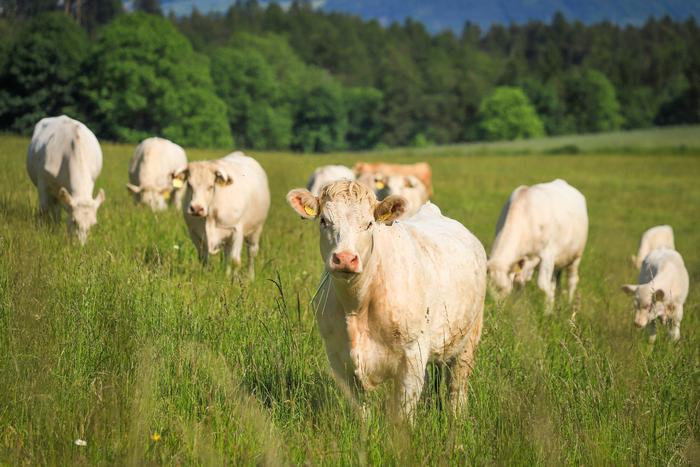
Credit: katerinavulcova, Pixabay, CC0 (https://creativecommons.org/publicdomain/zero/1.0/)
Beef operations that keep cattle on lifelong grass-based diets may have an overall higher carbon footprint than those that switch cattle to grain-based diets partway through their lives. Daniel Blaustein-Rejto of the Breakthrough Institute, USA, and colleagues present these findings in the open-access journal PLOS ONE on December 13.
Cattle on lifelong grass diets are known as “pasture finished,” while those that switch from grass to grain before slaughter are “grain finished.” Prior research has suggested that pasture-finished beef operations have a higher carbon footprint than grain-finished operations. However, most studies have limited their focus to the amount of greenhouse gases emitted directly by beef production without considering other factors that may affect the overall carbon footprint.
To help deepen understanding, Blaustein-Rejto and colleagues calculated and compared the carbon footprint of 100 beef operations located in 16 countries. In addition to direct greenhouse gas emissions, their calculations incorporated soil carbon sequestration—the capture and long-term storage in pasture soils of atmospheric carbon, often in the form of dead plants and cattle waste. They also accounted for the carbon opportunity cost—the carbon that would have been sequestered if the land had native ecosystems instead of being used for beef production.
Extensive statistical analysis showed that the pasture-finished operations produce 20 percent more greenhouse gases than grain-finished operations—in line with prior studies. However, after incorporating soil carbon sequestration and carbon opportunity cost, the total carbon footprint of pasture-finished operations was 42 percent higher, likely due to its more intense usage of land.
Further analysis suggested that an increase in land use intensity is indeed strongly associated with a bigger overall carbon footprint for beef operations. The calculations also suggest that, averaging across all operations in the study, carbon opportunity costs may contribute even more to an operation’s overall carbon footprint than its direct greenhouse gas emissions.
The researchers say their findings emphasize the need for climate mitigation efforts to account for carbon opportunity costs of beef production. With pasture-finished beef often being seen as more premium, carbon footprint data may also provide important additional information to aid consumer choice.
The authors add: “Our research reveals that the carbon cost of land use accounts for the largest part of beef’s carbon footprint. Therefore, there is an even larger carbon cost than typically found to land-intensive beef operations, such as many grass-fed systems, even when taking into account potential carbon sequestration due to grazing.”
#####
In your coverage please use this URL to provide access to the freely available article in PLOS ONE: https://journals.plos.org/plosone/article?id=10.1371/journal.pone.0295035
Citation: Blaustein-Rejto D, Soltis N, Blomqvist L (2023) Carbon opportunity cost increases carbon footprint advantage of grain-finished beef. PLoS ONE 18(12): e0295035. https://doi.org/10.1371/journal.pone.0295035
Author Countries: USA
Funding: The authors received no specific funding for this work.
Journal
PLoS ONE
DOI
10.1371/journal.pone.0295035
Method of Research
Observational study
Subject of Research
Animals
Article Title
Carbon opportunity cost increases carbon footprint advantage of grain-finished beef
Article Publication Date
13-Dec-2023
COI Statement
The authors have declared that no competing interests exist.

