With an estimated 1.9 million new cases and more than 600,000 deaths each year, cancer remains the second most common cause of death in the U.S., trailing only heart disease. And while there are more than 200 types of cancer, the abnormal synthesis of a protein known as STAT3 is unique to the majority of tumors.
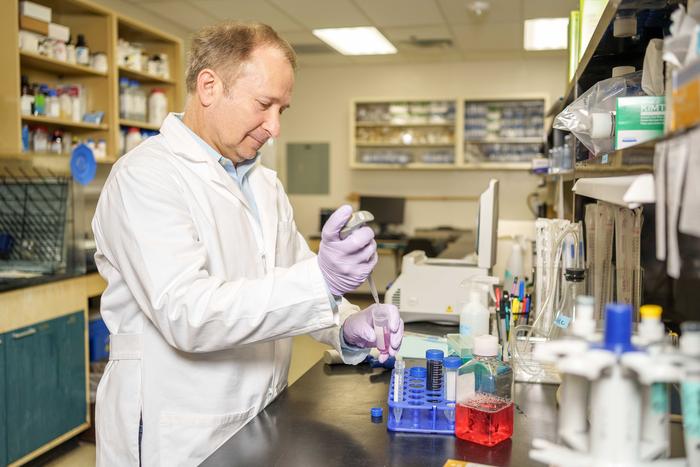
Credit: TTUHSC
With an estimated 1.9 million new cases and more than 600,000 deaths each year, cancer remains the second most common cause of death in the U.S., trailing only heart disease. And while there are more than 200 types of cancer, the abnormal synthesis of a protein known as STAT3 is unique to the majority of tumors.
STAT3 is known as a transcriptional regulator, which means it regulates the expression of several genes. In fact, STAT3 is associated with approximately 70% of all human tumors and is responsible for uncontrolled cell growth and disease progression.
To investigate new approaches to inhibit STAT3 and develop new cancer treatments, the National Institutes of Health-National Cancer Institute recently awarded a two-year, $153,000 grant (“Development of an Anti-Cancer Approach Through a Novel Pathway of Translational Regulation”) to Andrey Karamyshev, Ph.D., from the Texas Tech University Health Sciences Center School of Medicine.
Regardless of a tumor’s type or location in the body, elevated STAT3 levels are known markers of unfavorable cancer prognoses. Because of that, Karamyshev said inhibiting STAT3 became a popular starting point for researchers seeking to develop new cancer treatments.
“You just inhibit this one protein and you cure 70% or more of all cancers, so it was an attractive target for many years,” Karamyshev said. “Unfortunately, all trials that used small molecules to directly inhibit the STAT 3 protein failed because when STAT3 interacted with the molecules, it created an aggregation that inhibited certain cell functions that are dependent on STAT3, which led to high toxicity.”
As additional research demonstrated that STAT3 could not be directly inhibited, Karamyshev began investigating ways to indirectly inhibit the protein, such as disrupting its synthesis or stability. Because disrupting STAT3 stability was unsuccessful in several other studies, he focused his research on disrupting STAT3 at the translation level during its synthesis by ribosomes, which are the molecular machines that make proteins, including STAT3.
Several years ago, Karamyshev’s lab discovered a specific pathway known as the RAPP (Regulation of Aberrant Protein Production). Though RAPP was not relevant to STAT3 at the time, that work also showed that if protein synthesis is disrupted on the ribosome, the protein’s mRNAs are specifically degraded. Karamyshev hypothesized that inhibiting STAT3 synthesis at this level could lead to new treatments for cancer, so he began looking for proteins that can interact with and disrupt STAT3 during its synthesis on the ribosomes.
“This is the major difference in our research,” Karamyshev said. “We are looking for the elements of the protein synthesis and how the protein — STAT3 in this case — interacts with other proteins. The idea is if we can identify these interacting proteins, we can inhibit them, which will push the ‘button’ for downregulation of STAT3.”
When Karamyshev’s lab discovered the RAPP pathway, they were actually studying proteins that are secreted outside of the cell. They noticed that when these secretory proteins cannot be recognized by a specific protein complex (a signal recognition particle, or SRP) which is required for transport, the mRNA templates degraded. However, as a transcriptional regulator, STAT3 is shuttled between the cell’s cytoplasm and nucleus, and it is not a secretory protein.
Because the proteins regulating STAT3 mRNA stability on the ribosome are not known yet, the current project is directed toward identifying these new RAPP components that interact with STAT3 on the ribosome during its synthesis. Once these components are identified, they can be inhibited to decrease the level of STAT3 mRNA level. This approach could help scientists develop new anti-cancer treatments, and the preliminary results obtained by Karamyshev’s lab demonstrate the proof of principle to develop this approach.
“This is a very new concept that shows we can regulate STAT3 indirectly and we can downregulate its expression,” Karamyshev said. “It can open new opportunities to find specific molecules which can target the RAPP pathway components instead of the STAT3. And when certain small molecules are found to be insufficient to directly downregulate STAT3 activity or expression, we can use a completely different set of molecules that regulate the other proteins which are involved in indirect STAT3 inhibition. The concept is very simple: you push a ‘button’ and it triggers a decrease of STAT3, which can ultimately result in new treatments for many cancers.”
###