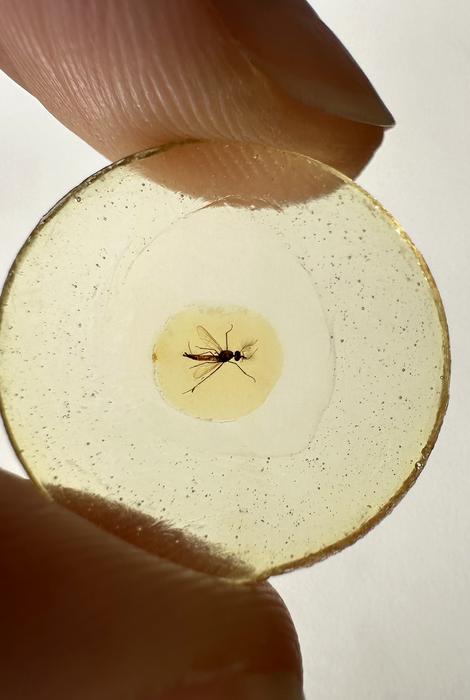
Researchers reporting in the journal Current Biology on December 4 have found the earliest-known fossil mosquito in Lower Cretaceous amber from Lebanon. What’s more, the well-preserved insects are two males of the same species with piercing mouthparts, suggesting they likely sucked blood. That’s noteworthy because, among modern-day mosquitoes, only females are hematophagous, meaning that they use piercing mouthparts to feed on the blood of people and other animals.
Credit: Dany Azar
Researchers reporting in the journal Current Biology on December 4 have found the earliest-known fossil mosquito in Lower Cretaceous amber from Lebanon. What’s more, the well-preserved insects are two males of the same species with piercing mouthparts, suggesting they likely sucked blood. That’s noteworthy because, among modern-day mosquitoes, only females are hematophagous, meaning that they use piercing mouthparts to feed on the blood of people and other animals.
“Lebanese amber is, to date, the oldest amber with intensive biological inclusions, and it is a very important material as its formation is contemporaneous with the appearance and beginning of radiation of flowering plants, with all what follows of co-evolution between pollinators and flowering plants,” says Dany Azar of the Nanjing Institute of Geology and Palaeontology at the Chinese Academy of Sciences and the Lebanese University.
“Molecular dating suggested that the family Culicidae arose during the Jurassic, but previously the oldest record was mid-Cretaceous,” says André Nel of the National Museum of Natural History of Paris (Muséum National d’Histoire Naturelle de Paris). “Here we have one from the early Cretaceous, about 30 million years before.”
The Culicidae family of arthropods includes more than 3,000 species of mosquitoes. The new findings suggest that male mosquitoes in the past fed on blood as well, according to the researchers. They also help to narrow the “ghost-lineage gap” for mosquitoes, they say.
Female mosquitoes are notorious for their blood-feeding ways, which has made them a major vector for spreading infectious diseases. Hematophagy in insects is thought to have arisen as a shift from piercing-sucking mouthparts used to extract plant fluids. For example, blood-sucking fleas likely arose from nectar-feeding insects. But the evolution of blood feeding has been hard to study in part due to gaps in the insect fossil record.
In the new study, Azar, Nel, Diying Huang, and Michael S. Engel describe two male mosquitoes with piercing mouthparts, including an exceptionally sharp, triangular mandible and elongated structure with small, tooth-like denticles.
They report that the mosquitoes’ preservation in amber extends the definitive occurrence of the mosquito family of insects into the early Cretaceous. It also suggests that the evolution of hematophagy was more complicated than had been suspected, with hematophagous males in the distant past.
In future work, Nel says the team wants to learn more about the “utility” of having hematophagy in Cretaceous male mosquitoes. They’re also curious to explore “why this no longer exists,” he says.
###
This work was supported by the National Natural Science Foundation of China
Current Biology, Azar et al. “The earliest fossil mosquito” https://www.cell.com/current-biology/fulltext/S0960-9822(23)01448-3
Current Biology (@CurrentBiology), published by Cell Press, is a bimonthly journal that features papers across all areas of biology. Current Biology strives to foster communication across fields of biology, both by publishing important findings of general interest and through highly accessible front matter for non-specialists. Visit: http://www.cell.com/current-biology. To receive Cell Press media alerts, contact [email protected].
Journal
Current Biology
DOI
10.1016/j.cub.2023.10.047
Method of Research
Observational study
Subject of Research
Animals
Article Title
The earliest fossil mosquito
Article Publication Date
4-Dec-2023