• HOME
  • NEWS
  • EXPLORE
    • CAREER
      • Companies
      • Jobs
    • EVENTS
    • iGEM
      • News
      • Team
    • PHOTOS
    • VIDEO
    • WIKI
  • BLOG
  • COMMUNITY
    • FACEBOOK
    • INSTAGRAM
    • TWITTER
Saturday, February 7, 2026
BIOENGINEER.ORG
No Result
View All Result
  • Login
  • HOME
  • NEWS
  • EXPLORE
    • CAREER
      • Companies
      • Jobs
        • Lecturer
        • PhD Studentship
        • Postdoc
        • Research Assistant
    • EVENTS
    • iGEM
      • News
      • Team
    • PHOTOS
    • VIDEO
    • WIKI
  • BLOG
  • COMMUNITY
    • FACEBOOK
    • INSTAGRAM
    • TWITTER
  • HOME
  • NEWS
  • EXPLORE
    • CAREER
      • Companies
      • Jobs
        • Lecturer
        • PhD Studentship
        • Postdoc
        • Research Assistant
    • EVENTS
    • iGEM
      • News
      • Team
    • PHOTOS
    • VIDEO
    • WIKI
  • BLOG
  • COMMUNITY
    • FACEBOOK
    • INSTAGRAM
    • TWITTER
No Result
View All Result
Bioengineer.org
No Result
View All Result
Home NEWS Science News Biology

Decoding flavonoid metabolism: a closer look at plant-based diets

Bioengineer by Bioengineer
December 4, 2023
in Biology
Reading Time: 2 mins read
0
Understanding how our bodies metabolize different flavonoids in our diets
Share on FacebookShare on TwitterShare on LinkedinShare on RedditShare on Telegram

In a world where plant-based lifestyles are on the rise, the power of foods such as broccoli, celery, and tofu, which are rich in flavonoids, is becoming clearer. Flavonoids are phenolic compounds produced by plants that are essential for plant development and defense and have long been said to have therapeutic and preventive effects against cancer and heart disease. However, the exact process of how our bodies metabolize flavonoids remains unclear.
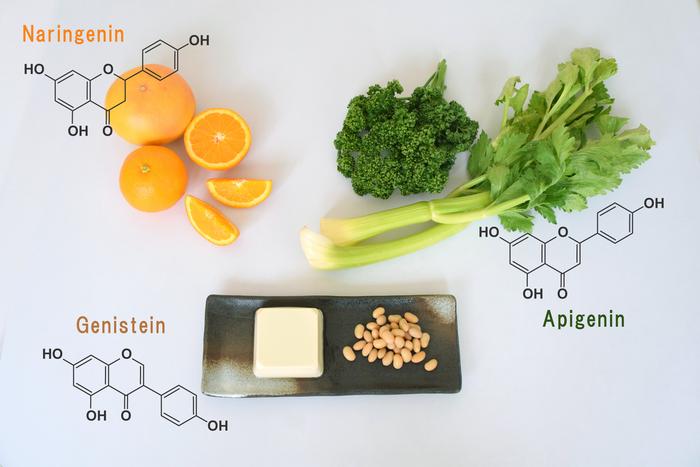
Understanding how our bodies metabolize different flavonoids in our diets

Credit: Osaka Metropolitan University

In a world where plant-based lifestyles are on the rise, the power of foods such as broccoli, celery, and tofu, which are rich in flavonoids, is becoming clearer. Flavonoids are phenolic compounds produced by plants that are essential for plant development and defense and have long been said to have therapeutic and preventive effects against cancer and heart disease. However, the exact process of how our bodies metabolize flavonoids remains unclear.

An international team of researchers led by visiting researcher Tsutomu Shimada and Professor Shigeo Takenaka of the Graduate School of Human Life and Ecology at Osaka Metropolitan University, has shed light on the mechanism of three major flavonoids – naringenin, apigenin and genistein – and the processes by which the body metabolizes them. Molecular docking analyses revealed that human enzymes modify flavonoids in a similar way to how plants modify flavonoids.

“The results of this research are fundamental in elucidating the correlation between the metabolism of flavonoids in the body and their potential health benefits,” explained Professor Takenaka.

Their findings were published in Chemical Research in Toxicology.


Other researchers on the paper are from: Osaka Institute of Public Health, Showa Pharmaceutical University, Konkuk University and Vanderbilt University.


###

About OMU 

Osaka Metropolitan University is the third largest public university in Japan, formed by a merger between Osaka City University and Osaka Prefecture University in 2022. OMU upholds “Convergence of Knowledge” through 11 undergraduate schools, a college, and 15 graduate schools. For more research news, visit https://www.omu.ac.jp/en/ or follow us on Twitter: @OsakaMetUniv_en, or Facebook. 


Journal

Chemical Research in Toxicology

DOI

10.1021/acs.chemrestox.3c00229

Method of Research

Experimental study

Subject of Research

Not applicable

Article Title

Oxidation of Naringenin, Apigenin, and Genistein by Human Family 1 Cytochrome P450 Enzymes and Comparison of Interaction of Apigenin with Human P450 1B1.1 and Scutellaria P450 82D.1

Article Publication Date

2-Oct-2023

Share12Tweet8Share2ShareShareShare2

Related Posts

Florida Cane Toad: Complex Spread and Selective Evolution

Florida Cane Toad: Complex Spread and Selective Evolution

February 7, 2026
New Study Uncovers Mechanism Behind Burn Pit Particulate Matter–Induced Lung Inflammation

New Study Uncovers Mechanism Behind Burn Pit Particulate Matter–Induced Lung Inflammation

February 6, 2026

DeepBlastoid: Advancing Automated and Efficient Evaluation of Human Blastoids with Deep Learning

February 6, 2026

Navigating the Gut: The Role of Formic Acid in the Microbiome

February 6, 2026

POPULAR NEWS

  • Robotic Ureteral Reconstruction: A Novel Approach

    Robotic Ureteral Reconstruction: A Novel Approach

    82 shares
    Share 33 Tweet 21
  • Digital Privacy: Health Data Control in Incarceration

    63 shares
    Share 25 Tweet 16
  • Study Reveals Lipid Accumulation in ME/CFS Cells

    57 shares
    Share 23 Tweet 14
  • Breakthrough in RNA Research Accelerates Medical Innovations Timeline

    53 shares
    Share 21 Tweet 13

About

We bring you the latest biotechnology news from best research centers and universities around the world. Check our website.

Follow us

Recent News

Decoding Prostate Cancer Origins via snFLARE-seq, mxFRIZNGRND

Digital Health Perspectives from Baltic Sea Experts

Florida Cane Toad: Complex Spread and Selective Evolution

Subscribe to Blog via Email

Enter your email address to subscribe to this blog and receive notifications of new posts by email.

Join 73 other subscribers
  • Contact Us

Bioengineer.org © Copyright 2023 All Rights Reserved.

Welcome Back!

Login to your account below

Forgotten Password?

Retrieve your password

Please enter your username or email address to reset your password.

Log In
No Result
View All Result
  • Homepages
    • Home Page 1
    • Home Page 2
  • News
  • National
  • Business
  • Health
  • Lifestyle
  • Science

Bioengineer.org © Copyright 2023 All Rights Reserved.