Commonly associated with longer days and slower paces, this summer’s record-smashing heat in Arizona demonstrated a concerning future for the planet’s warmest season. From power outages endangering entire neighborhoods and heat-related deaths rising among some of the state’s most vulnerable populations, the city of Phoenix found itself in national headlines. As national attention grew, one question became clear: How does anyone live there?
Credit: ASU Global Futures Laboratory
Commonly associated with longer days and slower paces, this summer’s record-smashing heat in Arizona demonstrated a concerning future for the planet’s warmest season. From power outages endangering entire neighborhoods and heat-related deaths rising among some of the state’s most vulnerable populations, the city of Phoenix found itself in national headlines. As national attention grew, one question became clear: How does anyone live there?
The consequences of extreme heat do not affect Arizona residents alone. Extreme heat made worldwide news this year, including in November when a 23-year-old woman died of cardiorespiratory arrest at a Taylor Swift concert in Brazil where heat indexes that day exceeded 120 degrees.
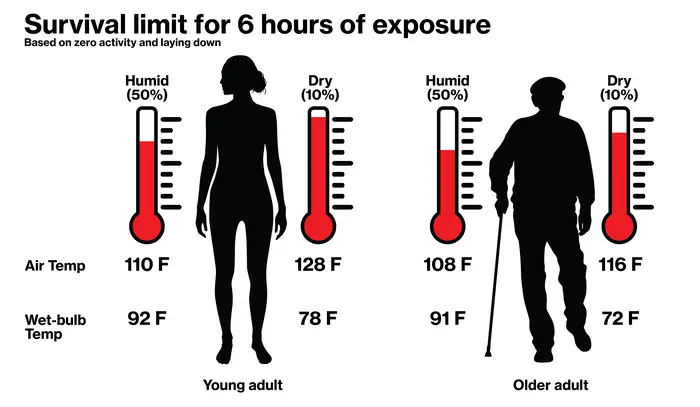
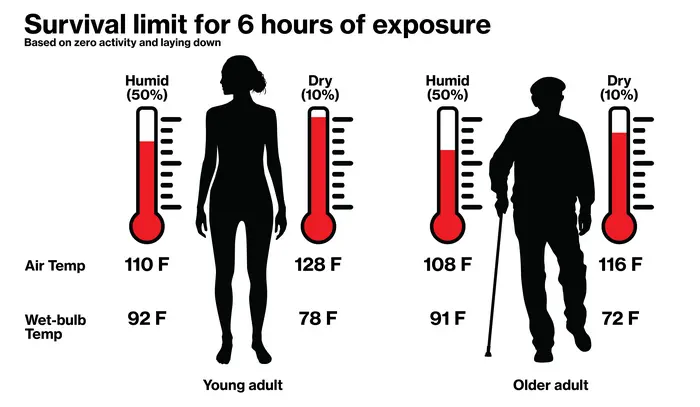
Jennifer Vanos, associate professor in the School of Sustainability at Arizona State University, studies extreme heat and its health impacts. She is the lead author of a new paper published Nov. 29 in Nature Communications. Titled “A physiological approach for assessing human survivability and liveability to heat in a changing climate,” the paper explores temperatures at which humans can survive. The research demonstrates that the current estimated upper temperature and humidity limits used for human survivability may not paint an accurate picture of the impacts of a warming planet on human health.
“For the past decade or so we have been using what we call a ‘wet bulb temperature’ of 35 degrees Celsius, or 95 degrees Fahrenheit, as the limit for human survivability,” said Vanos, also a Senior Global Futures Scientist in the Julie Ann Wrigley Global Futures Laboratory.
The wet-bulb temperature limit for human survival indicates the maximum combinations of temperature and humidity that humans can tolerate without suffering inevitable heat stroke over a fixed duration of exposure.
“The idea is that you could survive for up to six hours at that level of heat exposure,” Vanos said. “That number really oversimplifies what happens physiologically in the body when your body is exposed to that temperature, and it doesn’t account for important variables like age or other vulnerability factors.”
Vanos said the commonly-used wet-bulb temperature for human survivability assumes the person is indoors or shaded, unclothed, completely sedentary, fully heat acclimatized and of an “average size.” These assumptions do not align, in most cases, with how humanity navigates the summer season. The paper models scenarios that adjust for factors such as humidity, age, activity level and sun exposure, and provides a range of safe temperatures based on a series of characteristics.
“We didn’t only want to better understand the conditions that people could survive in,” Vanos said. “We wanted to understand the conditions that allowed people to live their lives. If the only safe way to live in an area is to be completely sedentary, people won’t want to live there. Being able to spend time outdoors and live your life without seeing a sustained rise in core temperature is a really important metric to understand today and as we move into the future.”
Vanos said Gisel Guzman Echavarria, an ASU student, was instrumental in creating the figures used throughout the paper to demonstrate the research findings.
The research, funded by the National Science Foundation, was conducted by a combination of climate scientists and physiologists, a collaboration that Vanos said was crucial in understanding the intertwined nature of heat and human health. Ollie Jay, professor and director of the Heat and Health Research Incubator at the University of Sydney, said the combined perspectives allow for a cohesive understanding of exactly how climate outcomes can impact people on the physiological and biophysical level.
“The existing wet-bulb temperature estimate of 35 degrees Celsius is used very commonly, with one example being the Intergovernmental Panel on Climate Change report,” said Jay, senior author of the paper. “These kinds of reports can shape policy efforts, but they are using a model for heat that is a very conservative estimate of what the impacts are going to be on humans. If we start using a more realistic, human-based model, the impacts are going to be more severe. They’re going to be more widespread and they’re going to happen sooner than we are projecting.”
Vanos and Jay agree that the survivability ranges provided in the paper can give an important glimpse into the future: one that includes an increased need for cooling infrastructure, a personalized approach to heat protection and possible heat-driven migration.
“One of the most important things I hope people understand from these findings is that conditions that are survivable for one person who is a very healthy young adult may be experienced much differently by someone who has a comorbidity or is taking prescription medication,” Vanos said. “As we move forward in extreme heat conditions, we need to give people the tools they need to make the unsurvivable days survivable.”
Journal
Nature Communications
DOI
10.1038/s41467-023-43121-5
Method of Research
Computational simulation/modeling
Subject of Research
People
Article Title
A physiological approach for assessing human survivability and liveability to heat in a changing climate
Article Publication Date
29-Nov-2023