Paeonia ostii is a widely grown woody crop with up to 40% α-linolenic acid in its seed oil, which is beneficial to human health. Drought is a major environmental factor limiting the popularisation of P. ostii in hilly and mountainous areas, which may affect plant growth or lead to plant death.WRKY is one of the largest families of transcription factors in plants, and plays an important role in plant response to drought stress. However, the molecular mechanism by which P. ostii WRKY transcription factors respond to drought stress is still unclear.
Credit: Horticulture Research
Paeonia ostii is a widely grown woody crop with up to 40% α-linolenic acid in its seed oil, which is beneficial to human health. Drought is a major environmental factor limiting the popularisation of P. ostii in hilly and mountainous areas, which may affect plant growth or lead to plant death.WRKY is one of the largest families of transcription factors in plants, and plays an important role in plant response to drought stress. However, the molecular mechanism by which P. ostii WRKY transcription factors respond to drought stress is still unclear.
In September 2023, Horticulture Research went online (Advance Access) with a research paper by Professor Tao Jun’s team at Yangzhou University entitled PoWRKY71 is involved in Paeonia ostii resistance to drought stress by directly regulating light-harvesting chlorophyll a/b-binding 151 gene.
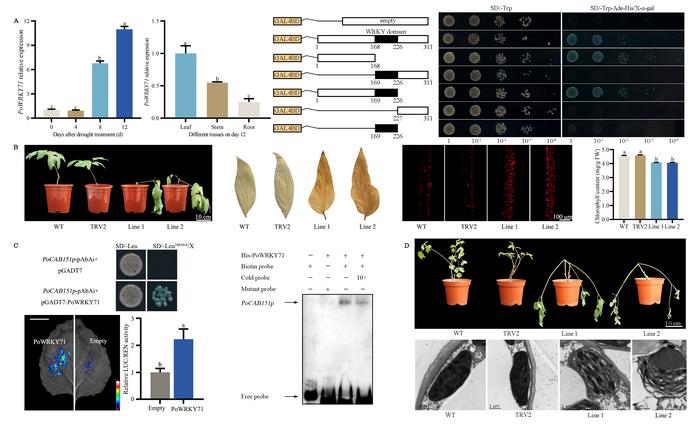
In order to analyse the molecular regulation mechanism of WRKY transcription factors in response to drought stress in P. ostii, the present study screened a WRKY family transcription factor PoWRKY71 based on our previous transcriptome, which positively regulated drought stress. It was found that PoWRKY71 expression was induced by drought stress, and PoWRKY71 was localized in the nucleus and possessed transcriptional activation activity. Then, the gene functional analysis study revealed that transient silencing of PoWRKY71 in P. ostii significantly reduced the drought tolerance of the plants, and the transgenic lines showed a significant increase in ROS accumulation and a significant decrease in chlorophyll content and photosynthesis; while overexpression of PoWRKY71 in tobacco significantly enhanced the drought tolerance of the plants, and the transgenic lines showed a significant decrease in ROS accumulation and a significant increase in chlorophyll content and photosynthesis. Further screening of genes related to chlorophyll biosynthesis and homeostasis regulation revealed that the expression of PoCAB151, a light-harvesting chlorophyll a/b-binding protein gene, was significantly down-regulated in the silenced plants, and it was clear from the Y1H, EMSA, and dual-luciferase experiments that PoWRKY71 could directly bind to PoCAB151 promoter and activate its expression. In addition, VIGS and overexpression techniques identified that PoCAB151 positively regulated the chloroplast homeostasis and drought tolerance in P. ostii.
In summary, this study revealed a new working model of PoWRKY71-PoCAB151 regulating drought tolerance of P. ostii, which provided an important reference for plant drought resistance breeding.
Luan Yuting, a PhD student at the College of Horticulture and Landscape Architecture, Yangzhou University, is the first author of the research paper. Professor Tao Jun and Zhao Daqiu are the co-corresponding authors, and postgraduate students Chen Zijie, Fang Ziwen, and Huang Xingqi doctor at Purdue University also participated in this study. This work was supported by the Forest and Grass Germplasm Resource Bank of Jiangsu Province, Modern Agriculture (Flower) Industrial Technology System of Jiangsu Province (JATS[2022]489 to JT) and the Key Disciplines of Jiangsu Province.
###
References
Authors
Luan Yuting1, Chen Zijie1, Fang Ziwen1, Huang Xingqi3, Zhao Daqiu1, Tao Jun1,2
Affiliations
1 College of Horticulture and Landscape Architecture, Yangzhou University, Yangzhou 225009, China
2 Joint International Research Laboratory of Agriculture and Agri-Product Safety, the Ministry of Education of China, Yangzhou University, Yangzhou 225009, China
3 Department of Biochemistry, Purdue University, West Lafayette, IN 47907, USA
About Tao Jun
Male, 1966-, Ph.D., Professor of College of Horticulture and Landscape Architecture, Yangzhou University, research interests: 1. floral physiology and molecular biology, 2. floral genetic physiology and germplasm innovation, 3. floral mining and exploitation of functional components.
Journal
Horticulture Research
DOI
10.1093/hr/uhad194
Method of Research
Experimental study
Subject of Research
Not applicable
Article Title
PoWRKY71 is involved in Paeonia ostii resistance to drought stress by directly regulating light-harvesting chlorophyll a/b-binding 151 gene
Article Publication Date
25-Sep-2023
COI Statement
The authors declare that they have no competing interests.