The Iron Age site of Casas del Turuñuelo was used repeatedly for ritualized animal sacrifice, according to a multidisciplinary study published November 22, 2023 in the open-access journal PLOS ONE by Mª Pilar Iborra Eres of the Institut Valencià de Conservació, Restauració i Investigació, Spain, Sebastián Celestino Pérez of Consejo Superior de Investigaciones Científicas, Spain, and their colleagues.
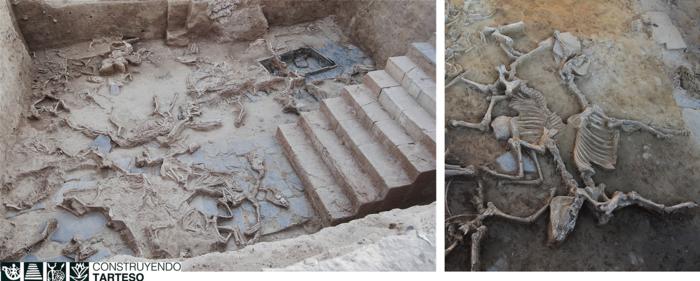
Credit: Construyendo Tarteso, CC-BY 4.0 (https://creativecommons.org/licenses/by/4.0/)
The Iron Age site of Casas del Turuñuelo was used repeatedly for ritualized animal sacrifice, according to a multidisciplinary study published November 22, 2023 in the open-access journal PLOS ONE by Mª Pilar Iborra Eres of the Institut Valencià de Conservació, Restauració i Investigació, Spain, Sebastián Celestino Pérez of Consejo Superior de Investigaciones Científicas, Spain, and their colleagues.
Archaeological sites with evidence of major animal sacrifices are rarely known from the Iron Age of the Mediterranean region, and there is a gap between information offered by written sources and by the archaeological record. This makes it difficult to establish a clear understanding of the patterns and protocols of this practice. In this study, researchers examine a well-preserved example of mass animal sacrifice from an Iron Age building in southwest Spain known as Casas del Turuñuelo, associated to Tartessos and dating toward the end of the 5th Century BCE.
The authors examined and dated 6770 bones belonging to 52 sacrificed animals which were buried in three sequential phases. The identified animals were predominantly adult horses, with smaller numbers of cattle and pigs and one dog. In the first two phases, skeletons were mostly complete and unaltered, but in the third phase, skeletons (except equids) show signs of having been processed for food, suggesting that some sort of meal accompanied this ritual. These data indicate that this space was used repeatedly over several years for sacrificial rituals whose practices and purposes varied.
This case study allows researchers to establish details about ritual protocols at this site, including the intentional selection of adult animals rather than young, and the importance of fire evidenced by the presence of burned plant and animal remains. Casas del Turuñuelo also exhibits unique features compared to other sites, such as the high abundance of sacrificed horses. This study advances efforts to contextualize ritual animal sacrifices across Europe.
The authors add: “This study highlights the role of mass animal sacrifices in the context of Iron Age European societies. Zooarchaeological, taphonomic and microstratigraphic investigations shed light on animal sacrifice practices and the Tartessian ritual behavior at the Iron Age site of Casas del Turuñuelo (Badajoz, Spain).”
#####
In your coverage please use this URL to provide access to the freely available article in PLOS ONE: https://journals.plos.org/plosone/article?id=10.1371/journal.pone.0293654
Citation: Iborra Eres MP, Albizuri S, Gutiérrez Rodríguez M, Jiménez Fragoso J, Lira Garrido J, Martín Cuervo M, et al. (2023) Mass animal sacrifice at casas del Turuñuelo (Guareña, Spain): A unique Tartessian (Iron Age) site in the southwest of the Iberian Peninsula. PLoS ONE 18(11): e0293654. https://doi.org/10.1371/journal.pone.0293654
Author Countries: Spain, France
Funding: The financial support and the results of this study stem from the National Project Construyendo Tarteso 2.0 I+D+I PID2019-108180GB-I00 ʽAnálisis constructivo, espacial y territorial de un modelo arquitectónico en el valle Medio del Guadianaʼ and from two projects of the Junta de Extremadura: PRI I+D+I IB18131 ‘Estudio de la hecatombe animal del yacimiento de ‘Casas del Turuñuelo’ (Guareña, Badajoz). La gestión de la cabaña equina y sus implicaciones socioeconómicas y rituales en época tartésica’ and PRI I+D+I IB18060 ‘Iberia a través de sus caballos: Estudio integral de la diversidad genética, enfermedades infecciosas y paleopatologías de los caballos extremeños de la Edad del Hierro’.
Journal
PLoS ONE
DOI
10.1371/journal.pone.0293654
Method of Research
Observational study
Subject of Research
Not applicable
Article Title
Mass animal sacrifice at casas del Turuñuelo (Guareña, Spain): A unique Tartessian (Iron Age) site in the southwest of the Iberian Peninsula
Article Publication Date
22-Nov-2023
COI Statement
The authors have declared that no competing interests exist.