LOS ALAMOS, N.M., Nov. 14, 2023 — An innovative approach to artificial intelligence (AI) enables reconstructing a broad field of data, such as overall ocean temperature, from a small number of field-deployable sensors using low-powered “edge” computing, with broad applications across industry, science and medicine.
Credit: Los Alamos National Laboratory
LOS ALAMOS, N.M., Nov. 14, 2023 — An innovative approach to artificial intelligence (AI) enables reconstructing a broad field of data, such as overall ocean temperature, from a small number of field-deployable sensors using low-powered “edge” computing, with broad applications across industry, science and medicine.
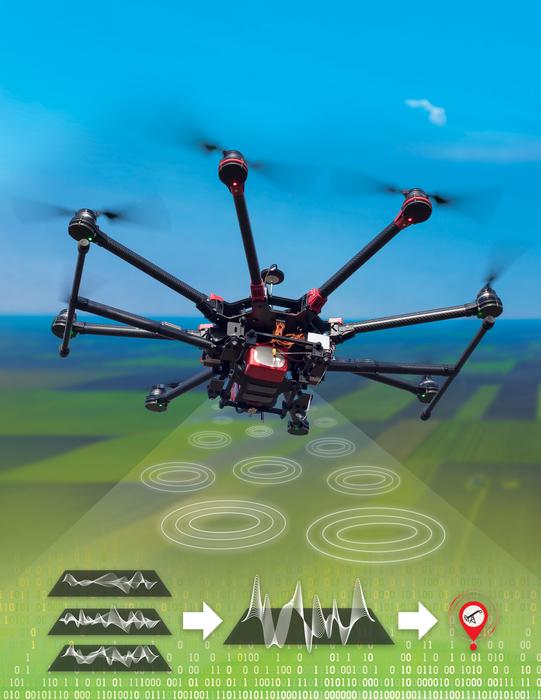
“We developed a neural network that allows us to represent a large system in a very compact way,” said Javier Santos, a Los Alamos National Laboratory researcher who applies computational science to geophysical problems. “That compactness means it requires fewer computing resources compared to state-of-the-art convolutional neural network architectures, making it well-suited to field deployment on drones, sensor arrays and other edge-computing applications that put computation closer to its end use.”
Novel AI approach boosts computing efficiency
Santos is first author of a paper published by a team of Los Alamos researchers in Nature Machine Intelligence on the novel AI technique, which they dubbed Senseiver. The work, which builds on an AI model called Perceiver IO developed by Google, applies the techniques of natural-language models such as ChatGPT to the problem of reconstructing information about a broad area — such as the ocean — from relatively few measurements.
The team realized the model would have broad application because of its efficiency. “Using fewer parameters and less memory requires fewer central processing unit cycles on the computer, so it runs faster on smaller computers,” said Dan O’Malley, a coauthor of the paper and Los Alamos researcher who applies machine learning to geoscience problems.
In a first in the published literature, Santos and his Los Alamos colleagues validated the model by demonstrating its effectiveness on real-world sets of sparse data — meaning information taken from sensors that cover only a tiny portion of the field of interest — and on complex data sets of three-dimensional fluids.
In a demonstration of the real-world utility of the Senseiver, the team applied the model to a National Oceanic and Atmospheric Administration sea-surface-temperature dataset. The model was able to integrate a multitude of measurements taken over decades from satellites and sensors on ships. From these sparse point measurements, the model forecast temperatures across the entire body of the ocean, which provides information useful to global climate models.
Bringing AI to drones and sensor networks
The Senseiver is well-suited to a variety of projects and research areas of interest to Los Alamos.
“Los Alamos has a wide range of remote sensing capabilities, but it’s not easy to use AI because models are too big and don’t fit on devices in the field, which leads us to edge computing,” said Hari Viswanathan, Los Alamos National Laboratory Fellow, environmental scientist and coauthor of the paper about the Senseiver. “Our work brings the benefits of AI to drones, networks of field-based sensors and other applications currently beyond the reach of cutting-edge AI technology.”
The AI model will be particularly useful in the Lab’s work identifying and characterizing orphaned wells. The Lab leads the Department of Energy-funded Consortium Advancing Technology for Assessment of Lost Oil & Gas Wells (CATALOG), a federal program tasked with locating and characterizing undocumented orphaned wells and measuring their methane emissions. Viswanathan is the lead scientist of CATALOG.
The approach offers improved capabilities for large, practical applications such as self-driving cars, remote modeling of assets in oil and gas, medical monitoring of patients, cloud gaming, content delivery and contaminant tracing.
The paper: “Development of the Senseiver for efficient field reconstruction from sparse observations.” Nature Machine Intelligence. DOI: 10.1038/s42256-023-00746-x
The funding: This work was funded by the Laboratory Directed Research and Development program at Los Alamos National Laboratory; the Department of Energy, Office of Science, Office of Basic Energy Sciences, Geoscience Research; and the DOE Office of Science, Basic Energy Sciences, Fossil Energy and Carbon Management, Undocumented Orphan Wells program.
-30-
LA-UR-23-32795
Journal
Nature Machine Intelligence
DOI
10.1038/s42256-023-00746-x
Method of Research
Experimental study
Subject of Research
Not applicable
Article Title
Development of the Senseiver for efficient field reconstruction from sparse observations.
Article Publication Date
6-Nov-2023