• HOME
  • NEWS
  • EXPLORE
    • CAREER
      • Companies
      • Jobs
    • EVENTS
    • iGEM
      • News
      • Team
    • PHOTOS
    • VIDEO
    • WIKI
  • BLOG
  • COMMUNITY
    • FACEBOOK
    • INSTAGRAM
    • TWITTER
Saturday, February 7, 2026
BIOENGINEER.ORG
No Result
View All Result
  • Login
  • HOME
  • NEWS
  • EXPLORE
    • CAREER
      • Companies
      • Jobs
        • Lecturer
        • PhD Studentship
        • Postdoc
        • Research Assistant
    • EVENTS
    • iGEM
      • News
      • Team
    • PHOTOS
    • VIDEO
    • WIKI
  • BLOG
  • COMMUNITY
    • FACEBOOK
    • INSTAGRAM
    • TWITTER
  • HOME
  • NEWS
  • EXPLORE
    • CAREER
      • Companies
      • Jobs
        • Lecturer
        • PhD Studentship
        • Postdoc
        • Research Assistant
    • EVENTS
    • iGEM
      • News
      • Team
    • PHOTOS
    • VIDEO
    • WIKI
  • BLOG
  • COMMUNITY
    • FACEBOOK
    • INSTAGRAM
    • TWITTER
No Result
View All Result
Bioengineer.org
No Result
View All Result
Home NEWS Science News Chemistry

Converting PFAS “forever chemicals” into valuable compounds

Bioengineer by Bioengineer
November 14, 2023
in Chemistry
Reading Time: 2 mins read
0
Converting PFAS “forever chemicals” into valuable carbenes
Share on FacebookShare on TwitterShare on LinkedinShare on RedditShare on Telegram

Osaka, Japan – Commonly known as “forever chemicals,” PFAS are notorious for persisting in the environment and in our bodies. Osaka Metropolitan University chemists may put an end to the “forever” life of PFAS with their simple yet innovative technique that converts these harmful substances into valuable compounds.
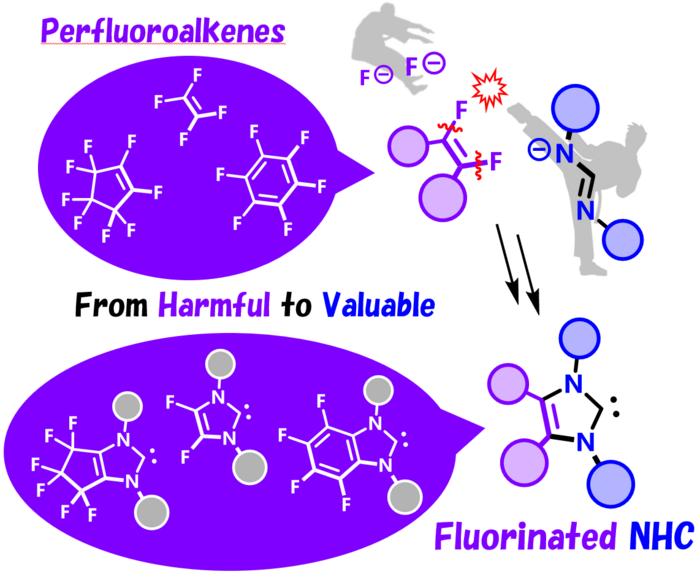
Converting PFAS “forever chemicals” into valuable carbenes

Credit: Kenichi Michigami, Osaka Metropolitan University

Osaka, Japan – Commonly known as “forever chemicals,” PFAS are notorious for persisting in the environment and in our bodies. Osaka Metropolitan University chemists may put an end to the “forever” life of PFAS with their simple yet innovative technique that converts these harmful substances into valuable compounds.

A research group led by Professor Masato Ohashi and Assistant Professor Kenichi Michigami of the Graduate School of Science at Osaka Metropolitan University has successfully synthesized ligands called fluorine-decorated N-heterocyclic carbenes (NHCs) from perfluoroalkenes, a type of PFAS (Perfluoroalkyl and Polyfluoroalkyl Substances). The NHCs developed in this study play significant roles in stabilizing unstable molecules as well as enhancing the performance of their ligated transition metal complexes.

The synthesis of fluorinated NHCs was achieved simply by removing two fluorine atoms from 1,2-difluoroalkene derivatives. Owing to the small size of fluorine atoms, the electron-accepting ability of the NHC ligand can be enhanced without substantially changing its steric properties.

“Our results enable the easy transformation of harmful PFAS into functional NHCs,” explained Dr. Michigami. “The versatile applications of fluorinated NHCs show potential advantages in various fields such as fluorine chemistry, organometallic chemistry, catalysis chemistry, and materials science.”

Their findings were published in the Journal of the American Chemical Society.


###

About OMU 

Osaka Metropolitan University is the third largest public university in Japan, formed by a merger between Osaka City University and Osaka Prefecture University in 2022. OMU upholds “Convergence of Knowledge” through 11 undergraduate schools, a college, and 15 graduate schools. For more research news, visit https://www.omu.ac.jp/en/ or follow us on Twitter: @OsakaMetUniv_en, or Facebook. 


Journal

Journal of the American Chemical Society

DOI

10.1021/jacs.3c06331

Method of Research

Experimental study

Article Title

N-Heterocyclic Carbenes with Polyfluorinated Groups at the 4- and 5-Positions from [3 + 2] Cycloadditions between Formamidinates and cis-1,2-Difluoroalkene Derivatives

Article Publication Date

26-Sep-2023

Share12Tweet8Share2ShareShareShare2

Related Posts

blank

Breakthrough in Environmental Cleanup: Scientists Develop Solar-Activated Biochar for Faster Remediation

February 7, 2026
blank

Cutting Costs: Making Hydrogen Fuel Cells More Affordable

February 6, 2026

Scientists Develop Hand-Held “Levitating” Time Crystals

February 6, 2026

Observing a Key Green-Energy Catalyst Dissolve Atom by Atom

February 6, 2026

POPULAR NEWS

  • Robotic Ureteral Reconstruction: A Novel Approach

    Robotic Ureteral Reconstruction: A Novel Approach

    82 shares
    Share 33 Tweet 21
  • Digital Privacy: Health Data Control in Incarceration

    63 shares
    Share 25 Tweet 16
  • Study Reveals Lipid Accumulation in ME/CFS Cells

    57 shares
    Share 23 Tweet 14
  • Breakthrough in RNA Research Accelerates Medical Innovations Timeline

    53 shares
    Share 21 Tweet 13

About

We bring you the latest biotechnology news from best research centers and universities around the world. Check our website.

Follow us

Recent News

Neg-Entropy: The Key Therapeutic Target for Chronic Diseases

Multidisciplinary Evidence-Based Guidelines for Therapeutic Drug Monitoring of Biologics in Inflammatory Bowel Disease

Early Tuberculosis Treatment Lowers Sepsis Mortality in People with HIV

Subscribe to Blog via Email

Enter your email address to subscribe to this blog and receive notifications of new posts by email.

Join 73 other subscribers
  • Contact Us

Bioengineer.org © Copyright 2023 All Rights Reserved.

Welcome Back!

Login to your account below

Forgotten Password?

Retrieve your password

Please enter your username or email address to reset your password.

Log In
No Result
View All Result
  • Homepages
    • Home Page 1
    • Home Page 2
  • News
  • National
  • Business
  • Health
  • Lifestyle
  • Science

Bioengineer.org © Copyright 2023 All Rights Reserved.