Suicide and mental health distress disproportionately affect veterans in the United States. According to a report from the Substance Abuse and Mental Health Services Administration, more than 5 million veterans suffered from these adverse behavioral health issues in 2020. That same year, after adjusting for age and sex differences in the population, the U.S. Department of Veterans Affairs (VA) estimated that veterans were 57.3 percent more likely to commit suicide than non-veterans.
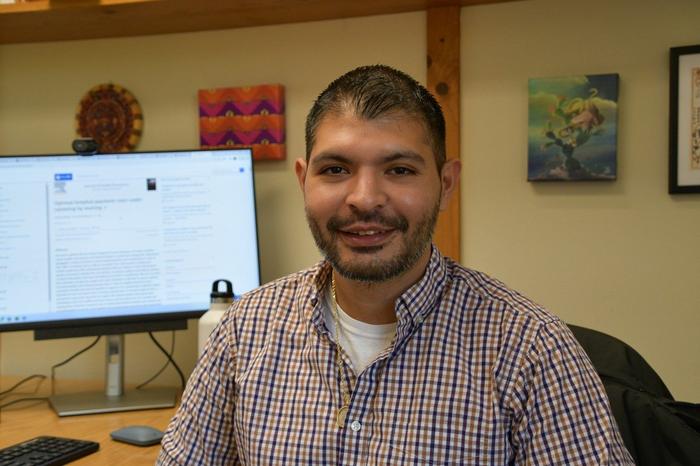
Credit: Sergio Ernesto Barrera. Photo by Spencer Coppage for Virginia Tech.
Suicide and mental health distress disproportionately affect veterans in the United States. According to a report from the Substance Abuse and Mental Health Services Administration, more than 5 million veterans suffered from these adverse behavioral health issues in 2020. That same year, after adjusting for age and sex differences in the population, the U.S. Department of Veterans Affairs (VA) estimated that veterans were 57.3 percent more likely to commit suicide than non-veterans.
While the Veterans Health Administration (VHA) has put several programs in place to address the mental health needs of veterans, recent studies show that more than half of all veterans experiencing a mental health condition are not receiving timely treatment. This rate rises closer to 90 percent for veterans with a substance abuse disorder.
“This suggests that there are serious obstacles preventing veterans — especially those with the most need — from seeking and receiving mental health services. Yet it is unclear what those obstacles are,” said Sergio Ernesto Barrera, assistant professor of economics in the College of Science.
Barrera has received a two-year $300,000 Suicide Prevention and Opioid Addiction Services Research Grant from the Virginia Department of Veterans Services to lead a two-year study that addresses this knowledge gap. The team will investigate determinants of suicide and substance abuse; explore factors impacting decisions to pursue mental health and substance use treatment from both VHA non-VHA providers; evaluate the appropriateness of current treatment allocations; and seek to understand if there are individual factors such as education, income, age, military service history, and characteristics of local area of residence that may be impacting care delivery.
“There could be many reasons for why veterans are not seeking or provided care. Their closest VHA facility may be located too far away. Local VHA facilities may not have enough or any space or physicians available to provide timely treatment for veterans. As a result, veterans may believe that trying to navigate the medical system is more trouble than it’s worth,” said Barrera. “Additionally, some biases may enter the decision-making process. Some veterans may believe that they will be penalized for seeking mental health care or substance abuse treatment, and some physicians may focus exclusively on combat related mental health issues like PTSD at the expense of non-service linked depression.”
The team plans to use a variety of data sources for its analysis that includes administrative data on military service and VA benefit usage, surveys administered by the National Center of Health Statistics, as well as surveys administered to veterans inquiring about mental health status and their perceived reasons for receiving or not receiving care.
An applied micro-economist, Barrera’s experience includes performing quantitative research on underinvestment in higher education relating to institutional barriers and subjective biases among underrepresented student groups. He has also performed work examining the impact of adolescent’s exposure to military personnel on future military service and education outcomes as well as the impact of World War II service on mortality, geographic relocation, and retirement outcomes.
He served five years in the U.S. Marine Corps as a cryptologic linguist from 2008-13, which included a deployment to Afghanistan as part of Operation Enduring Freedom.
Co-principal investigators include Conor Ryan, assistant professor of economics at Pennsylvania State University; May Gianoli, assistant professor of clinical psychiatry at Yale School of Medicine and director of the Mental Health Compensation and Pension service line at VA Connecticut Healthcare System; and Andrew Meisler, clinical psychologist, VA Connecticut Healthcare System.
Martin Anthony Vargas Alvines, a Ph.D. student advised by Barrera, will also have the opportunity to work on this project.
“Our ultimate goal is to provide the Virginia Department of Veterans Services with information that allows them to design interventions that will successfully remove barriers to seeking mental health services,” said Barrera.