• HOME
  • NEWS
  • EXPLORE
    • CAREER
      • Companies
      • Jobs
    • EVENTS
    • iGEM
      • News
      • Team
    • PHOTOS
    • VIDEO
    • WIKI
  • BLOG
  • COMMUNITY
    • FACEBOOK
    • INSTAGRAM
    • TWITTER
Saturday, February 7, 2026
BIOENGINEER.ORG
No Result
View All Result
  • Login
  • HOME
  • NEWS
  • EXPLORE
    • CAREER
      • Companies
      • Jobs
        • Lecturer
        • PhD Studentship
        • Postdoc
        • Research Assistant
    • EVENTS
    • iGEM
      • News
      • Team
    • PHOTOS
    • VIDEO
    • WIKI
  • BLOG
  • COMMUNITY
    • FACEBOOK
    • INSTAGRAM
    • TWITTER
  • HOME
  • NEWS
  • EXPLORE
    • CAREER
      • Companies
      • Jobs
        • Lecturer
        • PhD Studentship
        • Postdoc
        • Research Assistant
    • EVENTS
    • iGEM
      • News
      • Team
    • PHOTOS
    • VIDEO
    • WIKI
  • BLOG
  • COMMUNITY
    • FACEBOOK
    • INSTAGRAM
    • TWITTER
No Result
View All Result
Bioengineer.org
No Result
View All Result
Home NEWS Science News Biology

Agarose-based method shows potential in understanding extracellular vesicles’ role in cancer metastasis

Bioengineer by Bioengineer
October 31, 2023
in Biology
Reading Time: 3 mins read
0
Schematic representation of the agarose spot migration
Share on FacebookShare on TwitterShare on LinkedinShare on RedditShare on Telegram

A collaborative study led by researchers from Germans Trias i Pujol Research Institute has revealed the promising possibilities of using an agarose spot migration assay to examine the ability of extracellular vesicles to attract other cells in a controlled environment. The study has been recently published in the journal BMC Biology.
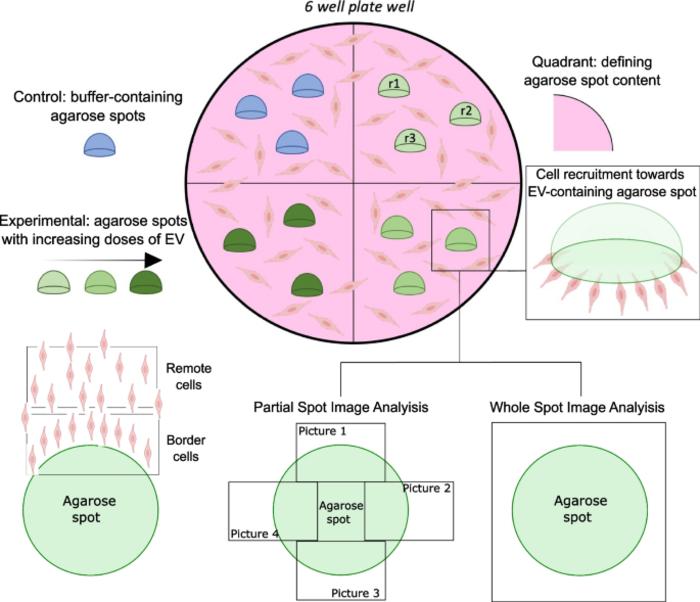
Schematic representation of the agarose spot migration

Credit: IGTP

A collaborative study led by researchers from Germans Trias i Pujol Research Institute has revealed the promising possibilities of using an agarose spot migration assay to examine the ability of extracellular vesicles to attract other cells in a controlled environment. The study has been recently published in the journal BMC Biology.

Extracellular vesicles (EVs) are nanoparticles released by cells which are present in various biological processes, including cellular communication. Recent research indicates that cancer-related EVs play an important role in forming a pre-metastatic niche (PMN) – a preparatory area that allows spreading tumour cells to establish and grow – by recruiting cells from the original tumour.

It is vital to understand and measure how these cancer-EVs can prompt cell migration and recruitment, both for developing cell-free therapeutic approaches and for improving our knowledge of cancer metastasis. In this context, classical in vitro (lab-based) migration assays do not fully capture the true ability of EVs to guide cells chemically to a new location.

The study led by researchers from IGTP’s research groups Innovation in Vesicles and Cells for Application in Therapy (IVECAT), Badalona Applied Research Group in Oncology (B·ARGO) and Resistance, Chemotherapy and Predictive Biomarkers (RCPB) emphasises how EVs can influence cancer metastasis. The research team adapted a laboratory method known as the agarose spot migration assay to EV requirements, which measures how well these tiny particles can attract other cells in a controlled environment.

Their analysis, including still images and time-lapse videos among others, revealed that EVs differ in their ability to recruit endothelial cells. More importantly, they were able to identify a greater recruitment capability in EVs from highly metastatic PC3 cancer cells compared to those from less metastatic LNCaP cells.

The first author of the study, Marta Clos-Sansalvador, a predoctoral student from IGTP’s group IVECAT, explains that “the agarose spot migration assay may offer a diversity of measurements and migration settings not provided by classical migration assays, like scratch assays, and reveal its potential use in the EV and cancer metastasis fields”. Clos-Sansalvador also points out the assay’s practicality: “EV-adapted agarose spot migration assay is a simple, low-cost, and versatile technique that can be easily adapted to most laboratories”.


Journal

BMC Biology

DOI

10.1186/s12915-023-01729-5

Method of Research

Experimental study

Subject of Research

Cells

Article Title

Agarose spot migration assay to measure the chemoattractant potential of extracellular vesicles: applications in regenerative medicine and cancer metastasis

Article Publication Date

26-Oct-2023

COI Statement

The authors declare no competing interests.

Share12Tweet8Share2ShareShareShare2

Related Posts

Florida Cane Toad: Complex Spread and Selective Evolution

Florida Cane Toad: Complex Spread and Selective Evolution

February 7, 2026
New Study Uncovers Mechanism Behind Burn Pit Particulate Matter–Induced Lung Inflammation

New Study Uncovers Mechanism Behind Burn Pit Particulate Matter–Induced Lung Inflammation

February 6, 2026

DeepBlastoid: Advancing Automated and Efficient Evaluation of Human Blastoids with Deep Learning

February 6, 2026

Navigating the Gut: The Role of Formic Acid in the Microbiome

February 6, 2026

POPULAR NEWS

  • Robotic Ureteral Reconstruction: A Novel Approach

    Robotic Ureteral Reconstruction: A Novel Approach

    82 shares
    Share 33 Tweet 21
  • Digital Privacy: Health Data Control in Incarceration

    63 shares
    Share 25 Tweet 16
  • Study Reveals Lipid Accumulation in ME/CFS Cells

    57 shares
    Share 23 Tweet 14
  • Breakthrough in RNA Research Accelerates Medical Innovations Timeline

    53 shares
    Share 21 Tweet 13

About

We bring you the latest biotechnology news from best research centers and universities around the world. Check our website.

Follow us

Recent News

Inflammasome Protein ASC Drives Pancreatic Cancer Metabolism

Phage-Antibiotic Combo Beats Resistant Peritoneal Infection

Boosting Remote Healthcare: Stepped-Wedge Trial Insights

Subscribe to Blog via Email

Enter your email address to subscribe to this blog and receive notifications of new posts by email.

Join 73 other subscribers
  • Contact Us

Bioengineer.org © Copyright 2023 All Rights Reserved.

Welcome Back!

Login to your account below

Forgotten Password?

Retrieve your password

Please enter your username or email address to reset your password.

Log In
No Result
View All Result
  • Homepages
    • Home Page 1
    • Home Page 2
  • News
  • National
  • Business
  • Health
  • Lifestyle
  • Science

Bioengineer.org © Copyright 2023 All Rights Reserved.