• HOME
  • NEWS
  • EXPLORE
    • CAREER
      • Companies
      • Jobs
    • EVENTS
    • iGEM
      • News
      • Team
    • PHOTOS
    • VIDEO
    • WIKI
  • BLOG
  • COMMUNITY
    • FACEBOOK
    • INSTAGRAM
    • TWITTER
Saturday, February 7, 2026
BIOENGINEER.ORG
No Result
View All Result
  • Login
  • HOME
  • NEWS
  • EXPLORE
    • CAREER
      • Companies
      • Jobs
        • Lecturer
        • PhD Studentship
        • Postdoc
        • Research Assistant
    • EVENTS
    • iGEM
      • News
      • Team
    • PHOTOS
    • VIDEO
    • WIKI
  • BLOG
  • COMMUNITY
    • FACEBOOK
    • INSTAGRAM
    • TWITTER
  • HOME
  • NEWS
  • EXPLORE
    • CAREER
      • Companies
      • Jobs
        • Lecturer
        • PhD Studentship
        • Postdoc
        • Research Assistant
    • EVENTS
    • iGEM
      • News
      • Team
    • PHOTOS
    • VIDEO
    • WIKI
  • BLOG
  • COMMUNITY
    • FACEBOOK
    • INSTAGRAM
    • TWITTER
No Result
View All Result
Bioengineer.org
No Result
View All Result
Home NEWS Science News Health

Canine cuddles can comfort equally across all genders

Bioengineer by Bioengineer
October 30, 2023
in Health
Reading Time: 2 mins read
0
BARK Session
Share on FacebookShare on TwitterShare on LinkedinShare on RedditShare on Telegram

While there are a number of studies demonstrating that dog therapy programs can improve a person’s social and emotional wellbeing, many typically have a disproportionate number of female participants.
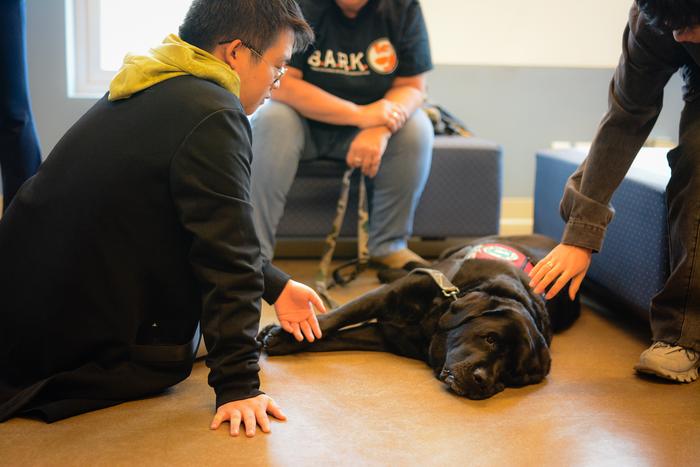
BARK Session

Credit: UBCO: Freya Green

While there are a number of studies demonstrating that dog therapy programs can improve a person’s social and emotional wellbeing, many typically have a disproportionate number of female participants.

Recent research led by Dr. John-Tyler Binfet, an Associate Professor in UBC Okanagan’s School of Education and Director of Building Academic Retention through K9s (BARK), evaluated if there are gender differences in wellbeing by setting up separate dog therapy sessions for those who identified as female, male and gender diverse participants.

Dr. Binfet has conducted numerous studies on the benefits of canine therapy, but to his knowledge, this is the first gender-specific study about canine therapy.

“Previous research has explored if it works and how it works, but not who it works for,” says Dr. Binfet. “This was one of the first studies that examined whether canine-assisted interventions work equally well for varied genders.”

For the study, students self-selected their gender cohort and were assigned to a session on a first-come first-serve basis. Prior to the sessions, they provided reports of wellbeing; specifically measuring their self-perceptions of campus and social connectedness, happiness, optimism, stress, homesickness and loneliness.

A total of 163 students—49 per cent women, 33 per cent men, and 17 per cent non-binary and other genders—participated in 20-minute sessions. In groups of three to four, the students engaged with a therapy dog and handler, and following the session they filled out a survey. The results showed, as expected, that there was a significant increase in wellbeing and a decrease in homesickness, stress and loneliness. The results also demonstrated that canines have a comparable positive wellness effect across diverse gender identities.

“In light of previous studies that note participants were predominantly women, our sampling of men, genderfluid and two-spirit participants furthers our understanding that the efficacy of these interventions does not appear to be gender dependent,” says Dr. Binfet. “The vast majority of responses showed that the dogs helped the students feel and experience something positive regardless of their gender.”

The findings could influence post-secondary mental health and wellness programs as educators continue to seek low-cost and low-barrier inclusive options for students.

The research, published in CABI Human-Animal Interactions, was supported by the BARK program.  


Journal

Human-Animal Interactions

DOI

10.1079/hai.2023.0037

Method of Research

Observational study

Subject of Research

Animals

Article Title

A mixed-methods examination of an on-campus canine-assisted intervention by gender: Women, men, and gender-diverse individuals’ self-reports of stress-reduction and well-being

Article Publication Date

18-Oct-2023

Share12Tweet8Share2ShareShareShare2

Related Posts

Personalized Guide to Understanding and Reducing Chemicals

February 7, 2026

Inflammasome Protein ASC Drives Pancreatic Cancer Metabolism

February 7, 2026

Phage-Antibiotic Combo Beats Resistant Peritoneal Infection

February 7, 2026

Boosting Remote Healthcare: Stepped-Wedge Trial Insights

February 7, 2026

POPULAR NEWS

  • Robotic Ureteral Reconstruction: A Novel Approach

    Robotic Ureteral Reconstruction: A Novel Approach

    82 shares
    Share 33 Tweet 21
  • Digital Privacy: Health Data Control in Incarceration

    63 shares
    Share 25 Tweet 16
  • Study Reveals Lipid Accumulation in ME/CFS Cells

    57 shares
    Share 23 Tweet 14
  • Breakthrough in RNA Research Accelerates Medical Innovations Timeline

    53 shares
    Share 21 Tweet 13

About

We bring you the latest biotechnology news from best research centers and universities around the world. Check our website.

Follow us

Recent News

Personalized Guide to Understanding and Reducing Chemicals

Inflammasome Protein ASC Drives Pancreatic Cancer Metabolism

Phage-Antibiotic Combo Beats Resistant Peritoneal Infection

Subscribe to Blog via Email

Enter your email address to subscribe to this blog and receive notifications of new posts by email.

Join 73 other subscribers
  • Contact Us

Bioengineer.org © Copyright 2023 All Rights Reserved.

Welcome Back!

Login to your account below

Forgotten Password?

Retrieve your password

Please enter your username or email address to reset your password.

Log In
No Result
View All Result
  • Homepages
    • Home Page 1
    • Home Page 2
  • News
  • National
  • Business
  • Health
  • Lifestyle
  • Science

Bioengineer.org © Copyright 2023 All Rights Reserved.