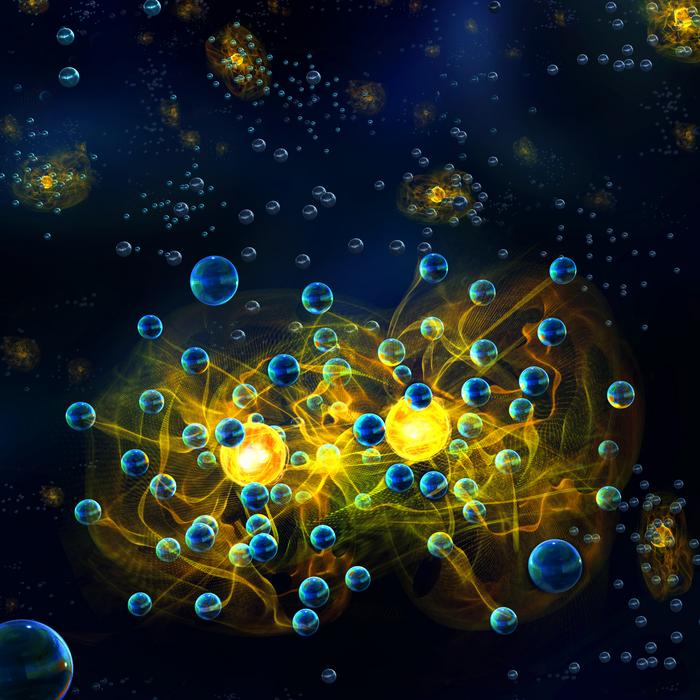
An electron moving through a solid generates a polarization in its environment due to its electric charge. In his theoretical considerations, the Russian physicist Lev Landau extended the description of such particles by their interaction with the environment and spoke of quasiparticles. More than ten years ago, the team led by Rudolf Grimm at the Institute of Quantum Optics and Quantum Information (IQQOI) of the Austrian Academy of Sciences (ÖAW) and the Department of Experimental Physics of the University of Innsbruck succeeded in generating such quasiparticles for both attractive and repulsive interactions with the environment. For this purpose, the scientists use an ultracold quantum gas consisting of lithium and potassium atoms in a vacuum chamber. With the help of magnetic fields, they control the interactions between the particles, and by means of radio-frequency pulses push the potassium atoms into a state in which they attract or repel the lithium atoms surrounding them. In this way, the researchers simulate a complex state similar to the one produced in the solid state by a free electron.
Credit: IQOQI Innsbruck/Harald Ritsch
An electron moving through a solid generates a polarization in its environment due to its electric charge. In his theoretical considerations, the Russian physicist Lev Landau extended the description of such particles by their interaction with the environment and spoke of quasiparticles. More than ten years ago, the team led by Rudolf Grimm at the Institute of Quantum Optics and Quantum Information (IQQOI) of the Austrian Academy of Sciences (ÖAW) and the Department of Experimental Physics of the University of Innsbruck succeeded in generating such quasiparticles for both attractive and repulsive interactions with the environment. For this purpose, the scientists use an ultracold quantum gas consisting of lithium and potassium atoms in a vacuum chamber. With the help of magnetic fields, they control the interactions between the particles, and by means of radio-frequency pulses push the potassium atoms into a state in which they attract or repel the lithium atoms surrounding them. In this way, the researchers simulate a complex state similar to the one produced in the solid state by a free electron.
A Closer Look at Solids
Now, the scientists led by Rudolf Grimm have been able to generate several such quasiparticles simultaneously in the quantum gas and observe their interactions with each other. „In a naive notion, one would assume that polarons always attract each other, regardless of whether their interaction with the environment is attractive or repulsive,” says the experimental physicist. „However, this is not the case. We see attractive interaction in bosonic polarons, repulsive interaction in fermionic polarons. Here, quantum statistics plays a crucial role.” The researchers have now been able to demonstrate this behavior, which in principle already follows as a consequence of Landau’s theory, in an experiment for the first time. The theoretical calculations for this were done by colleagues from Mexico, Spain and Denmark. „High experimental skills were required to implement this in the laboratory”, explains Cosetta Baroni, first author of the study, “because even the smallest deviations could have skewed the measurements.”
“Such investigations provide us with insights into very fundamental mechanisms of nature and offer us excellent opportunities to study them in detail,” says Rudolf Grimm excitedly.
Journal
Nature Physics
DOI
10.1038/s41567-023-02248-4
Method of Research
Experimental study
Article Title
Mediated interactions between Fermi polarons and the role of impurity quantum statistics
Article Publication Date
26-Oct-2023