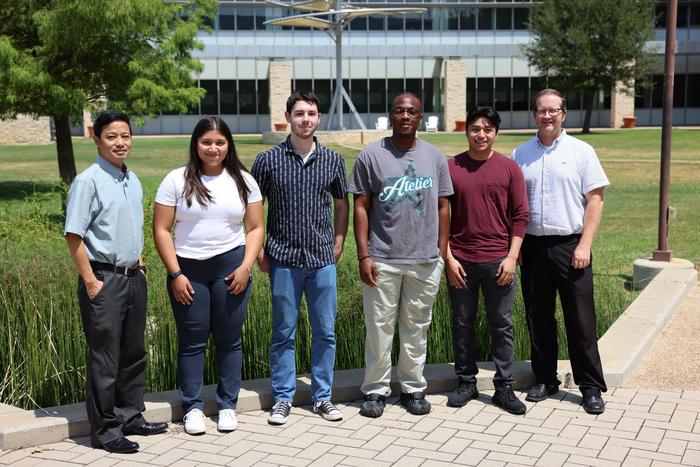
Four senior bioengineering students at The University of Texas at Arlington have won the Biomedical Engineering Society (BMES) Coulter College for Healthcare Innovation competition for their work on an early detection device for atrial fibrillation.
Credit: UT Arlington
Four senior bioengineering students at The University of Texas at Arlington have won the Biomedical Engineering Society (BMES) Coulter College for Healthcare Innovation competition for their work on an early detection device for atrial fibrillation.
Brady Killham, Juan Ramirez, Jeannette Santos and Michael Ikefuna, all seniors in UTA’s Bioengineering Department, earned the Best Overall award for their plan to develop FibGuard, a wearable, non-invasive atrial fibrillation early detection device.
UTA competed against teams from Vanderbilt, Purdue, Virginia Tech, Wake Forest, Texas A&M, the University of Oklahoma and Rensselaer Polytechnic Institute, among others. Previous winners include teams from Massachusetts Institute of Technology, the University of Florida, and Boston University. BMES hosted the competition, in partnership with Medtronic and The Wallace H. Coulter Foundation, so students could learn and engage with professionals, expand their networks and foster collaborations with fellow students who share similar interests.
“This is an outstanding result from our team, and we are proud of these students for their performance and their ability to learn and adjust during the competition,” said Michael Cho, chair of the Bioengineering Department. “Their experiences in the clinical immersion program really helped them succeed.”
Twelve universities are selected each year to take part in the competition. The UTA team, along with faculty advisors Jun Liao and Justyn Jaworski, also presented their winning project at the BMES annual conference in October.
Liao and Jaworski, a professor and assistant professor of bioengineering, respectively, picked the team members from the department’s National Institutes of Health-funded clinical immersion program, where students participate in summer clinical experiences at organizations such as UT Southwestern, Arlington EMS, Texas Health Resources and Arlington Memorial Hospital.
The goal of the competition is to gain a better understanding of the importance and quality of medical devices and the needs of patients and clinicians. During the three-day event, teams had access to mentors in the biomedical engineering field and from the business world. The mentors weighed in on teams’ ideas and gave feedback to help them fine-tune their product and presentation.
“We received a background assignment to become familiar with the needs in the area and then interviewed clinicians, such as Dr. Matthias Peltz at UT Southwestern, about what devices already exist, the market and the stockholders,” Killham said.
“The business side was the hardest because none of us had a business background,” Ikefuna said. “We were lucky to have this experience, and we learned quickly. The greatest takeaway was networking with real businesspeople from companies and startups.”
The UTA team developed novel enhancements to medical devices such as masks associated with the treatment of sleep apnea. These enhancements allow for early detection of atrial fibrillation in this high-risk patient population.
“We had ideas based on existing devices, but when we presented them to the mentors, they weren’t really into them,” Santos said. “We had to go back to the drawing board to find something unique, and that’s when we chose to focus on sleep apnea.”
The mentors were a valuable resource throughout the competition, according to Ramirez.
“There were a lot of components to this competition from design and business perspectives,” he said. “Telling us that our original idea wasn’t good really helped us because we found something that separated us from our competition. Once we found that subset, things really fell into place, and our mentors started getting more and more excited.”
- Written by Jeremy Agor, College of Engineering