A five-year, $6.4 million grant to develop an integrated, multiscale artificial intelligence (AI) approach to study genetic factors associated with Alzheimer’s disease has been awarded to UTHealth Houston by the National Institute on Aging, part of the National Institutes of Health.
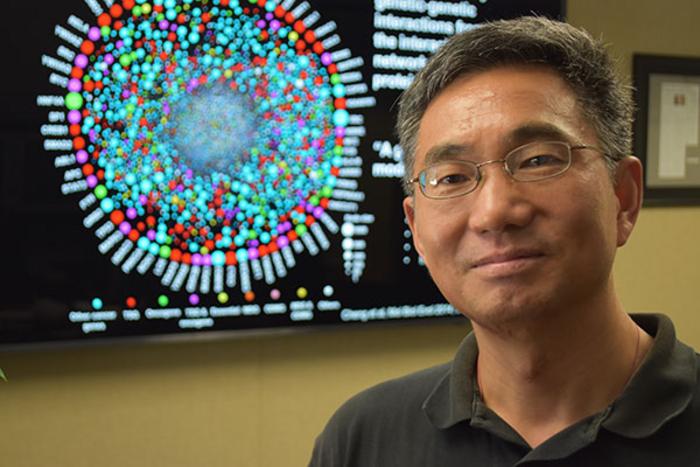
Credit: UTHealth Houston
A five-year, $6.4 million grant to develop an integrated, multiscale artificial intelligence (AI) approach to study genetic factors associated with Alzheimer’s disease has been awarded to UTHealth Houston by the National Institute on Aging, part of the National Institutes of Health.
A team led by Zhongming Zhao, PhD, and Xiaoqian Jiang, PhD, principal investigators and professors at McWilliams School of Biomedical Informatics at UTHealth Houston, are developing a deep-learning AI system to link brain imaging with cell-specific genetic factors to better understand the genetic architecture of Alzheimer’s disease and cognitive decline.
“This project will fill in the gap in Alzheimer’s disease research between neuroimaging and genetic studies,” said Zhao, chair and director of the Center for Precision Health at McWilliams School of Biomedical Informatics. “There are numerous computational analytical approaches that have been published in each field, but few can better address the link between neuroimaging and genetic data for a deep understanding of the disease.”
Zhao says a large amount of molecular neuroimaging biomarker and clinical data is already generated in information systems in the context of Alzheimer’s disease, but a wide range of causal factors have not always been connected.
To bridge this gap, researchers will group genetic and functional data using highly advanced machine-learning technology and an AI multimodality approach to characterize the genetic risk of Alzheimer’s disease.
“It is a very promising method to study. Because this is a neurodegenerative disease, we are calling it a deep-learning brain that will focus on brain reading,” said Jiang, chair of the Department of Health Data Science and Artificial Intelligence at the school. “After we develop the deep brain computational AI model, we will extend it to the single-cell level, which will be called the single-cell deep brain. This is a more powerful way to dissect the genetic components in Alzheimer’s disease.”
Researchers will address the cognitive decline of Alzheimer disease by integrating neuroimaging data into the deep-learning system. At this level, they will pair distinguished imaging features to the genomic data to visualize their commonalities.
To validate their AI models, they will use the neuroimaging and genetic data generated from Rush University Medical Center, led by Christopher Gaiteri, PhD, assistant professor in the Department of Neurosciences. In addition, they will join the national Alzheimer’s Disease Sequencing Project AI/Machine Learning Consortium.
“The idea is to find where the genes and neuroimages link to combine them into neuroimaging genetics, which will help explain the causation of cognitive decline from the disease. Understanding this can help researchers and patients find better treatment options for Alzheimer’s disease,” Zhao said.
Co-investigators on the study are Paul Schulz, MD, professor in the Department of Neurology with McGovern Medical School; and Kai Zhang, PhD; Yejin Kim, PhD; Yulin Dai, PhD; and Xiangning Chen, PhD, with McWilliams School of Biomedical Informatics. This research is funded by NIH grant U01AG079847.
Media Inquiries: 713-500-3030