“In this study, we discovered that senescence alters the amplitude and period of core circadian clock components, most notably BMAL1 […]”
Credit: 2023 Jachim et al.
“In this study, we discovered that senescence alters the amplitude and period of core circadian clock components, most notably BMAL1 […]”
BUFFALO, NY- October 16, 2023 – A new research paper was published on the cover of Aging (listed by MEDLINE/PubMed as “Aging (Albany NY)” and “Aging-US” by Web of Science) Volume 15, Issue 19, entitled, “BMAL1 modulates senescence programming via AP-1.”
Cellular senescence and circadian dysregulation are biological hallmarks of aging. Whether they are coordinately regulated has not been thoroughly studied. In this new study, researchers Sarah K. Jachim, Jian Zhong, Tamas Ordog, Jeong-Heon Lee, Aditya V. Bhagwate, Nagaswaroop Kengunte Nagaraj, Jennifer J. Westendorf, João F. Passos, Aleksey V. Matveyenko, and Nathan K. LeBrasseur from the Mayo Clinic in Rochester, Minnesota, hypothesized that BMAL1, a pioneer transcription factor and master regulator of the molecular circadian clock, plays a role in the senescence program.
“Here, we demonstrate BMAL1 is significantly upregulated in senescent cells and has altered rhythmicity compared to non-senescent cells.”
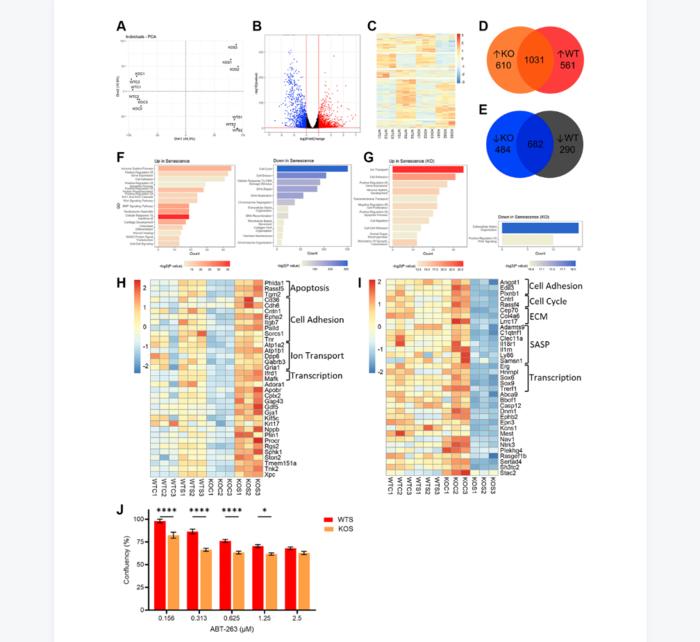
Through BMAL1-ChIP-seq, they showed that BMAL1 is uniquely localized to genomic motifs associated with AP-1 in senescent cells. Integration of BMAL1-ChIP-seq data with RNA-seq data revealed that BMAL1 presence at AP-1 motifs is associated with active transcription. Finally, the researchers showed that BMAL1 contributes to AP-1 transcriptional control of key features of the senescence program, including altered regulation of cell survival pathways, and confers resistance to drug-induced apoptosis.
“Overall, these results highlight a previously unappreciated role of the core circadian clock component BMAL1 on the molecular phenotype of senescent cells.”
Read the full study: DOI: https://doi.org/10.18632/aging.205112
Corresponding Author: Nathan K. LeBrasseur – [email protected]
Keywords: AP-1, circadian clock, cellular senescence, senolytic, transcription regulation
Sign up for free Altmetric alerts about this article: https://aging.altmetric.com/details/email_updates?id=10.18632%2Faging.205112
About Aging:
Launched in 2009, Aging (Aging-US) publishes papers of general interest and biological significance in all fields of aging research and age-related diseases, including cancer—and now, with a special focus on COVID-19 vulnerability as an age-dependent syndrome. Topics in Aging go beyond traditional gerontology, including, but not limited to, cellular and molecular biology, human age-related diseases, pathology in model organisms, signal transduction pathways (e.g., p53, sirtuins, and PI-3K/AKT/mTOR, among others), and approaches to modulating these signaling pathways.
Please visit our website at www.Aging-US.com and connect with us:
- SoundCloud
- X, formerly known as Twitter
- YouTube
- LabTube
Click here to subscribe to Aging publication updates.
For media inquiries, please contact [email protected].
Aging (Aging-US) Journal Office
6666 E. Quaker Str., Suite 1B
Orchard Park, NY 14127
Phone: 1-800-922-0957, option 1
###
Journal
Aging-US
DOI
10.18632/aging.205112
Method of Research
Observational study
Subject of Research
Cells
Article Title
BMAL1 modulates senescence programming via AP-1
Article Publication Date
10-Oct-2023