Joint press release by Hokkaido University and the Mitsubishi Chemical Group
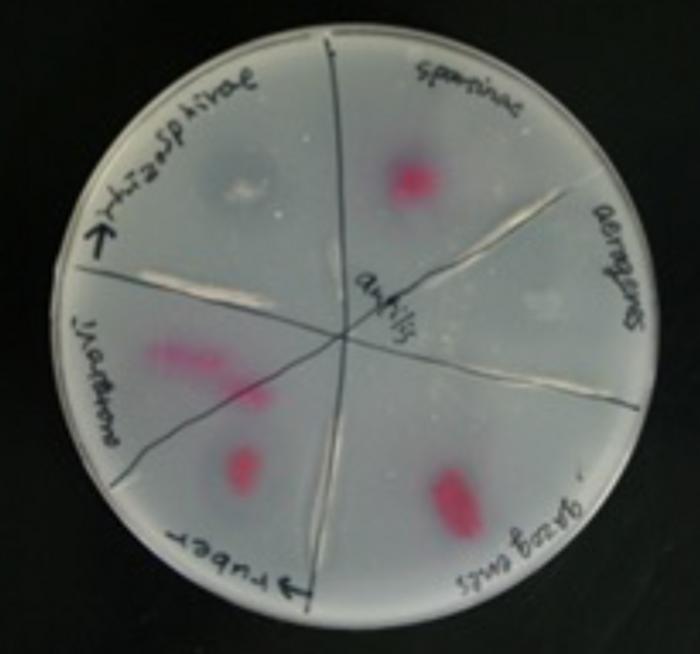
Credit: Yutaro Kimura et al., Environmental Microbiology, September 29, 2023.
Joint press release by Hokkaido University and the Mitsubishi Chemical Group
A bacterium that can degrade the common polymer polybutylene succinate (PBS), which naturally biodegrades to only a limited extent in marine environments, could lead to improved ways to recycle this polymer. The bacterium’s potential, and its enzyme molecule that breaks down PBS, was discovered by researchers at Hokkaido University, working with colleagues at the Mitsubishi Chemical Group in Japan. The team published their results in the journal Environmental Microbiology.
PBS is generally regarded as an eco-friendly polymer due to its biodegradability when discarded on land and exposed to the atmosphere. This has led to its increasing use since the early 1990s in industrial plastics, including mulching films, compostable bags and catering packaging. But many discarded plastics eventually find their way into the sea, and unfortunately PBS does not biodegrade well in that environment.
“Plastic pollution in the ocean is a global problem and we need to tackle it by gaining new understanding of plastic behaviour in that environment, and new technologies to deal with the pollution,” says Tomoo Sawabe, leader of the research team at Hokkaido University’s Faculty of Fisheries Sciences.
As only a small number of marine microorganisms able to biodegrade PBS had been discovered previously, Sawabe and his colleagues set out to try to find others and with better activity.
They examined the effect on PBS of microbes gathered from natural seawater off Japan, allowing them to identify several types of marine bacteria that could degrade it. They also identified the enzyme responsible for degrading PBS in a specific strain of bacteria called Vibrio ruber. They named the enzyme PBSase.
They then took things further by using molecular biological techniques to insert the gene for PBSase into the common bacterium Escherichia coli, which they cultured to produce highly purified samples of the enzyme for further study.
“Elucidating the degradation mechanism in seawater at the molecular level may lead to the development of new marine biodegradable polymers,” says Yasuhito Yamamoto, Sawabe’s collaborator at Mitsubishi Chemical Corporation of the Mitsubishi Chemical Group. “This enzyme could be used as a decomposition accelerator or catalyst for chemical recycling of collected waste plastics.”
The availability of the purified enzyme also allowed the researchers to examine its structure, with simulations suggesting it was closely related to a different enzyme known to degrade another common polymer: polyethylene terephthalate (PET).
“By exploring the enzyme’s activity in degrading other polymers, such as PET, we hope that our work will contribute more widely to advances in plastic recycling technologies,” Sawabe concludes.
This research is part of wider efforts to address the complexity of biodegradable polymer technologies caused by their differing biodegradability on land and in the sea. By learning more about what controls biodegradability in different environments, scientists will hopefully develop polymers that are best suited to the environments they are used in, and those that they may end up in after use.
Journal
Environmental Microbiology
DOI
10.1111/1462-2920.16512
Method of Research
Experimental study
Subject of Research
Cells
Article Title
A lesson from polybutylene succinate plastisphere to the discovery of novel plastic degrading enzyme genes in marine vibrios.
Article Publication Date
29-Sep-2023
COI Statement
The authors, YK, YF, RO, JY, and S. Mino declare no conflicts of interest. TS was involved in collaborative research with S. Misawa, S. Maruyama, YI, RM, HN, SK, and YY (Mitsubishi Chemical Corporation) under a contract approved by both Mitsubishi Chemical Corporation and Hokkaido University.