Jordan ranks second among countries with the lowest access to water and is expected to reach water insecurity by 2030. Within the country, the most water deprived communities live in the Northeast region of Mafraq’s Azraq Basin which is also home to approximately 120,000 resettled Syrian refugees who are dependent on water resources.
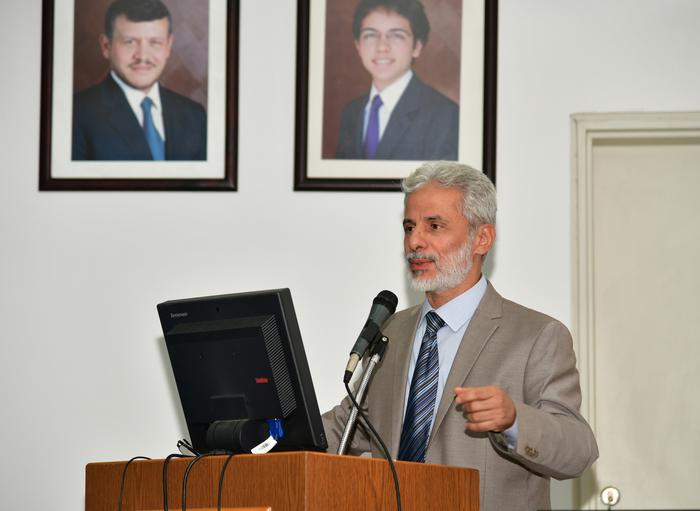
Credit: Wael Al-Delaimy, MD, PhD
Jordan ranks second among countries with the lowest access to water and is expected to reach water insecurity by 2030. Within the country, the most water deprived communities live in the Northeast region of Mafraq’s Azraq Basin which is also home to approximately 120,000 resettled Syrian refugees who are dependent on water resources.
A new three-year program called the Global Center on Climate Change, Water, Energy, Food, and Health Systems, led by the University of California San Diego Herbert Wertheim School of Public Health and Human Longevity Science, and supported by an international consortium of universities and community organizations, will address the impacts of climate change in the climate-vulnerable communities in the Azraq Basin.
“The Middle East is the front post or early warning of what a climate change crisis will look like. We need to act now through prevention and preparation to support the region to adapt to and for us to learn from it to prepare the most vulnerable communities locally and globally,” said Herbert Wertheim School of Public Health professor Wael Al-Delaimy, M.D., Ph.D., principal investigator of the Global Center on Climate Change, Water, Energy, Food, and Health Systems.
Funded by a $3.8 million National Institutes of Health (NIH) P20 grant, the program launched in mid-September with 30 scientists from UC San Diego, UC San Francisco, Texas A&M, University of Jordan, Hashemite University, The Royal Scientific Society in Jordan, and six Jordanian community organizations to target rural and refugee communities in the most water-deprived areas of Jordan. The program will address the four core elements of the NIH’s investment in climate health research: health effects research, health equity, intervention research, and training and capacity building.
“This program will provide an important resource for research partnerships and innovation in climate change impacts for disadvantaged communities around the globe,” said Vice Chancellor for Research Corinne Peek-Asa, Ph.D., M.P.H., Distinguished Professor at the Herbert Wertheim School of Public Health.
“It is a testament to our broad interdisciplinary and global footprint in climate and health research that UC San Diego successfully competed for an NIH-funded GeoHealth Hub on Climate Change and Health, and this grant will continue UC San Diego’s leadership in global climate change health impacts.”
Al-Delaimy is the director for the newly funded center as well the GeoHealth Hub and will be representing UC San Diego at the 2023 United Nations Climate Change Conference or Conference of the Parties of the UNFCCC, more commonly referred to as COP28, which for the first time has dedicated a day to address health impacts of climate change.
Given its status as the most water scarce-region, the area with the highest records of extreme heat, extreme income disparities between the very poor and very affluent, and political instability among many of the region’s countries, the Middle East is going to be the epicenter of the climate change health impacts, said Al-Delaimy.
Jordan is one of the few politically stable countries in the region and is aggressively looking for solutions to the water crises and has created a high-profile governmental committee to develop policies that can address this crisis in the short and long term.
Texas A&M University Water Energy Food Nexus Research Group is a partnering university within this center, represented by Rabi Mohtar, Ph.D., professor of Biological and Agricultural Engineering and Civil and Environmental Engineering, and founded the Texas A&M’s Water-Energy-Food Nexus Initiative.
“We are thrilled to receive this support from the NIH. This is an amazing collaboration that will be advancing the field and breaking new grounds by bringing in health as part of the nexus. We will start the initiative in Jordan and then expand it regionally and globally,” said Mohtar.