• HOME
  • NEWS
  • EXPLORE
    • CAREER
      • Companies
      • Jobs
    • EVENTS
    • iGEM
      • News
      • Team
    • PHOTOS
    • VIDEO
    • WIKI
  • BLOG
  • COMMUNITY
    • FACEBOOK
    • INSTAGRAM
    • TWITTER
Saturday, February 7, 2026
BIOENGINEER.ORG
No Result
View All Result
  • Login
  • HOME
  • NEWS
  • EXPLORE
    • CAREER
      • Companies
      • Jobs
        • Lecturer
        • PhD Studentship
        • Postdoc
        • Research Assistant
    • EVENTS
    • iGEM
      • News
      • Team
    • PHOTOS
    • VIDEO
    • WIKI
  • BLOG
  • COMMUNITY
    • FACEBOOK
    • INSTAGRAM
    • TWITTER
  • HOME
  • NEWS
  • EXPLORE
    • CAREER
      • Companies
      • Jobs
        • Lecturer
        • PhD Studentship
        • Postdoc
        • Research Assistant
    • EVENTS
    • iGEM
      • News
      • Team
    • PHOTOS
    • VIDEO
    • WIKI
  • BLOG
  • COMMUNITY
    • FACEBOOK
    • INSTAGRAM
    • TWITTER
No Result
View All Result
Bioengineer.org
No Result
View All Result
Home NEWS Science News

Collapsed chloroplasts are targeted in self-eating process

Bioengineer by Bioengineer
February 8, 2017
in Science News
Reading Time: 2 mins read
0
Share on FacebookShare on TwitterShare on LinkedinShare on RedditShare on Telegram
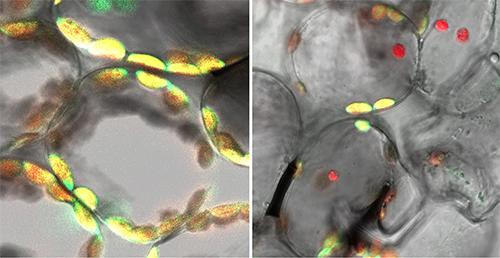
IMAGE

Credit: Masanori Izumi

Researchers at Tohoku University have identified a previously uncharacterized type of autophagy, during which an autophagic process termed chlorophagy removes collapsed chloroplasts in plant leaves. The findings could lead to new methods for controlling the aging of plants.

Chloroplasts are responsible for CO2 assimilation as photosynthesis reactions that need solar energy. As chloroplasts cannot use all the energy received from strong sunlight on a sunny day, they accumulate photodamage. The removal of damaged compounds is known as an essential process for plant survival in nature. But how collapsed chloroplasts are removed has yet to be explained.

Autophagy is the "self-eating" process of consuming unwanted elements in the cells of eukaryotes such as yeast, humans and plants. Dr. Masanori Izumi, from Tohoku University's Frontier Research Institute for Interdisciplinary Sciences, suspects that the turnover of damaged chloroplasts might be accomplished by any process of autophagy.

"Chloroplast turnover is also important in the production of crops." says Izumi. "As crops like rice or wheat turn from green to golden before harvest, chloroplasts are consumed, then nutrients are released and recycled to produce grains as a result of aging. We want to understand the basic, overall mechanism involved in the breakdown of chloroplasts."

According to the study, when a cress plant known as Arabidopsis thaliana is exposed to light stress from Ultraviolet-B (UVB) strong visible light or natural sunlight, chloroplasts are mobilized to the vacuole – an enclosed space where digestion occurs in plant cells. This phenomenon did not occur in the mutant plants lacking autophagy machinery, in which damaged chloroplasts showing abnormal shapes accumulated.

The team also discovered that the mutant leaves die more easily after exposure to UVB compared to the naturally occurring wild leaves. "In the mutants, the production of a reactive oxygen species, hydrogen peroxide, was stimulated after UVB damage. Chlorophagy is likely to be important in suppressing the production of toxic compounds and enabling survival under light stress," explains Izumi.

The researchers concluded that the chlorophagy process serves to remove collapsed chloroplasts under light stress conditions. This finding opens up new biological questions related to the regulation mechanism of chlorophagy, including how damaged chloroplasts are recognized and mobilized to the vacuole. The team believes that the identification of genes specifically regulating chlorophagy could help to create new approaches to manipulating chloroplast turnover during crop aging.

###

Media Contact

Masanori Izumi
[email protected]
@TohokuUniPR

http://www.tohoku.ac.jp/en/

############

Story Source: Materials provided by Scienmag

Share12Tweet8Share2ShareShareShare2

Related Posts

Phage-Antibiotic Combo Beats Resistant Peritoneal Infection

February 7, 2026

Boosting Remote Healthcare: Stepped-Wedge Trial Insights

February 7, 2026

Barriers and Boosters of Seniors’ Physical Activity in Karachi

February 7, 2026

Evaluating Pediatric Emergency Care Quality in Ethiopia

February 7, 2026
Please login to join discussion

POPULAR NEWS

  • Robotic Ureteral Reconstruction: A Novel Approach

    Robotic Ureteral Reconstruction: A Novel Approach

    82 shares
    Share 33 Tweet 21
  • Digital Privacy: Health Data Control in Incarceration

    63 shares
    Share 25 Tweet 16
  • Study Reveals Lipid Accumulation in ME/CFS Cells

    57 shares
    Share 23 Tweet 14
  • Breakthrough in RNA Research Accelerates Medical Innovations Timeline

    53 shares
    Share 21 Tweet 13

About

We bring you the latest biotechnology news from best research centers and universities around the world. Check our website.

Follow us

Recent News

Phage-Antibiotic Combo Beats Resistant Peritoneal Infection

Boosting Remote Healthcare: Stepped-Wedge Trial Insights

Barriers and Boosters of Seniors’ Physical Activity in Karachi

Subscribe to Blog via Email

Enter your email address to subscribe to this blog and receive notifications of new posts by email.

Join 73 other subscribers
  • Contact Us

Bioengineer.org © Copyright 2023 All Rights Reserved.

Welcome Back!

Login to your account below

Forgotten Password?

Retrieve your password

Please enter your username or email address to reset your password.

Log In
No Result
View All Result
  • Homepages
    • Home Page 1
    • Home Page 2
  • News
  • National
  • Business
  • Health
  • Lifestyle
  • Science

Bioengineer.org © Copyright 2023 All Rights Reserved.