• HOME
  • NEWS
  • EXPLORE
    • CAREER
      • Companies
      • Jobs
    • EVENTS
    • iGEM
      • News
      • Team
    • PHOTOS
    • VIDEO
    • WIKI
  • BLOG
  • COMMUNITY
    • FACEBOOK
    • INSTAGRAM
    • TWITTER
Friday, October 9, 2026
BIOENGINEER.ORG
No Result
View All Result
  • Login
  • HOME
  • NEWS
  • EXPLORE
    • CAREER
      • Companies
      • Jobs
        • Lecturer
        • PhD Studentship
        • Postdoc
        • Research Assistant
    • EVENTS
    • iGEM
      • News
      • Team
    • PHOTOS
    • VIDEO
    • WIKI
  • BLOG
  • COMMUNITY
    • FACEBOOK
    • INSTAGRAM
    • TWITTER
No Result
View All Result
Bioengineer.org
No Result
View All Result
Home NEWS Science News Biology

New study uncovers potential treatment for non-alcoholic fatty liver disease

Bioengineer by Bioengineer
October 2, 2023
in Biology
Reading Time: 2 mins read
0
Professor Jang Hyun Choi and Professor Sung Ho Park from the Department of Biological Sciences at UNIST
Share on FacebookShare on TwitterShare on LinkedinShare on RedditShare on Telegram

A breakthrough study, jointly led by Professor Jang Hyun Choi and Professor Sung Ho Park from the Department of Biological Sciences at UNIST has identified an important factor involved in the development of non-alcoholic fatty liver disease (NAFLD) caused by obesity. The research team discovered that Thrap3, a protein associated with thyroid hormone receptors, plays a significant role in exacerbating NAFLD by inhibiting the activity of adenosine monophosphate-activated protein kinase (AMPK), a key regulator of fat metabolism in the liver.
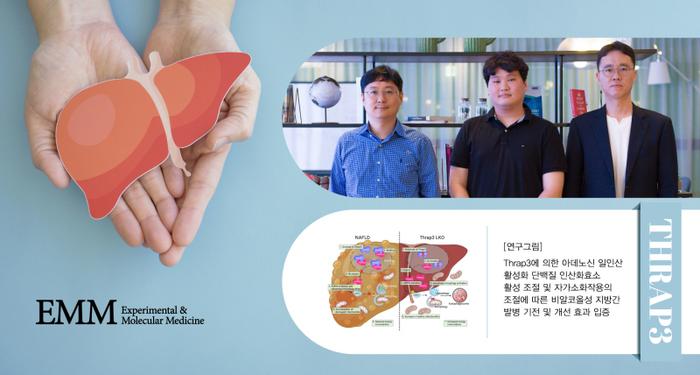
Professor Jang Hyun Choi and Professor Sung Ho Park from the Department of Biological Sciences at UNIST

Credit: UNIST

A breakthrough study, jointly led by Professor Jang Hyun Choi and Professor Sung Ho Park from the Department of Biological Sciences at UNIST has identified an important factor involved in the development of non-alcoholic fatty liver disease (NAFLD) caused by obesity. The research team discovered that Thrap3, a protein associated with thyroid hormone receptors, plays a significant role in exacerbating NAFLD by inhibiting the activity of adenosine monophosphate-activated protein kinase (AMPK), a key regulator of fat metabolism in the liver.

NAFLD encompasses various metabolic diseases such as fatty hepatitis and cirrhosis resulting from excessive fat accumulation. Despite its prevalence, effective treatments for NAFLD have been limited. However, this groundbreaking research sheds light on potential therapeutic approaches.

Through animal experiments conducted on rats, the research team demonstrated that Thrap3 directly binds to AMPK within the liver. This interaction prevents AMPK from translocating from the nucleus to the cytoplasm and impairs autophagy—a process crucial for breaking down triglycerides and reducing cholesterol levels. In essence, inhibiting Thrap3 expression presents a promising avenue for effectively treating NAFLD.

“We have encountered significant challenges while developing treatment strategies for non-alcoholic fatty liver disease. However, our discovery of the Thrap3 gene provides us with an effective method to tackle this condition,” commented Professor Choi.

Additionally, it was confirmed that suppressing Thrap3 expression effectively improves non-alcoholic steatohepatitis—an inflammatory disease stemming from fatty liver.

Supported by funding from Korea Research Foundation under the Ministry of Science and ICT, National Mouse Phenotype Analysis Group (KMPC), and UNIST Future Lead Project; this research was published online on August 1st in Experimental and Molecular Medicine. Professor Jang Hyun Choi, alongside Professor Sung Ho Park, served as corresponding authors of the paper, with Dr. Hyun-Jun Jang and Dr. Yo Han Lee from the Department of Biological Sciences at UNIST participating as co-authors.

Journal Reference
Hyun-Jun Jang, Yo Han Lee, Tam Dao, et al., “Thrap3 promotes nonalcoholic fatty liver disease by suppressing AMPK-mediated autophagy,” Exp. Mol. Med., (2023).


Journal

Experimental & Molecular Medicine

Article Title

Thrap3 promotes nonalcoholic fatty liver disease by suppressing AMPK-mediated autophagy

Article Publication Date

1-Aug-2023

Share12Tweet8Share2ShareShareShare2

Related Posts

Why the Brain's Master Clock Refuses to Reset When Temperatures Shift

Why the Brain’s Master Clock Refuses to Reset When Temperatures Shift

October 9, 2026
Britain's Hedgehogs Have Collapsed in the Countryside While Urban Populations Hold On

Britain’s Hedgehogs Have Collapsed in the Countryside While Urban Populations Hold On

October 9, 2026

Chromosome Crowding Sets the Size of the Mitotic Spindle Across Life

October 9, 2026

Rare Species May Be Safer Than They Look: Dispersal Diversity Shields Forests From Extinction

October 9, 2026

POPULAR NEWS

  • Alloys That Shrink Their Own Grains: New PIX Mechanism Refines Metals With Heat Alone

    Alloys That Shrink Their Own Grains: New PIX Mechanism Refines Metals With Heat Alone

    29 shares
    Share 12 Tweet 7
  • Endurance Exercise Reshapes the Liver in Males and Females Through Distinct Molecular Routes

    29 shares
    Share 12 Tweet 7
  • Single Transcription Factor PU.1 Rapidly Converts Fibroblasts into Macrophage-Lineage Cells

    29 shares
    Share 12 Tweet 7
  • New Scale Measures How Ready Nurse Educators Really Are for the AI Era

    29 shares
    Share 12 Tweet 7

About

We bring you the latest biotechnology news from best research centers and universities around the world. Check our website.

Follow us

Recent News

Alloys That Shrink Their Own Grains: New PIX Mechanism Refines Metals With Heat Alone

Endurance Exercise Reshapes the Liver in Males and Females Through Distinct Molecular Routes

Single Transcription Factor PU.1 Rapidly Converts Fibroblasts into Macrophage-Lineage Cells

Subscribe to Blog via Email

Success! An email was just sent to confirm your subscription. Please find the email now and click 'Confirm' to start subscribing.

Join 85 other subscribers
  • Contact Us

Bioengineer.org © Copyright 2023 All Rights Reserved.

Welcome Back!

Login to your account below

Forgotten Password?

Retrieve your password

Please enter your username or email address to reset your password.

Log In
No Result
View All Result
  • Homepages
    • Home Page 1
    • Home Page 2
  • News
  • National
  • Business
  • Health
  • Lifestyle
  • Science

Bioengineer.org © Copyright 2023 All Rights Reserved.