Neuroscientists at the Flatiron Institute in New York City and their colleagues have made a big breakthrough using one of the world’s smallest brains.
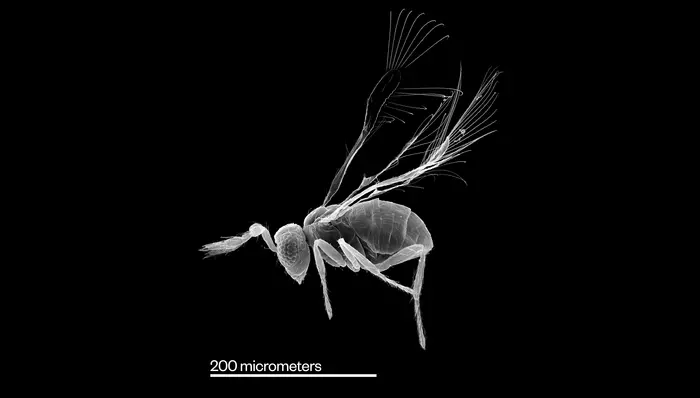
Credit: Alexey Polilov
Neuroscientists at the Flatiron Institute in New York City and their colleagues have made a big breakthrough using one of the world’s smallest brains.
Using an ion beam, an electron microscope and a lot of patience, the neuroscientists mapped out the entire early visual system — from the eyes that take in light to the neurons processing the information — for a parasitic wasp smaller than a grain of table salt. The feat marks the first time scientists have fully reconstructed such a system at the synaptic level from a single specimen of any animal species, the neuroscientists report online on September 29 in Current Biology.
While the tiny wasp has a minuscule brain (with just 8,600 cells compared to the typical human’s 171 billion), the itsy-bitsy insect is still capable of complex behaviors such as flight. “It’s incredible that there’s still so much complexity in such a small brain,” says study lead author Nicholas Chua, a former research analyst at the Flatiron Institute’s Center for Computational Neuroscience (CCN) who is now a Columbia University graduate student.
The wasp’s brain turned out to be “very similar to bigger brains, but simpler and smaller,” says study senior author Dmitri Chklovskii, a group leader at the CCN. The researchers are now mapping the wasp’s full brain, he says.
“The thought is that the principles by which the neurons and the neuronal circuits operate are the same between us and other animals,” he says, “and so that’s why we think that we can take what we learn from insects and apply it to the human brain.”
Understanding bug brains could also help researchers improve artificial intelligence tools, Chklovskii says. “When artificial neural networks were first created 70 years ago, they were inspired by the knowledge of neurons in the brain,” he says. “But our knowledge has progressed significantly since then. Capabilities of the human brain exceed that of artificial intelligence, and we know that it is built by different rules, so there must be some secret sauce that biology has that can help us build better AI.”
Chklovskii’s group at the CCN worked on the project in collaboration with the groups of Harald Hess of the Howard Hughes Medical Institute’s Janelia Research Campus and Alexey Polilov of Moscow State University.
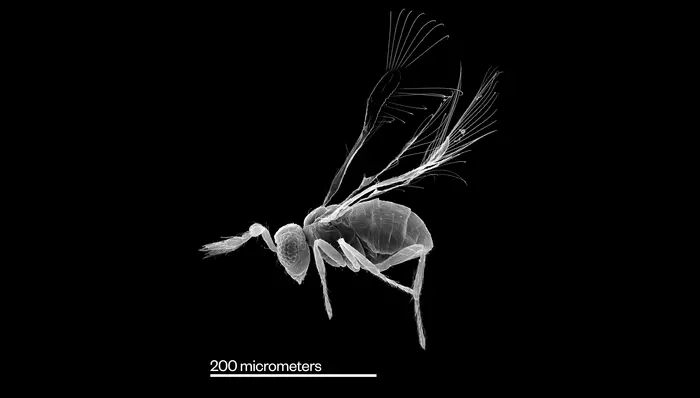
Studying the most basic brains in the animal kingdom makes it easier to identify the mechanisms and rules that govern complex behaviors, Chklovskii says. The parasitic wasp Megaphragma viggianii is an ideal subject for such a task. This microscopic wasp is only around 200 micrometers long, but it can fly and seek out the eggs of insects called thrips, in which the wasps lay their own eggs.
The species had to shrink drastically to get that small: Some of the wasp’s cells even forgo nuclei to save space. Fruit flies, a favorite subject of biologists, are around 3,000 micrometers long and have more than 10 times as many cells in their brains as the wasps.
“A fruit fly is like an elephant compared to this,” Chklovskii says. “This whole creature fits into a fruit fly’s eye.”
The neuroscientists faced a major challenge when mapping out the entire early visual system from the fruit fly’s eyes all the way to the neurons that perform the initial visual processing. Previously, scientists used several different specimens to make such maps. That approach, however, meant that not everything matched up due to variations between the individual specimens.
Instead, the neuroscientists used just a single wasp. Its cells were too small to image using light, so they shot a beam of electrons at the insect and recorded how the electrons scattered. After each pass, the researchers used an ion beam to shave a thin layer off the insect, revealing a deeper level of the insect’s head.
Next, the researchers mapped out the wasp’s brain cells and the connections between them, called synapses. They had to do this mostly by hand, an incredibly laborious undertaking. (For future studies, they have begun implementing an AI-powered tool that speeds up the process.)
Using this method, the neuroscientists gained a greater appreciation for how the wasps see and process visual information. For instance, they discovered how different parts of the wasp’s eyes contribute to the creature’s vision and found that the wasps can detect the polarization of light — something not previously known about the species.
The next step for the neuroscientists is to map out the rest of the wasp’s brain to reveal the entire interconnected framework that the insect uses for complex behavior. “After that, we want to apply the principles that we will learn from these simpler, bare-bones systems to more complex brains like ours,” Chklovskii says.
The Flatiron Institute is the research division of the Simons Foundation. The institute’s mission is to advance scientific research through computational methods, including data analysis, theory, modeling and simulation. The institute’s Center for Computational Neuroscience develops models, principles and conceptual frameworks that deepen our knowledge of brain function — both in health and in disease.
Journal
Current Biology
DOI
10.1016/j.cub.2023.09.021
Subject of Research
Animals
Article Title
A complete reconstruction of the early visual system of an adult insect
Article Publication Date
28-Sep-2023