Protecting large swaths of Earth’s land can help stem the tide of biodiversity loss—including for vertebrates like amphibians, reptiles, mammals and birds, according to a new study published in Nature Sept. 27. The study, led by the Smithsonian Environmental Research Center (SERC) and Conservation International, emphasizes the importance of proper governance for the success of protected lands, and offers much-needed support for the United Nations’ “30 by 30” initiative to conserve the world’s biodiversity.
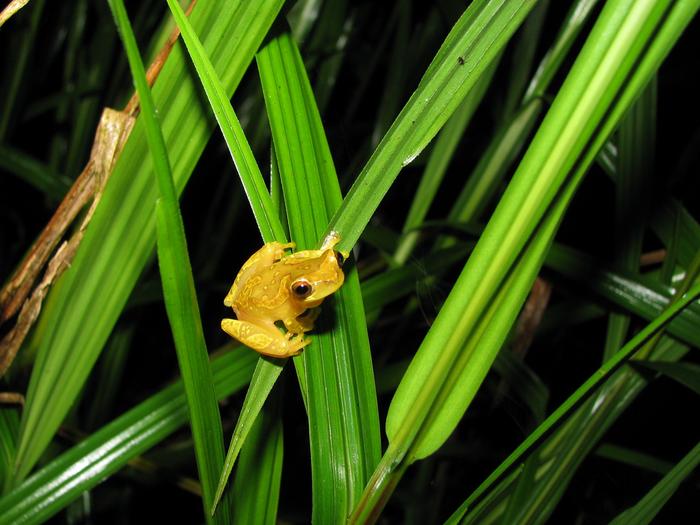
Credit: Justin Nowakowski
Protecting large swaths of Earth’s land can help stem the tide of biodiversity loss—including for vertebrates like amphibians, reptiles, mammals and birds, according to a new study published in Nature Sept. 27. The study, led by the Smithsonian Environmental Research Center (SERC) and Conservation International, emphasizes the importance of proper governance for the success of protected lands, and offers much-needed support for the United Nations’ “30 by 30” initiative to conserve the world’s biodiversity.
Human activity has accelerated the natural extinction rate of vertebrates by 22 times. Such biodiversity loss can destabilize food webs and jeopardize the many benefits biodiversity provides to people, including crop pollination, healthy diets and disease control.
“Humans are inextricably dependent on biodiversity for survival,” said Justin Nowakowski, SERC conservation biologist and lead author of the study. “It provides food, fuel, fiber and other ecosystem services that we depend on for life.”
Class Struggles
Nowakowski’s team captured data for over 1,000 species spanning every continent except Antarctica. They gathered their information from two databases: Living Planet and BioTIME, which contain biodiversity studies compiled from all over the world. The authors examined how 2,239 vertebrate populations fared over time, both inside and outside protected areas. To control for confounding variables, the authors took care that protected versus unprotected sites were as similar as possible in other respects.
On average, vertebrates declined 0.4% per year inside protected areas—nearly five times more slowly than vertebrates outside protected areas (1.8% per year).
“Protected areas take us from a situation in which biodiversity is not-so-slowly ebbing away, to one where populations are at least close to stable,” said Luke Frishkoff, coauthor and assistant professor of biology at the University of Texas at Arlington. “They buy us much-needed time to figure out how to reverse the biodiversity crisis.” At these rates, Frishkoff added, populations outside protected areas could see their numbers cut in half in just 40 years. Meanwhile, it would take 170 years for a population in a protected area to undergo the same fate.
Some vertebrate classes benefited more than others. Amphibians and birds inside protected lands enjoyed the biggest reprieves. The authors suspect this is because those classes face some of the biggest threats on the outside. For example, wetland birds are frequent victims of habitat loss. Amphibians, meanwhile, are dying in droves from the chytrid fungus while battling habitat loss and climate change. Their smaller sizes may contribute as well.
“Amphibians typically have fairly small home ranges, and they’re also really sensitive to small changes in the environment,” said coauthor Jessica Deichmann, an ecologist with the Liz Claiborne & Art Ortenberg Foundation. “So, with amphibians living within protected areas, you’re really able to protect more of the habitat that they’re utilizing than you are with, say, a mammal that has a really large home range.”
However, conversion of land nearby to agriculture or development diminished the benefits of protected areas, and climate change is compounding the problem. Reptiles were found to be especially vulnerable to climate change, even within protected areas. Amphibians suffered more from nearby land conversion. This makes connections between protected areas even more critical to conservation, the authors pointed out—especially as climate change continues to take its toll.
“Protected areas are tied to a specific place,” Nowakowski said. “But species are on the move….We need to design protected areas that are connected and account for this reality.”
Protectionist Politics
This study validates the importance of the United Nations’ work to protect biodiversity. At the United Nations Biodiversity Conference last December, nearly 200 nations pledged to counter rapid extinctions by protecting 30% of Earth’s land and water by 2030. The “30 by 30” commitment created a rush to establish more protected areas. But merely addressing the amount of protected land is not enough according to many conservation experts. It is vital to confirm that protected areas are meeting their primary goal: conserving biodiversity within those areas.
“Countries can comply with 30 by 30 by creating ‘paper parks’ [parks that exist on maps but are largely ineffective],” Deichmann said. “But that will not achieve the desired outcomes of 30 by 30. This study helps us better understand how we can actually achieve 30 by 30, through the creation of protected areas and other effective area-based conservation measures.”
To work well, the data show that protected areas need one more crucial ingredient: a stable, effective government. When the authors ran their analyses, good governance had just as powerful an impact for vertebrates as living in a protected area.
Nations with effective governments often see better enforcement of environmental laws. Corruption-free governments are also less likely to misappropriate conservation money—and are therefore more likely to get international conservation money in the first place. Government transparency can help with community empowerment as well, according to coauthor Carlos Muñoz Brenes, a social scientist with Conservation International. When local communities have a voice in conservation laws, including about protected lands, those protections frequently work better.
But protected areas alone are not enough. Conservation scientists increasingly recognize that Earth needs a portfolio of approaches to safeguard biodiversity, especially in the face of rapid environmental changes.
“There are mechanisms that are more flexible, that could contribute to protecting those biodiversity values and ecosystem values outside protected areas,” Muñoz Brenes said.
As an example, Muñoz Brenes pointed to “payment for ecosystem services” programs. Costa Rica, where Muñoz Brenes was born, has run such a program since 1996. Under the program, funded by a national gas tax, landowners near protected areas receive a payment from the government to preserve forests on their property.
“We have been able to reverse deforestation in Costa Rica, and a great deal thanks to this program,” Muñoz Brenes said. “But not only that, we have been able to increase forest cover through this mechanism outside protected areas.” Other flexible measures include biological corridors and Indigenous-led protected areas that limit but do not entirely restrict human activity.
John Carroll University, the University of California, Davis, and the Zoological Society of London also contributed to the study. The article will be available after publication on the journal’s website. For photos, an advance copy of the study or to speak with one of the authors, contact Kristen Goodhue at [email protected].
Journal
Nature
DOI
10.1038/s41586-023-06562-y
Method of Research
Meta-analysis
Subject of Research
Animals
Article Title
Protected areas slow declines unevenly across the tetrapod tree of life
Article Publication Date
27-Sep-2023
COI Statement
Authors declare that they have no competing interests.