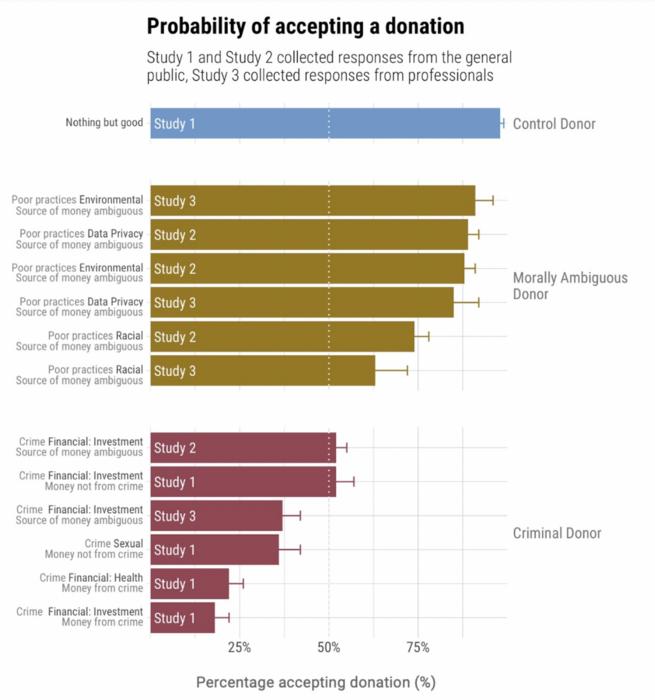
A study digs into a topical debate: should institutions accept donations from bad people? Jeffrey Epstein donated to MIT after he was a convicted sex offender. The Sackler family donated to museums around the world, which had to decide whether to keep their names on display and whether to continue accepting funds after the family faced widespread criticism and legal consequences for pushing addictive painkillers on the public. Ethicists are often split on whether organizations should take money from morally tainted donors. The money can support good outcomes in the world, but the reputation of the organization may suffer and the public may be outraged. Zoe Rahwan and Christina Leuker explored the question by surveying over 4,500 laypeople and almost 700 professional fundraisers between December 2019 and March 2021. The authors investigated several factors that might influence judgments on whether donations should be accepted, including donation size, anonymity, institution type, and the nature of the moral transgression. The latter variable was the most predictive of donation acceptability; both the public and professionals broadly agreed that organizations should reject donations from criminals and accept donations from morally ambiguous individuals. Professionals were hesitant to accept particularly large donations from morally compromised individuals, a pattern not seen in laypeople. Anonymity was not a major factor in the judgements of either of the surveyed samples. In general, respondents expected universities and museums to be more stringent in their standards than charities.
Credit: Rahwan & Leuker
A study digs into a topical debate: should institutions accept donations from bad people? Jeffrey Epstein donated to MIT after he was a convicted sex offender. The Sackler family donated to museums around the world, which had to decide whether to keep their names on display and whether to continue accepting funds after the family faced widespread criticism and legal consequences for pushing addictive painkillers on the public. Ethicists are often split on whether organizations should take money from morally tainted donors. The money can support good outcomes in the world, but the reputation of the organization may suffer and the public may be outraged. Zoe Rahwan and Christina Leuker explored the question by surveying over 4,500 laypeople and almost 700 professional fundraisers between December 2019 and March 2021. The authors investigated several factors that might influence judgments on whether donations should be accepted, including donation size, anonymity, institution type, and the nature of the moral transgression. The latter variable was the most predictive of donation acceptability; both the public and professionals broadly agreed that organizations should reject donations from criminals and accept donations from morally ambiguous individuals. Professionals were hesitant to accept particularly large donations from morally compromised individuals, a pattern not seen in laypeople. Anonymity was not a major factor in the judgements of either of the surveyed samples. In general, respondents expected universities and museums to be more stringent in their standards than charities.
Journal
PNAS Nexus
Article Title
When tainted money should fund public goods: fundraising professional and public moral preferences
Article Publication Date
26-Sep-2023