Over the past 22 years, wildfires in the United States have caused damages exceeding $100 billion, and as climate change continues to intensify wildfire frequency and severity, research is essential to protect lives, property, and ecosystems—and to help communities adapt to these changing conditions. To this end, the National Science Foundation (NSF) has added Worcester Polytechnic Institute (WPI) to its Wildfire Interdisciplinary Research Center (WIRC), a collaboration between universities and industry. Supported by a three-year, $450,000 grant with additional direct funding from industry partners, WPI will build upon its longstanding expertise in fire protection and work with San Jose State University to study new fire detection methods, robotics solutions to enhance first responder safety, and fire suppression systems for wildfires.
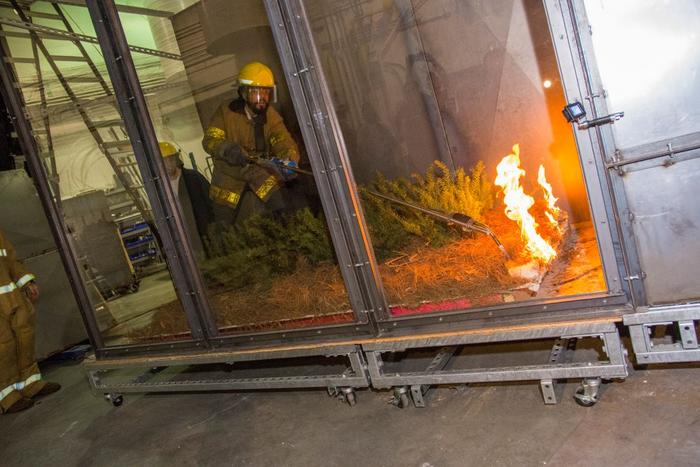
Credit: Worcester Polytechnic Institute
Over the past 22 years, wildfires in the United States have caused damages exceeding $100 billion, and as climate change continues to intensify wildfire frequency and severity, research is essential to protect lives, property, and ecosystems—and to help communities adapt to these changing conditions. To this end, the National Science Foundation (NSF) has added Worcester Polytechnic Institute (WPI) to its Wildfire Interdisciplinary Research Center (WIRC), a collaboration between universities and industry. Supported by a three-year, $450,000 grant with additional direct funding from industry partners, WPI will build upon its longstanding expertise in fire protection and work with San Jose State University to study new fire detection methods, robotics solutions to enhance first responder safety, and fire suppression systems for wildfires.
“The solutions to our current wildfire issues are going to require creative thinking across multiple sectors and disciplines,” said Dr. Kendra McLauchlan, Program Officer at the National Science Foundation and chair of the NSF Wildland Fire Initiative Working Group. “This is exactly the approach taken by WIRC, and the new site at WPI adds some really exciting capacity. We are looking forward to the innovations this industry-university partnership is able to achieve.”
“In a rapidly changing environment, where past experience can get you only so far, research really shows its value as the best way to understand, predict, and adapt to the major challenges faced by our societies,” says Albert Simeoni, WPI fire protection engineering professor and department head. “Many of these issues are interdisciplinary, so we need strong collaborations from a variety of experts. Not only do we have some of the world’s leading fire protection expertise, but WPI’s state-of-the-art Fire Protection Lab provides rare access to equipment to conduct experiments, enabling researchers to extract fundamental measurements of fire ignition and conflagration. I am grateful to be part of this Center that will allow us to leverage our research and resources—and expand our knowledge in one of the most pressing environmental challenges of our times.”
Simeoni is a world-renowned wildfire researcher and is the WPI principal investigator of the Center. Other WPI fire protection engineering researchers include Professor Ali Rangwala, Professor Nicholas Dembsey, and Assistant Professor James Urban, whose work will encompass:
- Trailblazing Research Depth: focusing on human safety and community resilience within the wildland-urban interface by investigating small-scale fire behavior, fire impact at the fire-front level, fire protection systems, and firefighter safety.
- Revolutionizing Fire Behavior Analysis: understanding fire spread through different layers of vegetation, characterizing firebrands, and generating reliable fire behavior data.
- Innovations in Fire Detection and Suppression: conducting groundbreaking studies on new fire detection methods, robotics for enhancing first responder safety, and sophisticated fire suppression systems for wildfires.
- Diverse Training for Future Leaders: contributing to the creation of a diverse STEM workforce that can effectively tackle the complex challenges posed by wildfires, ensuring a multifaceted approach by a new generation of fire managers, city planners, fire analysts, and fire meteorologists.
“We’ve seen the frequency and severity of wildfires increase rapidly in recent years – as well as the tragic human impact and destruction they cause,” said John McNeill, the Bernard M. Gordon Dean of WPI’s School of Engineering. “This partnership will further advance critical groundbreaking research that can reshape our understanding, prediction, and management of wildfires — and, ultimately, save lives.”