Even without a central brain, jellyfish can learn from past experiences like humans, mice, and flies, scientists report for the first time on September 22 in the journal Current Biology. They trained Caribbean box jellyfish (Tripedalia cystophora) to learn to spot and dodge obstacles. The study challenges previous notions that advanced learning requires a centralized brain and sheds light on the evolutionary roots of learning and memory.
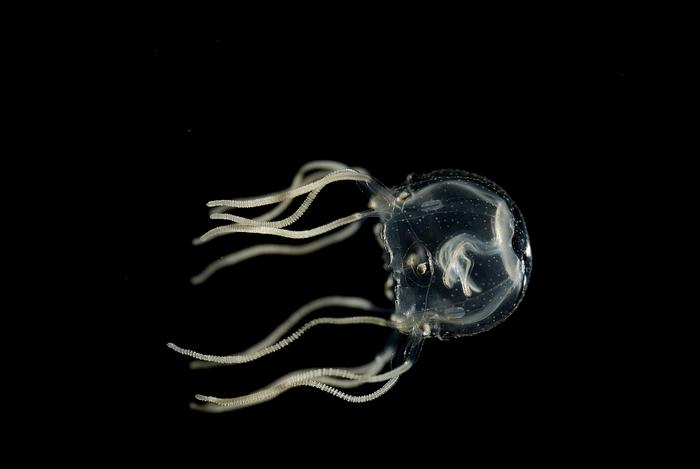
Credit: Jan Bielecki
Even without a central brain, jellyfish can learn from past experiences like humans, mice, and flies, scientists report for the first time on September 22 in the journal Current Biology. They trained Caribbean box jellyfish (Tripedalia cystophora) to learn to spot and dodge obstacles. The study challenges previous notions that advanced learning requires a centralized brain and sheds light on the evolutionary roots of learning and memory.
No bigger than a fingernail, these seemingly simple jellies have a complex visual system with 24 eyes embedded in their bell-like body. Living in mangrove swamps, the animal uses its vision to steer through murky waters and swerve around underwater tree roots to snare prey. Scientists demonstrated that the jellies could acquire the ability to avoid obstacles through associative learning, a process through which organisms form mental connections between sensory stimulations and behaviors.
“Learning is the pinnacle performance for nervous systems,” says first author Jan Bielecki of Kiel University, Germany. To successfully teach jellyfish a new trick, he says “it’s best to leverage its natural behaviors, something that makes sense to the animal, so it reaches its full potential.”
The team dressed a round tank with gray and white stripes to simulate the jellyfish’s natural habitat, with gray stripes mimicking mangrove roots that would appear distant. They observed the jellyfish in the tank for 7.5 minutes. Initially, the jelly swam close to these seemingly far stripes and bumped into them frequently. But by the end of the experiment, the jelly increased its average distance to the wall by about 50%, quadrupled the number of successful pivots to avoid collision and cut its contact with the wall by half. The findings suggest that jellyfish can learn from experience through visual and mechanical stimuli.
“If you want to understand complex structures, it’s always good to start as simple as you can,” says senior author Anders Garm of the University of Copenhagen, Denmark. “Looking at these relatively simple nervous systems in jellyfish, we have a much higher chance of understanding all the details and how it comes together to perform behaviors.”
The researchers then sought to identify the underlying process of jellyfish’s associative learning by isolating the animal’s visual sensory centers called rhopalia. Each of these structures houses six eyes and generates pacemaker signals that govern the jellyfish’s pulsing motion, which spikes in frequency when the animal swerves from obstacles.
The team showed the stationary rhopalium moving gray bars to mimic the animal’s approach to objects. The structure did not respond to light gray bars, interpreting them as distant. However, after the researchers trained the rhopalium with weak electric stimulation when the bars approach, it started generating obstacle-dodging signals in response to the light gray bars. These electric stimulations mimicked the mechanical stimuli of a collision. The findings further showed that combining visual and mechanical stimuli is required for associative learning in jellyfish and that the rhopalium serves as a learning center.
Next, the team plans to dive deeper into the cellular interactions of jellyfish nervous systems to tease apart memory formation. They also plan to further understand how the mechanical sensor in the bell works to paint a complete picture of the animal’s associative learning.
“It’s surprising how fast these animals learn; it’s about the same pace as advanced animals are doing,” says Garm. “Even the simplest nervous system seems to be able to do advanced learning, and this might turn out to be an extremely fundamental cellular mechanism invented at the dawn of the evolution nervous system.”
###
This work was supported by the Deutsche Forschungsgemeinschaft (DFG, German Research Foundation), the Danish Research Council (DFF), and the Villum Foundation.
Current Biology, Bielecki et al. “Associative learning in the box jellyfish Tripedalia cystophora” https://www.cell.com/current-biology/fulltext/S0960-9822(23)01136-3
Current Biology (@CurrentBiology), published by Cell Press, is a bimonthly journal that features papers across all areas of biology. Current Biology strives to foster communication across fields of biology, both by publishing important findings of general interest and through highly accessible front matter for non-specialists. Visit http://www.cell.com/current-biology. To receive Cell Press media alerts, contact [email protected].
Journal
Current Biology
DOI
10.1016/j.cub.2023.08.056
Method of Research
Experimental study
Subject of Research
Animals
Article Title
Associative learning in the box jellyfish Tripedalia cystophora
Article Publication Date
22-Sep-2023