A team of biomedical engineers from Brown University has developed a new hydrogel-based delivery system that balances the acidic environment in a tumor and greatly enhances the cancer-fighting activity of the chemotherapeutic drug it encapsulates in lab experiments.
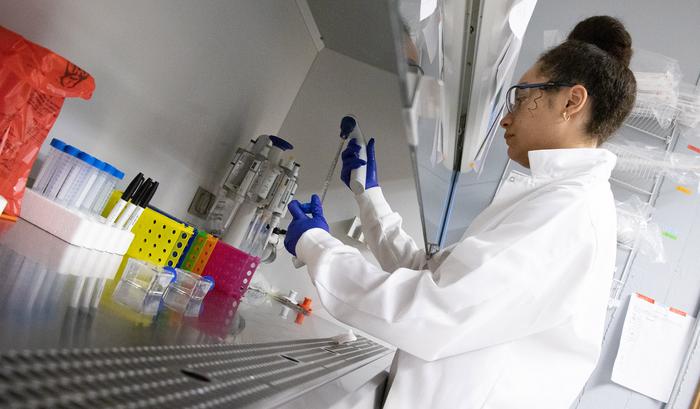
Credit: Juan Siliezar/Brown University.
A team of biomedical engineers from Brown University has developed a new hydrogel-based delivery system that balances the acidic environment in a tumor and greatly enhances the cancer-fighting activity of the chemotherapeutic drug it encapsulates in lab experiments.
The hydrogel system, which is injectable, acts as a buffer to the drug doxorubicin and directly delivers it to malignant tumors, helping to reduce unwanted side effects that occur when the drug isn’t released directly in the targeted site. The researchers say the hydrogel, which was designed to balance pH levels, has the potential to substantially improve chemotherapeutic treatments and reduce the risk of aggressive cancers spreading in the body by neutralizing acid levels in tumors.
The in vitro work is described in ACS Applied Materials and Interfaces.
“At its core, the research is about mitigating some of the critical problems that we face in cancer treatment,” said Zahra Ahmed, lead study author and a Ph.D. student in the Brown lab of Assistant Professor of Engineering Vikas Srivastava.
Ahmed and Srivastava explain that in the region known as the tumor microenvironment, many factors can negatively impact patient prognosis and chemotherapeutic efficacy. One of the main problems is acidosis, where the tumor environment becomes more acidic and pH levels plummet.
In patients with cancer, this increases the likelihood of metastasis, through which the cancer spreads to other parts of the body. It also significantly reduces the effectiveness of chemotherapeutics. For instance, in acidic environments, doxorubicin — one of the current leading chemotherapeutics — goes through what’s known as ion trapping. Essentially, the drug gets trapped by the acidic environment outside the cells and can’t penetrate inside them, which prevents it from killing the cancer cells.
Doxorubicin is toxic and when administered through the current practice of intravenous delivery, it doesn’t discriminate between cancer cells and non-cancerous healthy cells, leading to significant side effects. Compounding these challenges is that there is no current method to directly balance acidic pH levels in cancerous tumors.
This is where the hydrogel the team engineered comes in.
“What we’re trying to do is to develop a method to locally deliver doxorubicin but also mitigate acidosis at the same time,” Ahmed said. “To do this, we created an injectable hydrogel where we combined the delivery of the chemotherapeutic doxorubicin with something to combat the acidic pH in the local region. In this case, we used sodium bicarbonate, a chemical compound that is commonly used to treat acid indigestion.”
Initial lab tests done on breast cancer cells in vitro show that the method works. The hydrogel acts as a buffer and uses the sodium bicarbonate to increase the pH level, which then causes the chemotherapeutic power of doxorubicin in killing the cancer cells to increase by a factor or two to three.
Srivastava’s research team has been working on the project for more than three years. He describes the work as a step-by-step progression after they started looking at regulating pH in the acidic tumor microenvironment.
“When we had success in pH regulation using hydrogels, which has been shown to reduce metastasis in certain cancers, we then began figuring out how to get a sodium bicarbonate delivery system to a precise tumor location,” said Srivastava, whose lab at Brown’s School of Engineering conducts research in solid mechanics, soft materials and mechanobiology. “We formulated an injectable hydrogel that can be locally delivered and has the ability to regulate the pH of the tumor environment. We then wondered if we could also simultaneously deliver a chemotherapeutic. Can we deliver doxorubicin locally using the same delivery vehicle? We’ve now done all these things together to a great effect and have shown very promising results on two cancer cell lines in vitro.”
The researchers chose to develop a biocompatible hydrogel as their delivery system because of their growing use and versatility. Hydrogels, for example, are used for manufacturing contact lenses, hygiene products and used for drug release and medical dressings. The hydrogel system that the researcher developed can be stored at 4 degrees Celsius for long terms of time before use, making it convenient for practical medical use.
Next in this line of research, the team hopes to apply its combined pH regulating and therapeutic delivering hydrogel system in pre-clinical settings and go from experiments in test tubes to experiments in animals and eventually progress to human patients.
Other authors on the study include Brown undergraduates Angelina Schorr and Rachel Rowey; graduate student Kevin LoGiudice; former graduate students Gavin Mays and Shruti Trivedi; and former undergraduate student Haisong Yang.
Journal
ACS Applied Materials & Interfaces
DOI
10.1021/acsami.3c09733
Article Title
Increasing Chemotherapeutic Efficacy Using pH-Modulating and Doxorubicin-Releasing Injectable Chitosan-Poly(ethylene glycol) Hydrogels
Article Publication Date
20-Sep-2023