• HOME
  • NEWS
  • EXPLORE
    • CAREER
      • Companies
      • Jobs
    • EVENTS
    • iGEM
      • News
      • Team
    • PHOTOS
    • VIDEO
    • WIKI
  • BLOG
  • COMMUNITY
    • FACEBOOK
    • INSTAGRAM
    • TWITTER
Saturday, February 7, 2026
BIOENGINEER.ORG
No Result
View All Result
  • Login
  • HOME
  • NEWS
  • EXPLORE
    • CAREER
      • Companies
      • Jobs
        • Lecturer
        • PhD Studentship
        • Postdoc
        • Research Assistant
    • EVENTS
    • iGEM
      • News
      • Team
    • PHOTOS
    • VIDEO
    • WIKI
  • BLOG
  • COMMUNITY
    • FACEBOOK
    • INSTAGRAM
    • TWITTER
  • HOME
  • NEWS
  • EXPLORE
    • CAREER
      • Companies
      • Jobs
        • Lecturer
        • PhD Studentship
        • Postdoc
        • Research Assistant
    • EVENTS
    • iGEM
      • News
      • Team
    • PHOTOS
    • VIDEO
    • WIKI
  • BLOG
  • COMMUNITY
    • FACEBOOK
    • INSTAGRAM
    • TWITTER
No Result
View All Result
Bioengineer.org
No Result
View All Result
Home NEWS Science News Chemistry

Mixture of BP/SnSe2-PVA, showing different photoelectric charm

Bioengineer by Bioengineer
September 20, 2023
in Chemistry
Reading Time: 2 mins read
0
Mode-locked YDFL
Share on FacebookShare on TwitterShare on LinkedinShare on RedditShare on Telegram

The formation of dissipative solitons is influenced by several factors, such as spectral filtering effects and Kerr nonlinear effects. This interaction leads to the possibility of mode locking over a wide range of parameters, generating pulses whose type and evolution are completely different from the conventional physical laws and optical properties, tolerating higher nonlinear effects and thus effectively avoiding the generation of pulse splitting. The physical laws and optical properties offer a major improvement over the conventional optical pulse.
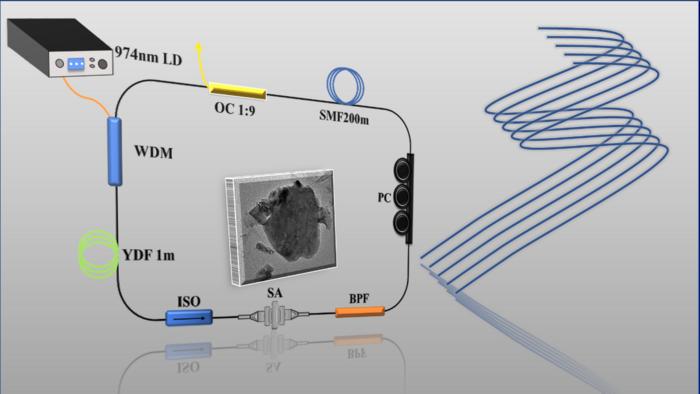
Mode-locked YDFL

Credit: Yuting Ouyang, Jiayu Zhang, Wanggen Sun, Mengxiao Li, Tao Chen, Haikun Zhang, Wenjing Tang, Wei Xia

The formation of dissipative solitons is influenced by several factors, such as spectral filtering effects and Kerr nonlinear effects. This interaction leads to the possibility of mode locking over a wide range of parameters, generating pulses whose type and evolution are completely different from the conventional physical laws and optical properties, tolerating higher nonlinear effects and thus effectively avoiding the generation of pulse splitting. The physical laws and optical properties offer a major improvement over the conventional optical pulse.


Researchers led by Prof. Haikun Zhang at University of Jinan (UJN) designed to use two materials with different optical properties, BP and SnSe2, to assemble into a heterojunction by stacking them together using van der Waals forces, so that the materials can maintain their respective optical properties while achieving electron migration and inter band leap through interlayer coupling, thus achieving optical synergy, and the composite material is further optimized for optoelectronic properties. The composites were fabricated into saturable absorbers to be prepared as fiber lasers, showing the great potential of the composites composed of two 2D materials for ultrafast optics applications. The work entitled “Picosecond dissipative soliton generation from an ytterbium-doped fiber laser based on BP/SnSe2-PVA mixture saturable absorber” was published on Frontiers of Optoelectronics (published on Jul. 19, 2023). 


Journal

Frontiers of Optoelectronics

DOI

10.1007/s12200-023-00074-3

Method of Research

Experimental study

Subject of Research

Not applicable

Article Title

Picosecond dissipative soliton generation from an ytterbium-doped fiber laser based on a BP/SnSe2-PVA mixture saturable absorber

Article Publication Date

19-Jul-2023

Share12Tweet8Share2ShareShareShare2

Related Posts

blank

Breakthrough in Environmental Cleanup: Scientists Develop Solar-Activated Biochar for Faster Remediation

February 7, 2026
blank

Cutting Costs: Making Hydrogen Fuel Cells More Affordable

February 6, 2026

Scientists Develop Hand-Held “Levitating” Time Crystals

February 6, 2026

Observing a Key Green-Energy Catalyst Dissolve Atom by Atom

February 6, 2026

POPULAR NEWS

  • Robotic Ureteral Reconstruction: A Novel Approach

    Robotic Ureteral Reconstruction: A Novel Approach

    82 shares
    Share 33 Tweet 21
  • Digital Privacy: Health Data Control in Incarceration

    63 shares
    Share 25 Tweet 16
  • Study Reveals Lipid Accumulation in ME/CFS Cells

    57 shares
    Share 23 Tweet 14
  • Breakthrough in RNA Research Accelerates Medical Innovations Timeline

    53 shares
    Share 21 Tweet 13

About

We bring you the latest biotechnology news from best research centers and universities around the world. Check our website.

Follow us

Recent News

Phage-Antibiotic Combo Beats Resistant Peritoneal Infection

Boosting Remote Healthcare: Stepped-Wedge Trial Insights

Barriers and Boosters of Seniors’ Physical Activity in Karachi

Subscribe to Blog via Email

Enter your email address to subscribe to this blog and receive notifications of new posts by email.

Join 73 other subscribers
  • Contact Us

Bioengineer.org © Copyright 2023 All Rights Reserved.

Welcome Back!

Login to your account below

Forgotten Password?

Retrieve your password

Please enter your username or email address to reset your password.

Log In
No Result
View All Result
  • Homepages
    • Home Page 1
    • Home Page 2
  • News
  • National
  • Business
  • Health
  • Lifestyle
  • Science

Bioengineer.org © Copyright 2023 All Rights Reserved.