Australian koala populations have been decimated by bushfires in recent years – and researchers are forecasting that bushfires will threaten them and their habitat even more in coming decades.
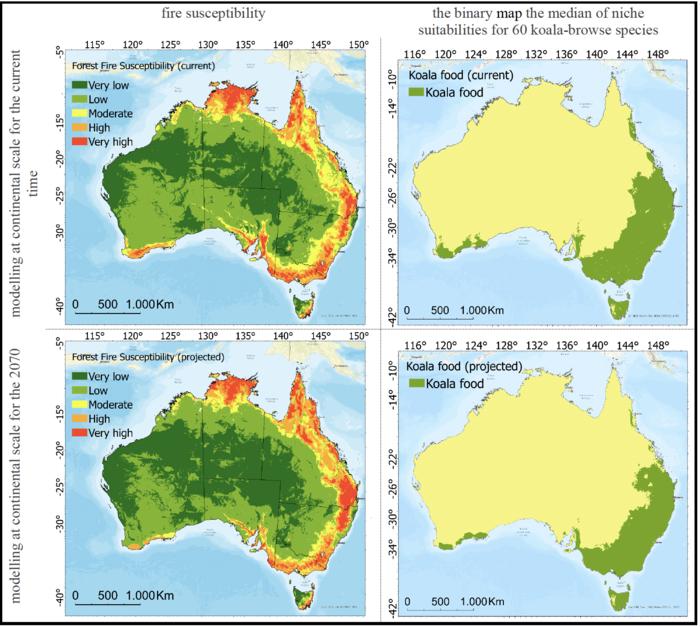
Credit: Farzin Shabani, Flinders University.
Australian koala populations have been decimated by bushfires in recent years – and researchers are forecasting that bushfires will threaten them and their habitat even more in coming decades.
A team of experts in ecology and species distribution modelling has studied the impact climate change is having on fire risk across the forests koalas depend on, finding a significant increase in susceptibility of these habitats to bushfires.
Through generating fire susceptibility maps for the present and in the year 2070, researchers were able to identify the threat that wildfires pose to koalas now and under future climate change, and found alarming outcomes.
Presently, 39.56% of koala habitat in Australia is highly susceptible to bushfires, but the modelling predicts this will rise to 44.61% by 2070. These percentages also reflect a general increase in the susceptibility of all Australian vegetation to bushfires.
“Wildfires will increasingly impact koala populations in the future. If this iconic and vulnerable marsupial is to be protected, conservation strategies need to be adapted to deal with this threat,” says lead author of the research, Assistant Professor Farzin Shabani, who now works in the Department of Biological and Environmental Sciences at Qatar University .
“It is crucial to strike a balance between ensuring that koala habitats and populations are not completely destroyed by fire while also allowing for forest rejuvenation and regeneration through periodic burns.”
Using the dynamic Decision Tree machine learning algorithm, the research team generated a series of fire susceptibility maps. These show the proportion of Australia experiencing “high” or “very high” fire susceptibility increasing from 14.9% now to 15.66% by 2070 – while fire susceptibility of areas suitable for the plants that koalas depend on is tipped to jump from 39.56% to 44.61% by 2070.
Of particular interest is that state-based modelling results showed that fire susceptibility of koala habitat will increase more in South Australia and Queensland than in other states. By 2070, 89.11% of the total koala habitat in South Australia and 65.24% in Queensland is projected to have high or very high fire susceptibility.
“Koalas may still be able to survive in areas highly susceptible to bushfires if their food sources can also withstand the fire-prone conditions, and if koalas can re-populate previously burnt-out areas from neighbouring habitat — but this task is becoming more difficult due to habitat fragmentation and the increasingly large areas being burnt,” says research co-author Dr John Llewelyn, from the Global Ecology Lab at Flinders University.
By studying the tree species koalas depend on, earlier research by Professor Shabani and colleagues found that suitable habitat for koalas may contract by as much as 62% of its current range by the year 2070—and that was without considering the impact of fire on koala populations. Together, these results highlight the challenges to koala conservation in the coming decades.
“While many of the affected tree species have an inherent resilience to fire, the massive biogeographic and demographic impact of widespread wildfires may leave ecosystems declining across landscapes, increasing susceptibility to regeneration failure,” says Dr Llewelyn.
He adds that strategies are needed to protect koalas and other fire-vulnerable species whilst allowing for forest rejuventation through burning at appropriate intervals, spatial extents, and intensities; failure to use such strategies could have catastrophic consequences for koalas as a species.
“Fires of greater severity — megafires — will likely reduce the quality of koala habitats, increase habitat fragmentation, make it harder for koalas to recolonise areas, and directly kill more koalas, leading to increasingly isolated and smaller populations that are vulnerable to local extinction,” he says.
Journal
Environmental Technology & Innovation
DOI
10.1016/j.eti.2023.103331
Method of Research
Computational simulation/modeling
Subject of Research
Animals
Article Title
Habitat in flames: How climate change will affect fire risk across koala forests
Article Publication Date
1-Nov-2023