“[…] we describe a conceptually different measurement (not a prediction) of persons’ biological age, which we term a noise barometer […]”
Credit: 2023 Mei et al.
“[…] we describe a conceptually different measurement (not a prediction) of persons’ biological age, which we term a noise barometer […]”
BUFFALO, NY- September 18, 2023 – A new priority research paper was published on the cover of Aging (listed by MEDLINE/PubMed as “Aging (Albany NY)” and “Aging-US” by Web of Science) Volume 15, Issue 17, entitled, “Fail-tests of DNA methylation clocks, and development of a noise barometer for measuring epigenetic pressure of aging and disease.”
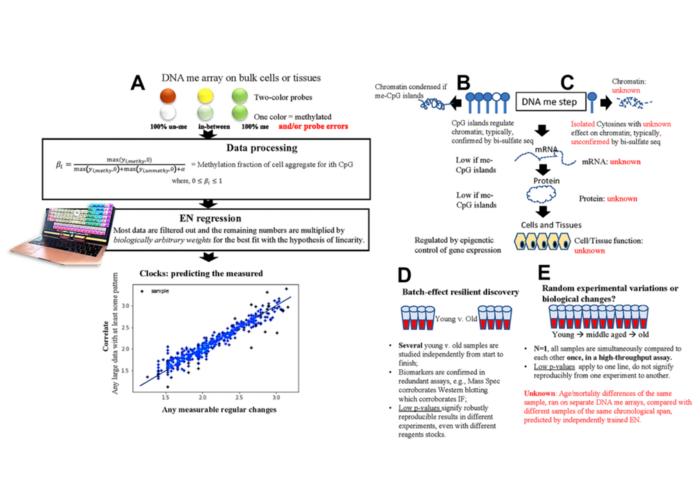
In this new study, researchers Xiaoyue Mei, Joshua Blanchard, Connor Luellen, Michael J. Conboy, and Irina M. Conboy from the University of California, Berkeley, show that Elastic Net (EN) DNA methylation (DNAme) clocks have low accuracy of predictions for individuals of the same age and a low resolution between healthy and disease cohorts; caveats inherent in applying linear model to non-linear processes.
“We found that change in methylation of cytosines with age is, interestingly, not the determinant for their selection into the clocks.”
Moreover, an EN clock’s selected cytosines change when non-clock cytosines are removed from the training data; as expected from optimization in a machine learning (ML) context, but inconsistently with the identification of health markers in a biological context. To address these limitations, the researchers moved from predictions to measurement of biological age, focusing on the cytosines that on average remain invariable in their methylation through lifespan, postulated to be homeostatically vital. They established that dysregulation of such cytosines, measured as the sums of standard deviations of their methylation values, quantifies biological noise, which in their hypothesis is a biomarker of aging and disease.
“We term this approach a ‘noise barometer’ – the pressure of aging and disease on an organism.”
These noise-detecting cytosines are particularly important as sums of SD on the entire 450K DNAme array data yield a random pattern through chronology. Testing how many cytosines of the 450K arrays become noisier with age, the team found that the paradigm of DNAme noise as a biomarker of aging and disease remarkably manifests in ~1/4 of the total. In that large set even the cytosines that have on average constant methylation through age show increased SDs and can be used as noise detectors of the barometer.
Read the full study: DOI: https://doi.org/10.18632/aging.205046
Corresponding Author: Irina M. Conboy – [email protected]
Keywords: DNA methylation, epigenetics, aging clocks’ fail-tests, biological noise
Sign up for free Altmetric alerts about this article: https://aging.altmetric.com/details/email_updates?id=10.18632%2Faging.205046
About Aging:
Launched in 2009, Aging (Aging-US) publishes papers of general interest and biological significance in all fields of aging research and age-related diseases, including cancer—and now, with a special focus on COVID-19 vulnerability as an age-dependent syndrome. Topics in Aging go beyond traditional gerontology, including, but not limited to, cellular and molecular biology, human age-related diseases, pathology in model organisms, signal transduction pathways (e.g., p53, sirtuins, and PI-3K/AKT/mTOR, among others), and approaches to modulating these signaling pathways.
Please visit our website at www.Aging-US.com and connect with us:
- SoundCloud
- X, formerly known as Twitter
- YouTube
- LabTube
Click here to subscribe to Aging publication updates.
For media inquiries, please contact [email protected].
Aging (Aging-US) Journal Office
6666 E. Quaker Str., Suite 1B
Orchard Park, NY 14127
Phone: 1-800-922-0957, option 1
###
Journal
Aging-US
DOI
10.18632/aging.205046
Method of Research
Experimental study
Subject of Research
People
Article Title
Fail-tests of DNA methylation clocks, and development of a noise barometer for measuring epigenetic pressure of aging and disease
Article Publication Date
12-Sep-2023