Philadelphia, September 18, 2023 – Very young children who attend child care and receive onsite meals and snacks were more likely to be food secure and in good health, and less likely to be admitted after a hospital emergency department visit than children in child care whose meals and snacks were provided from home, according to a new study in the Journal of the Academy of Nutrition and Dietetics, published by Elsevier. These potential benefits could extend beyond the children themselves to their families, including through possible reductions in stress, and to society as a whole through potentially significant healthcare cost savings.
Credit: Journal of the Academy of Nutrition and Dietetics
Philadelphia, September 18, 2023 – Very young children who attend child care and receive onsite meals and snacks were more likely to be food secure and in good health, and less likely to be admitted after a hospital emergency department visit than children in child care whose meals and snacks were provided from home, according to a new study in the Journal of the Academy of Nutrition and Dietetics, published by Elsevier. These potential benefits could extend beyond the children themselves to their families, including through possible reductions in stress, and to society as a whole through potentially significant healthcare cost savings.
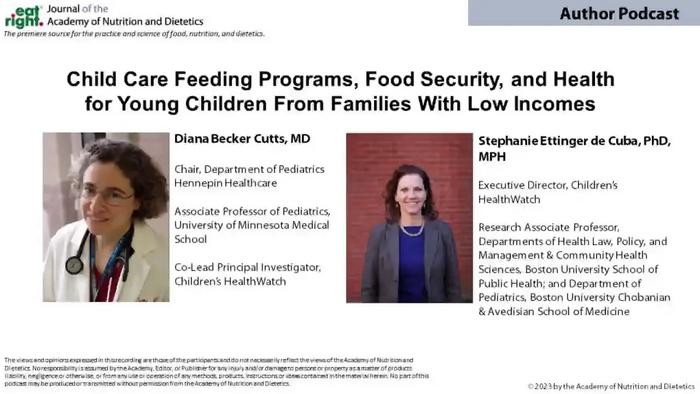
Lead author Stephanie Ettinger de Cuba, PhD, MPH, Executive Director, Children’s HealthWatch; Research Associate Professor, Department of Health Law, Policy & Management, Boston University School of Public Health; and Department of Pediatrics, Boston University Chobanian & Avedisian School of Medicine, explained, “Good nutrition in early childhood is an essential foundation for healthy child growth and development, and our research points to the potential impact of policies that provide very young children with wholesome meals while they are in child care.”
Children’s HealthWatch brings together pediatricians, child health researchers, and policy experts to achieve health equity for young children and their families by advancing research to transform policy.
The study included 3,084 children attending child care, aged 13 to 48 months, from low-income households with a child care subsidy. The investigators interviewed their parents or caregivers as they sought medical care for the children in emergency departments or primary care clinics in five US cities: Baltimore, Boston, Little Rock, Minneapolis, and Philadelphia, between January 2010 and March 2020. Approximately 87% of the group studied meals and snacks provided by the child care facility to meals and snacks provided by parents and served in the child care settings, most likely federally supported through the Child and Adult Care Feeding Program (CACFP).
Compared to those with parent-provided meals and snacks, children with child care-provided meals were 30% less likely to live in food-insecure households, 39% less likely to be in fair or poor health, and 41% less likely to be admitted to the hospital from the emergency department.
Senior investigator Diana B. Cutts, MD, University of Minnesota, Chair, Department of Pediatrics, Hennepin County Medical Center, Minneapolis, noted, “Food justice for children is about consistent access to healthy, developmentally appropriate nutrition for every child, in every site of their care. Nutritional programs that support young children are an essential investment in children, families, and communities with a return that is not only immediate but extends for generations.”
The study also bolsters the evidence that child care feeding programs, specifically CACFP, are essential supports for young children’s health and their families’ food security in combination with and also independent of other nutrition programs.
Dr. Ettinger de Cuba added, “Strengthening and improving access to programs like CACFP offers a vitally important pathway to ensuring both children and their families can flourish. The Child Nutrition Reauthorization Act (CNR) provides an immediate opportunity to improve and expand child nutrition programs in an evidence-based way, support child and family health, and prevent hospitalizations and associated costs.”
Opportunities to strengthen CACFP include boosting funding levels to enable more providers to participate in the program, reducing administrative barriers and burdens, and increasing reimbursement rates to support the cost of healthy foods and the means to prepare them.
In 2010, Congress made changes to CACFP that improved meal quality and reduced barriers to participation. The time period of data collected and analyzed for this study (2010-2020) runs parallel to these changes and their implementation, which provided the investigators with a unique opportunity to demonstrate the importance of the program, especially in light of its upcoming reauthorization at the federal level.
According to Dr. Ettinger de Cuba, “The widespread disruptions observed during the pandemic, which immediately followed the study period, highlighted the critical role of child care in providing healthy meals and snacks for low-income children and underscored the importance of strengthening child care nutrition programs.”
Journal
Journal of the Academy of Nutrition and Dietetics
DOI
10.1016/j.jand.2023.06.003
Method of Research
Survey
Subject of Research
People
Article Title
Child Care Feeding Programs Associated With Food Security and Health for Young Children From Families With Low Incomes