

• HOME
  • NEWS
  • EXPLORE
    • CAREER
      • Companies
      • Jobs
    • EVENTS
    • iGEM
      • News
      • Team
    • PHOTOS
    • VIDEO
    • WIKI
  • BLOG
  • COMMUNITY
    • FACEBOOK
    • INSTAGRAM
    • TWITTER
Monday, August 31, 2026
BIOENGINEER.ORG
No Result
View All Result
  • Login
  • HOME
  • NEWS
  • EXPLORE
    • CAREER
      • Companies
      • Jobs
        • Lecturer
        • PhD Studentship
        • Postdoc
        • Research Assistant
    • EVENTS
    • iGEM
      • News
      • Team
    • PHOTOS
    • VIDEO
    • WIKI
  • BLOG
  • COMMUNITY
    • FACEBOOK
    • INSTAGRAM
    • TWITTER
  • HOME
  • NEWS
  • EXPLORE
    • CAREER
      • Companies
      • Jobs
        • Lecturer
        • PhD Studentship
        • Postdoc
        • Research Assistant
    • EVENTS
    • iGEM
      • News
      • Team
    • PHOTOS
    • VIDEO
    • WIKI
  • BLOG
  • COMMUNITY
    • FACEBOOK
    • INSTAGRAM
    • TWITTER
No Result
View All Result
Bioengineer.org
No Result
View All Result
Home NEWS Science News Chemistry

Chemistry Professor Holger Braunschweig receives Frederick Hawthorne Award

Bioengineer by Bioengineer
September 15, 2023
in Chemistry
Reading Time: 2 mins read
0
Award Winner Holger Braunschweig
Share on FacebookShare on TwitterShare on LinkedinShare on RedditShare on Telegram

Holger Braunschweig can still remember very well the first scientific research lecture he ever heard. It was in 1984, in his first semester as a chemistry student at RWTH Aachen University. The speaker was a chemist from the USA and an expert on the element boron, Frederick Hawthorne (1928-2021).
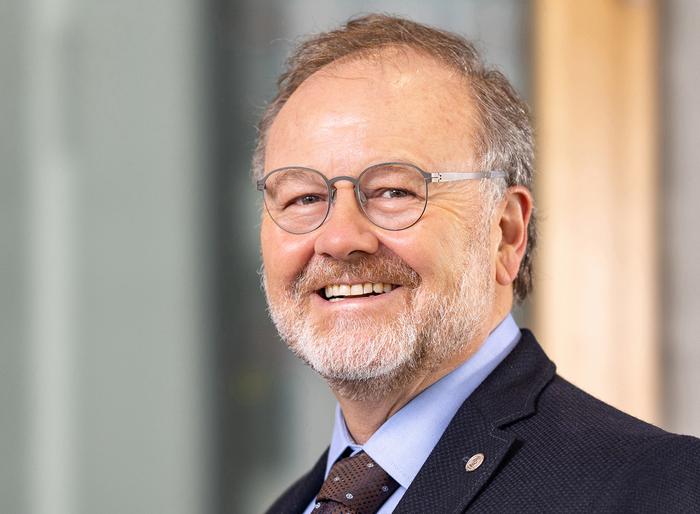
Award Winner Holger Braunschweig

Credit: Christoph Weiss

Holger Braunschweig can still remember very well the first scientific research lecture he ever heard. It was in 1984, in his first semester as a chemistry student at RWTH Aachen University. The speaker was a chemist from the USA and an expert on the element boron, Frederick Hawthorne (1928-2021).

Almost 40 years later, Holger Braunschweig has now learned that he will receive a prize named after Hawthorne: the 2024 M. Frederick Hawthorne Award in Main Group Inorganic Chemistry, endowed with US$ 5,000. Braunschweig is now a renowned boron expert himself and a chemistry professor at Julius-Maximilians-Universität (JMU) Würzburg.

Creativity and independent thinking

The American Chemical Society (ACS) awards the Hawthorne Prize to researchers who have presented outstanding work on the main group elements of the periodic table – which includes boron. In selecting the award winners, their “creativity and independence of thought” also play a role, as stated on the ACS website.

“I am very pleased to receive this award because Frederick Hawthorne was one of the pioneers of boron chemistry. He laid many foundations for modern boron chemistry – a field in which I myself work. I also feel particularly honoured because the American Chemical Society rarely awards its prizes to scientists based outside the USA,” says the laureate.

Another honour is associated with the prize: Holger Braunschweig is to give an accompanying award lecture at the spring meeting of the ACS 2024 in New Orleans.

More awards for Holger Braunschweig

The Frederick Hawthorne Award is not the only award the JMU chemistry professor has received in recent months. He was also honoured with the A. Chakravorty Endowment Lecture 2024 of the Indian Association for the Cultivation of Science (IACS Kolkata); as well as the Frankland Lecture 2023 of Imperial College London and the Margot Becke Lecture 2023 of the University of Heidelberg.

About the award winner

JMU Professor Holger Braunschweig (61) is one of the world’s leading experts on the element boron. Since 2002, he has headed the Chair of Inorganic Chemistry II and, since 2016, the newly founded Institute for Sustainable Chemistry and Catalysis with Boron at the University of Würzburg. In his research, he has achieved many fundamental breakthroughs and has been awarded a number of major prizes for them.

Among others, he was awarded two ERC Advanced Grants of the European Research Council, each endowed with 2.5 million euros. He received the prestigious Leibniz Prize from the German Research Foundation and a 1.5 million euro grant from the Reinhart Koselleck Programme, which supports particularly innovative projects.


Share12Tweet8Share2ShareShareShare2

Related Posts

β-Sitosterol from Ipomoea carnea Jacq. As a promising anti-inflammatory agent: Evidence from in silico modeling and in vitro validation

β-Sitosterol from Ipomoea carnea Jacq. As a promising anti-inflammatory agent: Evidence from in silico modeling and in vitro validation

August 31, 2026
Graded membranes point to a sustainable route for refining complex petroleum

Graded membranes point to a sustainable route for refining complex petroleum

August 31, 2026

Round-robin tests quantify catalyst activity and deactivation in CO2 hydrogenation modelling

August 30, 2026

Researchers reveal guiding principles for electrochemical synthesis of multimetallic nanocrystals

August 30, 2026

POPULAR NEWS

  • β-Sitosterol from Ipomoea carnea Jacq. As a promising anti-inflammatory agent: Evidence from in silico modeling and in vitro validation

    29 shares
    Share 12 Tweet 7
  • Design, fabrication and characterization of a wearable Fiber Bragg grating sensor for cardiorespiratory monitoring using finger plethysmography

    29 shares
    Share 12 Tweet 7
  • KAIST opens the era of industrial-scale microbial foods, proposing growth strategies for the next-generation protein market

    29 shares
    Share 12 Tweet 7
  • Virologist awarded $2 million NIH grant to investigate how virus-infected cells live and die

    29 shares
    Share 12 Tweet 7

About

We bring you the latest biotechnology news from best research centers and universities around the world. Check our website.

Follow us

Recent News

β-Sitosterol from Ipomoea carnea Jacq. As a promising anti-inflammatory agent: Evidence from in silico modeling and in vitro validation

Design, fabrication and characterization of a wearable Fiber Bragg grating sensor for cardiorespiratory monitoring using finger plethysmography

KAIST opens the era of industrial-scale microbial foods, proposing growth strategies for the next-generation protein market

Subscribe to Blog via Email

Enter your email address to subscribe to this blog and receive notifications of new posts by email.

Join 85 other subscribers
  • Contact Us

Bioengineer.org © Copyright 2023 All Rights Reserved.

Welcome Back!

Login to your account below

Forgotten Password?

Retrieve your password

Please enter your username or email address to reset your password.

Log In
No Result
View All Result
  • Homepages
    • Home Page 1
    • Home Page 2
  • News
  • National
  • Business
  • Health
  • Lifestyle
  • Science

Bioengineer.org © Copyright 2023 All Rights Reserved.