Polluted air can contribute to the development of asthma and other conditions, and the first step toward combating its effects is continuous, accurate monitoring. Most measurement devices are stationary, placed just feet above the ground, but contaminants can drift away. Now, researchers publishing in ACS’ Analytical Chemistry have developed a “lab-on-a-drone” system that, unlike similar gadgets, can detect and analyze levels of pollutants, such as smelly hydrogen sulfide gas, all while still floating in mid-air.
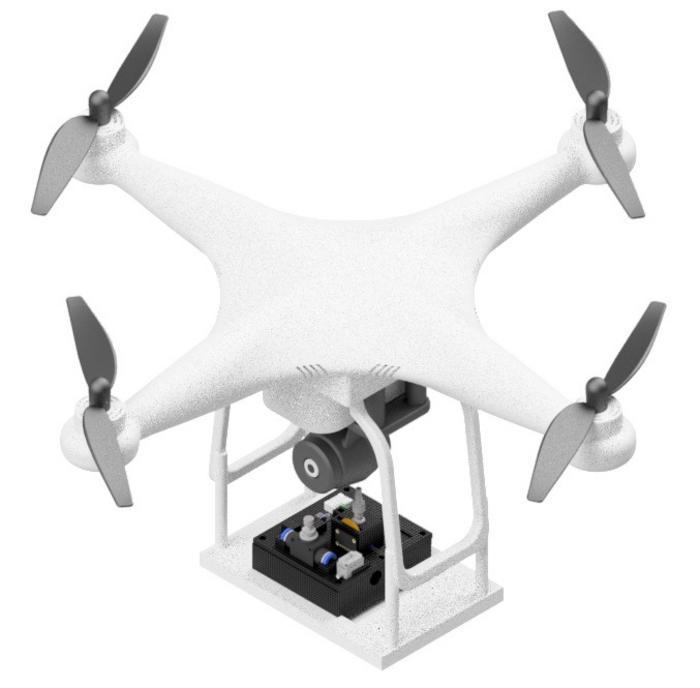
Credit: Adapted from Analytical Chemistry, 2023, DOI: 10.1021/acs.analchem.3c02719
Polluted air can contribute to the development of asthma and other conditions, and the first step toward combating its effects is continuous, accurate monitoring. Most measurement devices are stationary, placed just feet above the ground, but contaminants can drift away. Now, researchers publishing in ACS’ Analytical Chemistry have developed a “lab-on-a-drone” system that, unlike similar gadgets, can detect and analyze levels of pollutants, such as smelly hydrogen sulfide gas, all while still floating in mid-air.
Hydrogen sulfide (H2S) is one of the stinkiest air pollutants, well known for its putrid, rotten-egg odor. Though it’s naturally found in well water and volcanic emissions, it’s also a common byproduct of petroleum refineries and wastewater treatment plants. The gas is an irritant, and in high enough amounts, it can be toxic. Most methods to quantify H2S and other pollutants rely on ground-based instruments, and expensive devices such as satellites are required to collect measurements at higher altitudes. Unmanned drones have been used by researchers to gather samples in mid-air, but analyses still had to be performed on the ground with traditional instruments. So, João Flávio da Silveira Petruci and colleagues wanted to create an inexpensive “lab-on-a-drone” that could sample and analyze H2S gas while in the air and report the results in real time — a first for devices of its kind.
Using a 3D printer, the team manufactured a custom device that was mounted to the bottom of a commercially available quadcopter drone. It took advantage of a unique chemical reaction between H2S and a green-glowing fluorescein mercuric acetate molecule. When excited by an onboard blue LED light, the interaction caused a decrease in the green fluorescence intensity, which was detected and quantified. This reaction is highly selective and was not affected by other, interfering gaseous air pollutants.
The team took their drone to a wastewater treatment plant, where it sampled air on the ground, then at around 30 and 65 feet in the air at three different times throughout the day. The detection device transmitted its results via Bluetooth to a smartphone, allowing for real-time monitoring. In the evening, there was a clear increase in H2S concentration as the drone increased altitude, though it never exceeded the acceptable ambient level. The researchers say that this system could be adapted to detect other pollutants in the future.
The authors acknowledge funding from the Coordination for the Improvement of Higher Education Personnel, the Research Support Foundation of the State of Minas Gerais, and the National Council for Scientific and Technological Development.
The American Chemical Society (ACS) is a nonprofit organization chartered by the U.S. Congress. ACS’ mission is to advance the broader chemistry enterprise and its practitioners for the benefit of Earth and all its people. The Society is a global leader in promoting excellence in science education and providing access to chemistry-related information and research through its multiple research solutions, peer-reviewed journals, scientific conferences, eBooks and weekly news periodical Chemical & Engineering News. ACS journals are among the most cited, most trusted and most read within the scientific literature; however, ACS itself does not conduct chemical research. As a leader in scientific information solutions, its CAS division partners with global innovators to accelerate breakthroughs by curating, connecting and analyzing the world’s scientific knowledge. ACS’ main offices are in Washington, D.C., and Columbus, Ohio.
To automatically receive news releases from the American Chemical Society, contact [email protected].
Follow us: Twitter | Facebook | LinkedIn | Instagram
Journal
Analytical Chemistry
DOI
10.1021/acs.analchem.3c02719
Article Title
AirQuality Lab-on-a-Drone: A Low-Cost 3D-Printed Analytical IoT Platform for Vertical Monitoring of Gaseous H2S
Article Publication Date
6-Sep-2023