Building a mathematics-based understanding of biology at all scales of life — from individual cells to interactions between species — is the goal of a new $50 million institute supported by the U.S. National Science Foundation in partnership with the Simons Foundation. The two organizations are each providing $25 million to launch the National Institute for Theory and Mathematics in Biology (NITMB). The institute will bring together experts across the mathematical and biological sciences to explore research challenges related to a broad range of topics and industries, such as the environment, biomedicine and biotechnology.
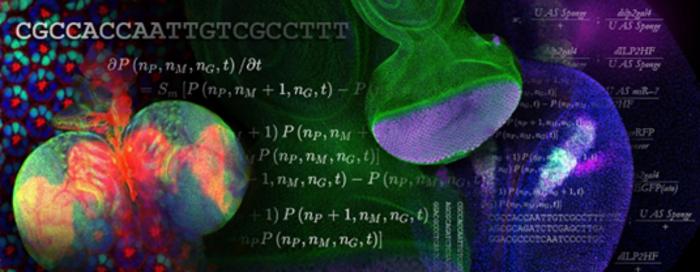
Credit: Richard Carthew/Northwestern University/U.S. National Science Foundation
Building a mathematics-based understanding of biology at all scales of life — from individual cells to interactions between species — is the goal of a new $50 million institute supported by the U.S. National Science Foundation in partnership with the Simons Foundation. The two organizations are each providing $25 million to launch the National Institute for Theory and Mathematics in Biology (NITMB). The institute will bring together experts across the mathematical and biological sciences to explore research challenges related to a broad range of topics and industries, such as the environment, biomedicine and biotechnology.
The institute will be led by Northwestern University in collaboration with the University of Chicago and will conduct interdisciplinary research for at least five years. The overarching aim is to uncover the fundamental principles governing life through the creation of new mathematical theories, data-informed models and computational and statistical tools. The institute will target promising and challenging areas of exploration: how organisms learn and adapt to change, how the functioning of genes and molecular signals produce a fully formed individual from a single cell, how the behavior of living things is generated by neuron-level activity in the brain, and more.
“Breakthroughs in the mathematical sciences have allowed humanity to understand and do things previously thought to be impossible, like safely traveling to the moon or accurately predicting storms,” says NSF Director Sethuraman Panchanathan. “The National Institute for Theory and Mathematics in Biology is a bold effort to further grow the unique power of mathematics and biology to help address some of society’s greatest challenges, like sustainable agriculture, preventing pandemics and mitigating the effects of climate change.”
“As Eugene Wigner famously said, the ‘unreasonable effectiveness of mathematics’ can advance science like nothing else,” says Simons Foundation President David Spergel. “Accordingly, this new institute holds the possibility of transforming our understanding of biology through mathematics. We are pleased to partner with NSF in supporting an effort that will be led by two great institutions and will not only produce great science, but help train a generation of researchers to be bilingual in mathematics and biology.”
Modern advances in the biological sciences have given rise to veritable oceans of available data describing organisms whale-sized to microscopic at all stages of life. That growing body of data presents opportunities for new mathematical approaches for analyzing complex biological data and the development of mathematical models capable of finding as yet unseen aspects of biological phenomena and principles. The institute will serve as a collaborative nexus between mathematical and biological scientists at institutions in several states, including minority-serving institutions and emerging research institutions. Led by NITMB, those institutions will create a national-level community of researchers through joint research projects and other collaborative activities that create new data and novel approaches to biological questions.
Educational outreach and workforce development are also key components of the new institute, which will provide training and mentorship for over 300 undergraduate and graduate students and over 100 early career postdoctoral researchers. The institute will conduct extensive educational outreach activities with local middle school students through a collaboration which pairs grade-school students with graduate student mentors for a full year of hands-on learning and projects. The institute will also train local middle and high school teachers in how to incorporate new mathematical and biological advances into their classroom lessons.
The National Institute for Theory and Mathematics in Biology is supported by NSF through its Mathematical and Physical Sciences Directorate and Biological Sciences Directorate.