In a survey of cat owners, those who fed their cats vegan diets tended to report better health outcomes for their pets than those who provided meat-based diets, though the differences were not statistically significant. Andrew Knight of the University of Winchester, UK, and colleagues present these findings in the open-access journal PLOS ONE on September 13.
Credit: Anne-Lise Paris, www.in-graphidi.com, PLOS, CC-BY 4.0 (https://creativecommons.org/licenses/by/4.0/)
In a survey of cat owners, those who fed their cats vegan diets tended to report better health outcomes for their pets than those who provided meat-based diets, though the differences were not statistically significant. Andrew Knight of the University of Winchester, UK, and colleagues present these findings in the open-access journal PLOS ONE on September 13.
Many pet foods contain cooked meat as the primary protein source, but a growing number of available products use alternative protein sources, such as plants or fungi. Some veterinary professionals have voiced concerns that vegan diets—which lack meat, eggs, and dairy—are less healthy for cats than meat-based diets. However, limited research has examined these concerns.
To help clarify the healthfulness of vegan cat diets, Knight and colleagues analyzed survey responses from 1,369 cat owners who were asked to report about a single cat in their household that had been fed either a vegan or meat-based diet for at least one year. The survey asked participants several questions regarding the cat’s health, followed by questions about its diet. About 9 percent of participants reported feeding their cat a vegan diet, and the rest a meat-based diet.
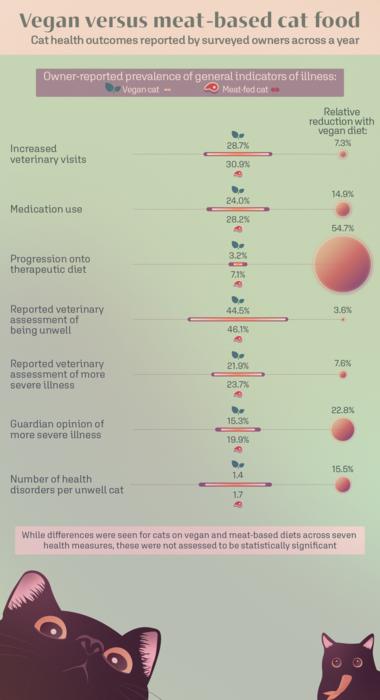
After statistically accounting for other factors that could influence health—such as a cat’s age or whether it is neutered—the researchers found that participants reported that vegan diets were associated with a lower risk of several health indicators, although none of the differences were statistically significant. For instance, compared to owners of cats on meat-based diets, owners of cats on vegan diets tended to report fewer veterinary visits, less medication use, and that their veterinarian would be more likely describe their cat as being healthier. After analysis, there was no statistically significant difference between the reported health indicators of cats on vegan diets and those on meat-based diets.
The survey also asked about 22 specific health disorders; 42 percent of owners of cats on meat-based diets reported at least one disorder, compared to 37 percent of owners of cats on vegan diets.
The researchers say their findings support the healthfulness of vegan diets for cats. They note, however, that they did not analyze the nutrient content of the cats’ diets.
#####
In your coverage please use this URL to provide access to the freely available article in PLOS ONE: https://journals.plos.org/plosone/article?id=10.1371/journal.pone.0284132
Citation: Knight A, Bauer A, Brown H (2023) Vegan versus meat-based cat food: Guardian-reported health outcomes in 1,369 cats, after controlling for feline demographic factors. PLoS ONE 18(9): e0284132. https://doi.org/10.1371/journal.pone.0284132
Author Countries: UK, Australia, Germany
Funding: This research and its publication open access was funded by food awareness organisation ProVeg International (https://proveg.com). AK received this award ID: Oct2019- 0000000286. However, this funder played no role in study conceptualisation, design, data collection and analysis, preparation of the resultant manuscript nor decisions relating to publication. We are grateful for their financial support.
Journal
PLoS ONE
DOI
10.1371/journal.pone.0284132
Method of Research
Survey
Subject of Research
Not applicable
Article Title
Vegan versus meat-based cat food: Guardian-reported health outcomes in 1,369 cats, after controlling for feline demographic factors
Article Publication Date
13-Sep-2023
COI Statement
This research and its publication open access was funded by food awareness organisation ProVeg International (https://proveg.com). AK received this award ID: Oct2019-0000000286. However, this funder played no role in study conceptualisation, design, data collection and analysis, preparation of the resultant manuscript nor decisions relating to publication. This does not alter our adherence to PLOS ONE policies on sharing data and materials.