Researchers from Tokyo Medical and Dental University (TMDU) identify the potential pathological mechanisms of a familial form of Parkinson’s disease, caused by mutations in the CHCHD2 gene
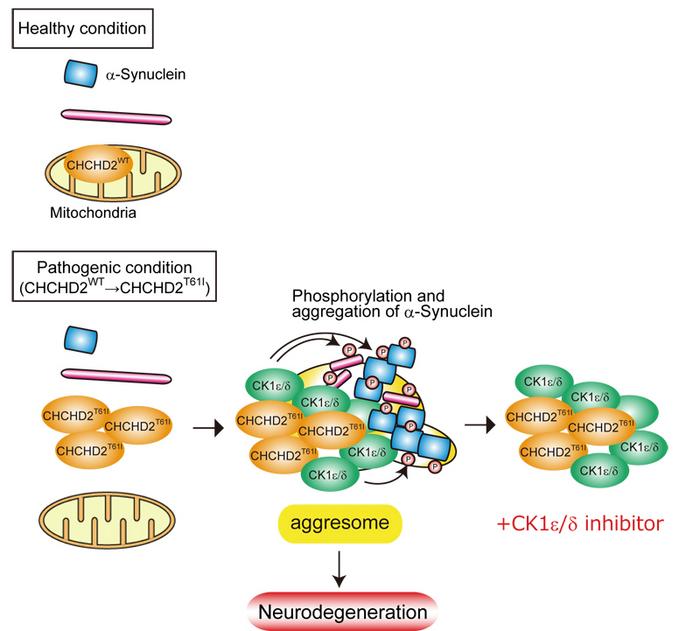
Credit: Department of Pathological Cell Biology, TMDU
Researchers from Tokyo Medical and Dental University (TMDU) identify the potential pathological mechanisms of a familial form of Parkinson’s disease, caused by mutations in the CHCHD2 gene
Tokyo, Japan – Parkinson’s disease, characterized by various motor dysfunctions, is the second most common neurodegenerative disorder in the world. It is known that specific gene mutations that are passed down through families are responsible for some cases of Parkinson’s disease. But now, researchers from Japan have found that this might open the doors to new therapies.
In a study published recently in EMBO Molecular Medicine, researchers from Tokyo Medical and Dental University (TMDU) have identified the cellular processes that likely lead to Parkinson’s disease in patients with mutations in a specific gene.
Motor disorders seen in Parkinson’s disease are caused by the death of cells that produce dopamine—an important molecule for cellular communication—in a brain region known as the substantia nigra. In this region, protein aggregates containing a protein known as alpha-synuclein form. However, the exact cause and the process remains unknown.
Researchers from TMDU decided to investigate these mechanisms in a familial form of Parkinson’s disease caused by mutations in CHCHD2, a gene encoding a specific domain containing two CHCHD2 proteins. To do this, they induced a CHCHD2 mutation in both cell cultures and mice.
“When we looked at normal CHCHD2 protein in cells, it was located in the mitochondria, which provides energy to the cell,” says lead author of the study Satoru Torii. “But the mutant CHCHD2 was expressed in a very different area—in the cell cytosol, where it recruited another protein known as casein kinase 1 epsilon/delta (Csnk1e/d) and led to the aggregation of phosphorylated alpha-synuclein and neurofilaments.”
Because the mutant CHCHD2 caused Parkinson’s disease-related pathology in cells, the researchers investigated its effects in mice using two different methods of expressing mutant CHCHD2. All mice with CHCHD2 mutation had motor impairments, and their brains showed mislocalized CHCHD2 and aggregated alpha-synuclein in the dopamine-producing cells of the substantia nigra. The same observations were made when the research team looked at a postmortem brain of a patient with Parkinson’s disease caused by a CHCHD2 mutation, and in laboratory cell cultures harvested from another patient.
“The most exciting finding for us was that, when we inhibited the associated protein Csnk1e/d, we saw motor improvements and fewer Parkinson’s disease-related symptoms in the Parkinson’s disease model mice, as well as less pathology in cells grown from a patient with a CHCHD2 gene mutation,” explains Shigeomi Shimizu, senior author of the study. “This suggests that it may be possible to delay—or even prevent—Parkinson’s disease development in people with this mutation.”
Given that there are currently no treatments that effectively slow or halt the progression of Parkinson’s disease, the findings of this study are very encouraging, especially for patients with CHCHD2 mutations. The results also improve our understanding of how Parkinson’s disease can develop in the brain and bring hope to all patients and their families.
###
The article, “Involvement of casein kinase 1 epsilon/delta (Csnk1e/d) in the pathogenesis of familial Parkinson’s disease caused by CHCHD2,” was published in EMBO Molecular Medicine at DOI: 10.15252/emmm.202317451
Journal
EMBO Molecular Medicine
DOI
10.15252/emmm.202317451
Article Title
Involvement of casein kinase 1 epsilon/delta (Csnk1e/d) in the pathogenesis of familial Parkinson’s disease caused by CHCHD2