The United States Department of Agriculture’s (USDA) Agricultural Research Service (ARS) scientists and research partners have found a faster, safer, and less expensive way for growers to detect the invasive Lebbeck mealybug, according to a recent study published in Journal of Applied Entomology.
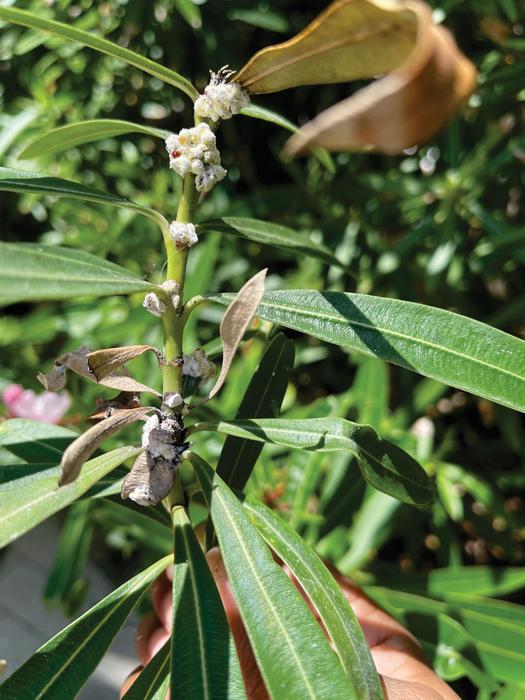
Credit: Muhammad “Zee” Ahmed
The United States Department of Agriculture’s (USDA) Agricultural Research Service (ARS) scientists and research partners have found a faster, safer, and less expensive way for growers to detect the invasive Lebbeck mealybug, according to a recent study published in Journal of Applied Entomology.
The Lebbeck mealybug (Nipaecoccus viridis) feeds on and damages various citrus fruits and ornamental plants, resulting in thousands of dollars in damages. The invasive species is currently in Florida and may eventually spread to other states.
To control Lebbeck mealybug populations and prevent their spread, growers can use field diagnostic kits for early detection to ensure that the tiny pest is indeed a Lebbeck mealybug versus another mealybug species in Florida. A previous study suggested that a 10% potassium hydroxide solution should be used in the diagnostic kits, because the solution turns the hemolymph — the circulating fluid that is similar to blood — of the Lebbeck mealybug green, whereas other mealybug species did not turn green, providing a rapid species confirmation test for all life stages of the Lebbeck mealybug in the field.
However, due to the potential safety hazards associated with potassium hydroxide’s corrosiveness, researchers sought to find a safer alternative for growers.
“It is critical to ensure that any diagnostic tool developed for use in the field is safe for growers, scouts, and other individuals who may come into contact with such tools,” said Muhammad “Zee” Ahmed, ARS research entomologist at the U.S. Horticultural Research Laboratory. “The identification of the pest in its early stages can help growers develop a plan to control the invasive species and thereby reduce the need for pesticides and minimize the impact of pesticide usage on non-target species, especially biological control agents and pollinators as well as the environment.”
In the study, the researchers found that a 5% sodium hydroxide solution successfully turned live specimens of the Lebbeck mealybug green. The results were identical to specimens tested with the 10% potassium hydroxide solution.
According to Ahmed, there are potential benefits to using the 5% sodium hydroxide solution over the 10% potassium hydroxide solution.
“Sodium hydroxide is less corrosive, more water soluble, and less expensive than potassium hydroxide,” said Ahmed. “In addition, sodium hydroxide is commonly used in household cleaning and is publicly acceptable as safe with caution.”
Ahmed and his colleagues Christina Dorado and Cindy McKenzie at the U.S. Horticultural Research Laboratory are working closely with research partners in updating field guides for the diagnostic kits for the Lebbeck mealybug. The kits, which are specific to Florida, will be provided to growers and scouts through diagnostic workshops and the University of Florida Extension offices in the near future.
“The diagnostic workshops and Extension activities will help to build awareness and knowledge among stakeholders, enhancing their ability to detect and manage this invasive pest effectively,” Ahmed said.
The study was done in collaboration with the University of Florida, the California Department of Food and Agriculture, and the USDA’s Animal and Plant Health Inspection Service (APHIS).
The Agricultural Research Service is the U.S. Department of Agriculture’s chief scientific in-house research agency. Daily, ARS focuses on solutions to agricultural problems affecting America. Each dollar invested in U.S. agricultural research results in $20 of economic impact.
Journal
Journal of Applied Entomology
DOI
10.1111/jen.13177
Method of Research
Experimental study
Subject of Research
Not applicable
Article Title
Development of a species-level field diagnostic kit for Nipaecoccus viridis (Newstead) (Hemiptera: Pseudococcidae), an invasive and regulatory pest in the United States
Article Publication Date
22-Aug-2023