• HOME
  • NEWS
  • EXPLORE
    • CAREER
      • Companies
      • Jobs
    • EVENTS
    • iGEM
      • News
      • Team
    • PHOTOS
    • VIDEO
    • WIKI
  • BLOG
  • COMMUNITY
    • FACEBOOK
    • INSTAGRAM
    • TWITTER
Saturday, February 7, 2026
BIOENGINEER.ORG
No Result
View All Result
  • Login
  • HOME
  • NEWS
  • EXPLORE
    • CAREER
      • Companies
      • Jobs
        • Lecturer
        • PhD Studentship
        • Postdoc
        • Research Assistant
    • EVENTS
    • iGEM
      • News
      • Team
    • PHOTOS
    • VIDEO
    • WIKI
  • BLOG
  • COMMUNITY
    • FACEBOOK
    • INSTAGRAM
    • TWITTER
  • HOME
  • NEWS
  • EXPLORE
    • CAREER
      • Companies
      • Jobs
        • Lecturer
        • PhD Studentship
        • Postdoc
        • Research Assistant
    • EVENTS
    • iGEM
      • News
      • Team
    • PHOTOS
    • VIDEO
    • WIKI
  • BLOG
  • COMMUNITY
    • FACEBOOK
    • INSTAGRAM
    • TWITTER
No Result
View All Result
Bioengineer.org
No Result
View All Result
Home NEWS Science News

Tarantulas inspire new structural color with the greatest viewing angle

Bioengineer by Bioengineer
February 7, 2017
in Science News
Reading Time: 2 mins read
0
Share on FacebookShare on TwitterShare on LinkedinShare on RedditShare on Telegram
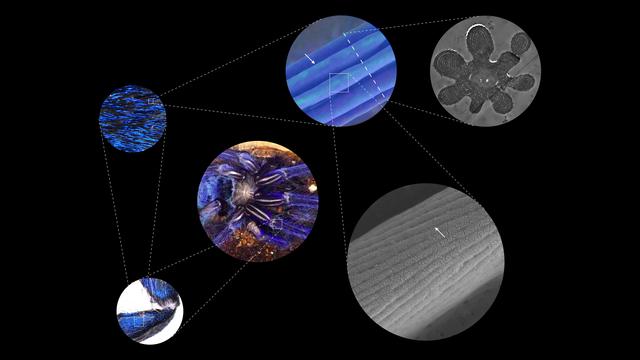
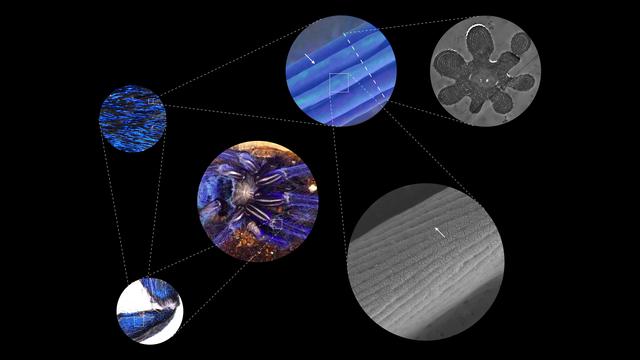
IMAGE

Credit: The University of Akron

Inspired by the hair of blue tarantulas, researchers from The University of Akron lead a team that made a structural-colored material that shows consistent color from all viewing directions. This finding overturns the conventional wisdom that long-range order photonic structures are always iridescent, opening new potential to mass produce structural colors because highly ordered designs are easy to scale-up and manufacture. Bor-Kai (Bill) Hsiung and his colleagues at UA, Ghent University, Karlsruhe Institute of Technology and the University of Nebraska-Lincoln published their research, which is featured on the cover of the January 2017 journal of Advanced Optical Materials.

"Structural colors are more vibrant and durable than the pigments used in most human-made products," explained Hsiung, the lead author of this research and a Biomimicry Fellow in the Integrated Bioscience Ph.D. program at The University of Akron. "They are produced by optical effects when light interacts with nanostructures that are about the same size as the wavelength of light." Think of a peacock, or a butterfly. The problem is that most structural colors are strongly iridescent, changing color when viewed from different angles. It's beautiful out in nature, but not very functional when we're watching television and we move to a new seat."

The team first discovered that many vibrant blue tarantulas do not show iridescence even though the spiders use nanostructures to produce those colors. Since the spider's blue color is not iridescent, Hsiung's team suggested that the same process could be applied to make pigment replacements that never fade, as well as to help reduce glare on wide-angle viewing systems in phones, televisions and other devices.

As they dug deeper, they found that the hairs of some species of blue tarantulas show a special flower-like shape that they hypothesized reduced the iridescent effect resulting from periodic structures. Then, thanks to the crowdfunding push they received earlier, they were able to test this hypothesis using a series of computer simulations and physical prototypes built using cutting-edge nano-3D printing technology.

Their color produced by the 3D printed structures has a viewing angle of 160 degrees, the largest viewing angle of any synthetic structural colors demonstrated.

"These structural colorants could be used as pigment replacements – many of which are toxic – in materials such as plastics, metal, textiles and paper, and for producing color for wide-angle viewing systems such as phones and televisions," Hsiung said.

###

Media Contact

Lisa Craig
[email protected]
330-972-7429
@UAkronNews

http://www.uakron.edu/

############

Story Source: Materials provided by Scienmag
Share12Tweet8Share2ShareShareShare2

Related Posts

Phage-Antibiotic Combo Beats Resistant Peritoneal Infection

February 7, 2026

Boosting Remote Healthcare: Stepped-Wedge Trial Insights

February 7, 2026

Barriers and Boosters of Seniors’ Physical Activity in Karachi

February 7, 2026

Evaluating Pediatric Emergency Care Quality in Ethiopia

February 7, 2026
Please login to join discussion

POPULAR NEWS

  • Robotic Ureteral Reconstruction: A Novel Approach

    Robotic Ureteral Reconstruction: A Novel Approach

    82 shares
    Share 33 Tweet 21
  • Digital Privacy: Health Data Control in Incarceration

    63 shares
    Share 25 Tweet 16
  • Study Reveals Lipid Accumulation in ME/CFS Cells

    57 shares
    Share 23 Tweet 14
  • Breakthrough in RNA Research Accelerates Medical Innovations Timeline

    53 shares
    Share 21 Tweet 13

About

We bring you the latest biotechnology news from best research centers and universities around the world. Check our website.

Follow us

Recent News

Phage-Antibiotic Combo Beats Resistant Peritoneal Infection

Boosting Remote Healthcare: Stepped-Wedge Trial Insights

Barriers and Boosters of Seniors’ Physical Activity in Karachi

Subscribe to Blog via Email

Enter your email address to subscribe to this blog and receive notifications of new posts by email.

Join 73 other subscribers
  • Contact Us

Bioengineer.org © Copyright 2023 All Rights Reserved.

Welcome Back!

Login to your account below

Forgotten Password?

Retrieve your password

Please enter your username or email address to reset your password.

Log In
No Result
View All Result
  • Homepages
    • Home Page 1
    • Home Page 2
  • News
  • National
  • Business
  • Health
  • Lifestyle
  • Science

Bioengineer.org © Copyright 2023 All Rights Reserved.