Micro- and nanodisk lasers have recently emerged as promising optical sources and probes for various applications in the fields of nanophotonics and biomedicine. Their ability to achieve lasing at a deterministic wavelength and ultra-narrowband precision is critical for several applications in on-chip photonic communications, on-chip bioimaging, biochemical sensing, and quantum photonic information processing. However, the large-scale fabrication of such precise wavelength micro- and nanodisk lasers remains challenging. Current nanofabrication processes introduce randomness in the disk diameter, making it difficult to achieve deterministic wavelengths in laser batches.
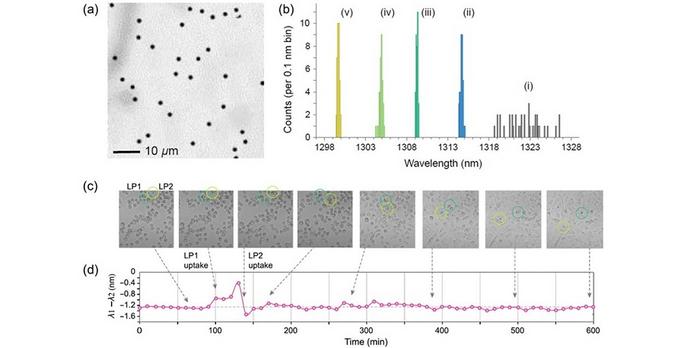
Credit: Sarkar et al., doi 10.1117/1.AP.5.5.056004.
Micro- and nanodisk lasers have recently emerged as promising optical sources and probes for various applications in the fields of nanophotonics and biomedicine. Their ability to achieve lasing at a deterministic wavelength and ultra-narrowband precision is critical for several applications in on-chip photonic communications, on-chip bioimaging, biochemical sensing, and quantum photonic information processing. However, the large-scale fabrication of such precise wavelength micro- and nanodisk lasers remains challenging. Current nanofabrication processes introduce randomness in the disk diameter, making it difficult to achieve deterministic wavelengths in laser batches.
Addressing this issue, a team of researchers from Harvard Medical School and Massachusetts General Hospital’s Wellman Center for Photomedicine has developed an innovative photoelectrochemical (PEC) etching-based technique that facilitates precise tuning of the lasing wavelength of microdisk lasers with subnanometric accuracy. Their work is published in the Gold Open Access journal Advanced Photonics.
The new approach allows for the fabrication of micro- and nano-laser batches with precise and predetermined emission wavelengths. The key to this breakthrough lies in the use of PEC etching, which offers an efficient and scalable way to fine-tune the wavelength of microdisk lasers.
In their work, the team successfully obtained SiO2-capped indium gallium arsenide phosphide microdisks on indium phosphide pillar structures. Then they precisely tuned the lasing wavelengths of these microdisks to deterministic values, by performing photoelectrochemical etching in a diluted sulfuric acid solution. They also examined the mechanism and kinetics underlying the specific PEC etching. Finally, they transferred the wavelength-tuned microdisk arrays onto a polydimethylsiloxane substrate, producing free-standing, isolated laser particles with distinct lasing wavelengths. The resulting microdisks showed lasing emission with an ultranarrow bandwidth of less than 0.6 nm for on-pillar lasers and under 1.5 nm for the isolated particles.
This result opens doors to many new nanophotonic and biomedical applications. For instance, the free-standing microdisk lasers can serve as physical optical barcodes for heterogeneous biological samples, enabling the tagging of specific cell types and the targeting of specific molecules in multiplexed assays.
Cell-type specific tagging is currently performed using conventional biomarkers, such as organic fluorophores, quantum dots, and fluorescent beads, which have broad emission linewidths. As a result, only a few specific cell types can be tagged simultaneously. In contrast, microdisk lasers with their ultra-narrowband light emission would enable simultaneous identification of a larger number of cell types.
Accordingly, the team tested out and successfully demonstrated the precisely tuned microdisk laser particles as biomarkers by using them to tag live normal breast epithelial MCF10A cells in culture. With their ultranarrow bandwidth emission, these lasers can potentially revolutionize biosensing performed using well-established biomedical and optical techniques, such as cell dynamics imaging, flow cytometry, and multi-omics analyses.
The PEC etching-based technique marks a significant advancement of microdisk lasers. The scalable nature of the method, along with its sub-nm accuracy, opens up new possibilities for the myriad applications such lasers find in nanophotonic and biomedical devices as well as in the barcoding of specific cell populations and assay molecules.
For details, read the Gold Open Access article by D. Sarkar et al., “Precise photoelectrochemical tuning of semiconductor microdisk lasers,” Adv. Photon. 5(5), 056004 (2023), doi 10.1117/1.AP.5.5.056004.
Journal
Advanced Photonics
DOI
10.1117/1.AP.5.5.056004
Article Title
Precise photoelectrochemical tuning of semiconductor microdisk lasers
Article Publication Date
1-Sep-2023