

• HOME
  • NEWS
  • EXPLORE
    • CAREER
      • Companies
      • Jobs
    • EVENTS
    • iGEM
      • News
      • Team
    • PHOTOS
    • VIDEO
    • WIKI
  • BLOG
  • COMMUNITY
    • FACEBOOK
    • INSTAGRAM
    • TWITTER
Tuesday, September 1, 2026
BIOENGINEER.ORG
No Result
View All Result
  • Login
  • HOME
  • NEWS
  • EXPLORE
    • CAREER
      • Companies
      • Jobs
        • Lecturer
        • PhD Studentship
        • Postdoc
        • Research Assistant
    • EVENTS
    • iGEM
      • News
      • Team
    • PHOTOS
    • VIDEO
    • WIKI
  • BLOG
  • COMMUNITY
    • FACEBOOK
    • INSTAGRAM
    • TWITTER
  • HOME
  • NEWS
  • EXPLORE
    • CAREER
      • Companies
      • Jobs
        • Lecturer
        • PhD Studentship
        • Postdoc
        • Research Assistant
    • EVENTS
    • iGEM
      • News
      • Team
    • PHOTOS
    • VIDEO
    • WIKI
  • BLOG
  • COMMUNITY
    • FACEBOOK
    • INSTAGRAM
    • TWITTER
No Result
View All Result
Bioengineer.org
No Result
View All Result
Home NEWS Science News Chemistry

FAIR data and inclusive science to enable clean energy

Bioengineer by Bioengineer
September 1, 2023
in Chemistry
Reading Time: 3 mins read
0
Auburn scientists receive a DOE award to accelerate fusion energy research
Share on FacebookShare on TwitterShare on LinkedinShare on RedditShare on Telegram

Fusion is the process of combining two light atomic nuclei to form a single heavier one while releasing massive amounts of energy. The Sun and all stars are powered through fusion, which makes it the universe’s preferred method of producing energy. Recent breakthroughs in fusion research have led to the US government’s Bold Vision for Commercial Fusion Energy and the remarkable growth of the global fusion industry.
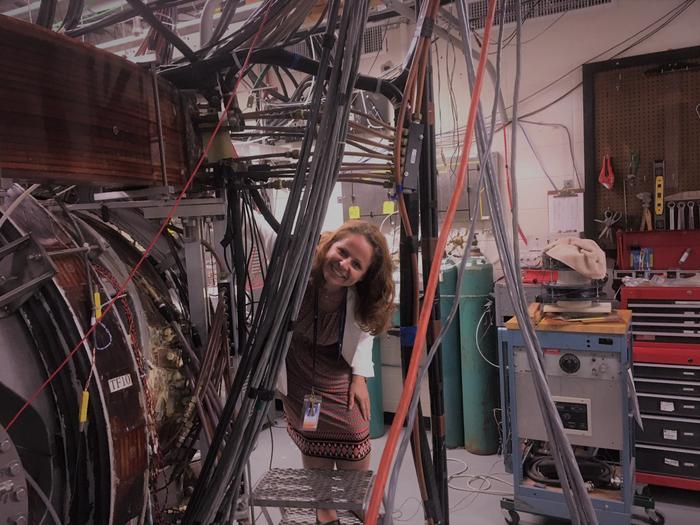
Auburn scientists receive a DOE award to accelerate fusion energy research

Credit: Photo by: Dr. David Maurer (CTH PI)

Fusion is the process of combining two light atomic nuclei to form a single heavier one while releasing massive amounts of energy. The Sun and all stars are powered through fusion, which makes it the universe’s preferred method of producing energy. Recent breakthroughs in fusion research have led to the US government’s Bold Vision for Commercial Fusion Energy and the remarkable growth of the global fusion industry.

To accelerate the development of fusion-powered reactors on Earth, the US Department of Energy has selected a collaboration among researchers at MIT (as lead), Auburn University, William & Mary, University of Wisconsin-Madison, and the HDF Group to receive close to $5 million in funding. The project will develop a platform where data from different fusion devices, including Auburn’s Compact Toroidal Hybrid (CTH), is managed according to Findable, Interoperable, Accessible, and Reusable (FAIR) standards and UNESCO’s Open Science (OS) recommendations. The data will also be adapted for use with machine learning (ML) tools. The platform’s databases will be built using MDSplusML, an upgraded version of the MDSplus open-source software developed by MIT’s Plasma Science and Fusion Center researchers in the ’80s to catalog the results of the Alcator C-Mod’s experiments. Today, nearly 40 fusion research institutes use MDSplus to store and provide external access to their fusion data. The release of MDSplusML will enable free exchange of data and models across institutions, thus speeding up progress in fusion research.

The Auburn portion of the project is led by Dr. Evdokiya (Eva) Kostadinova, an Assistant Professor in the Physics Department, who specializes in interdisciplinary plasma research. Kostadinova and her students will collaborate with Dr. David Maurer, an Associate Professor in the Physics Department and head of CTH. In Auburn’s CTH experiment, magnetic fields can be shaped in different ways to confine a hot plasma – the state of matter in which fusion reactions occur. Open-sourcing CTH data and adapting it for use with ML tools will allow researchers to explore various concepts for fusion reactors. On the significance of this award, Kostadinova comments, “Fusion research has made remarkable progress, which is evident from multiple exciting results from experiments worldwide. However, true breakthroughs rely on strong collaborations committed to open science and a diversity of viewpoints. This project will enable such collaborations and will allow us to use machine learning to uncover fundamental science hidden in big datasets.”

In addition to being a cross-institutional collaboration between four universities and an industry partner, the project also includes a strong focus on workforce development. With four out of five PIs being women scientists, the team hopes to inspire and encourage diversity in the next generation of fusion scientists. To make this a reality, each year of the project the College of William and Mary will host a summer school where undergraduate students will learn how to employ ML techniques in fusion research. On the role of diverse leadership, the MIT lead, Dr. Cristina Rea, says, “Having the opportunity to lead such an important project is extremely meaningful, and I feel a responsibility to show that women are leaders in STEM. We have an incredible team, strongly motivated to improve our fusion ecosystem and to contribute to making fusion energy a reality.”


Share12Tweet8Share2ShareShareShare2

Related Posts

β-Sitosterol from Ipomoea carnea Jacq. As a promising anti-inflammatory agent: Evidence from in silico modeling and in vitro validation

β-Sitosterol from Ipomoea carnea Jacq. As a promising anti-inflammatory agent: Evidence from in silico modeling and in vitro validation

August 31, 2026
Graded membranes point to a sustainable route for refining complex petroleum

Graded membranes point to a sustainable route for refining complex petroleum

August 31, 2026

Round-robin tests quantify catalyst activity and deactivation in CO2 hydrogenation modelling

August 30, 2026

Researchers reveal guiding principles for electrochemical synthesis of multimetallic nanocrystals

August 30, 2026

POPULAR NEWS

  • β-Sitosterol from Ipomoea carnea Jacq. As a promising anti-inflammatory agent: Evidence from in silico modeling and in vitro validation

    29 shares
    Share 12 Tweet 7
  • Design, fabrication and characterization of a wearable Fiber Bragg grating sensor for cardiorespiratory monitoring using finger plethysmography

    29 shares
    Share 12 Tweet 7
  • KAIST opens the era of industrial-scale microbial foods, proposing growth strategies for the next-generation protein market

    29 shares
    Share 12 Tweet 7
  • Virologist awarded $2 million NIH grant to investigate how virus-infected cells live and die

    29 shares
    Share 12 Tweet 7

About

We bring you the latest biotechnology news from best research centers and universities around the world. Check our website.

Follow us

Recent News

β-Sitosterol from Ipomoea carnea Jacq. As a promising anti-inflammatory agent: Evidence from in silico modeling and in vitro validation

Design, fabrication and characterization of a wearable Fiber Bragg grating sensor for cardiorespiratory monitoring using finger plethysmography

KAIST opens the era of industrial-scale microbial foods, proposing growth strategies for the next-generation protein market

Subscribe to Blog via Email

Enter your email address to subscribe to this blog and receive notifications of new posts by email.

Join 85 other subscribers
  • Contact Us

Bioengineer.org © Copyright 2023 All Rights Reserved.

Welcome Back!

Login to your account below

Forgotten Password?

Retrieve your password

Please enter your username or email address to reset your password.

Log In
No Result
View All Result
  • Homepages
    • Home Page 1
    • Home Page 2
  • News
  • National
  • Business
  • Health
  • Lifestyle
  • Science

Bioengineer.org © Copyright 2023 All Rights Reserved.