• HOME
  • NEWS
  • EXPLORE
    • CAREER
      • Companies
      • Jobs
    • EVENTS
    • iGEM
      • News
      • Team
    • PHOTOS
    • VIDEO
    • WIKI
  • BLOG
  • COMMUNITY
    • FACEBOOK
    • INSTAGRAM
    • TWITTER
Tuesday, November 24, 2026
BIOENGINEER.ORG
No Result
View All Result
  • Login
  • HOME
  • NEWS
  • EXPLORE
    • CAREER
      • Companies
      • Jobs
        • Lecturer
        • PhD Studentship
        • Postdoc
        • Research Assistant
    • EVENTS
    • iGEM
      • News
      • Team
    • PHOTOS
    • VIDEO
    • WIKI
  • BLOG
  • COMMUNITY
    • FACEBOOK
    • INSTAGRAM
    • TWITTER
No Result
View All Result
Bioengineer.org
No Result
View All Result
Home NEWS Science News Chemistry

Weakly-solvating electrolyte enables ultralow temperature (-80 ℃) and high-power CFx/Li primary batteries

Bioengineer by Bioengineer
August 22, 2023
in Chemistry
Reading Time: 2 mins read
0
Weakly-Solvating Electrolyte Enables Ultralow Temperature (-80 ℃) and High-Power CFx/Li Primary Batteries
Share on FacebookShare on TwitterShare on LinkedinShare on RedditShare on Telegram

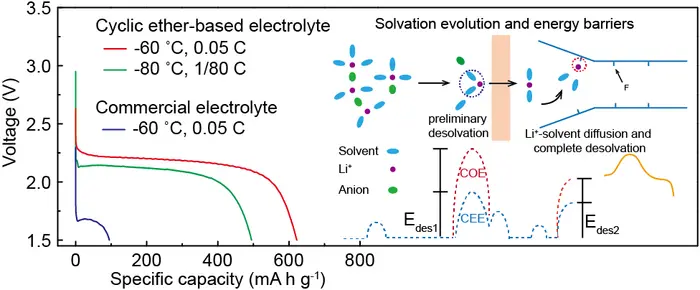
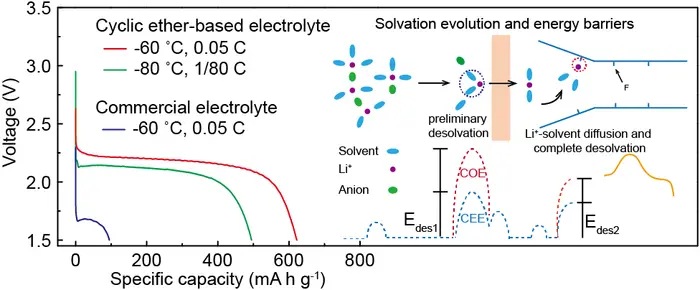
By selecting low melting point solvents and suitable salts and precisely tailoring Li+-coordinated environment via integration of low-affinity solvents with moderate anions, the weakly solvating cyclic ether-based electrolyte is introduced to significantly decrease desolvation activation energies and facilitate reaction kinetics, which are proved by Molecular dynamics and binding energy calculation .
Weakly-Solvating Electrolyte Enables Ultralow Temperature (-80 ℃) and High-Power CFx/Li Primary Batteries

Credit: ©Science China Press

By selecting low melting point solvents and suitable salts and precisely tailoring Li+-coordinated environment via integration of low-affinity solvents with moderate anions, the weakly solvating cyclic ether-based electrolyte is introduced to significantly decrease desolvation activation energies and facilitate reaction kinetics, which are proved by Molecular dynamics and binding energy calculation .

Discharged until 1.5V cut-off voltage, the assembled CFx/Li batteries yield 723, 652, and 495 mA h g-1 provided with average output voltages of 2.26, 2.22, and 2.11 V at -40, -60, and -80 °C, corresponding to energy densities of 1634, 1447 and 1044 W h kg-1, the best performances among current organic liquid electrolyte to the best of our knowledge. The higher capacity retention up to 82 % is produced at a discharge rate of 15 C (25°C). To further testify potential for practical applications, the assembled CFx/Li cells with high load increased to 18-22 mg cm-2 still show energy densities of 1683 and 1395 W h kg-1 at -40 and -60˚C

Researchers propose powerful strategy for electrolyte modification with cost-effectiveness and practical scalability, which has unexploited application value and favorable exploitation foreground for ultralow-temperature primary battery


See the article:

Weakly-Solvating Electrolyte Enables Ultralow Temperature (-80 ℃) and High-Power CFx/Li Primary Batteries

https://doi.org/10.1007/s11426-023-1638-0


Journal

Science China Chemistry

DOI

10.1007/s11426-023-1638-0

Share12Tweet8Share2ShareShareShare2

Related Posts

Radiation and Non-Newtonian Yield Stress Dictate Rotating Casson Nanofluid Transport

Radiation and Non-Newtonian Yield Stress Dictate Rotating Casson Nanofluid Transport

November 24, 2026
Indium Phosphide Quantum Dots Enable Cadmium-Free Solar Photocatalysis Through Interfacial Engineering

Indium Phosphide Quantum Dots Enable Cadmium-Free Solar Photocatalysis Through Interfacial Engineering

November 24, 2026

Layered Chemical and Computational Strategies Boost DNA Origami Stability Over Thousand-Fold

November 24, 2026

Engineered MXene Hybrid Adsorbents Selectively Remove Fluoride from Saline Waters

November 24, 2026

POPULAR NEWS

  • Suppression of FOXO3a Drives Pancreatic Cancer Progression via WNT Signaling Activation

    Suppression of FOXO3a Drives Pancreatic Cancer Progression via WNT Signaling Activation

    29 shares
    Share 12 Tweet 7
  • Pelvic MRI and Serum Adipokines Predict Postoperative Endometrial Cancer Recurrence Risk

    29 shares
    Share 12 Tweet 7
  • Migrating Bacteriocytes Deliver Symbiotic Bacteria to Cockroach Ovaries During Nymphal Development

    29 shares
    Share 12 Tweet 7
  • Nixtamalized Bean Flours Boost Protein and Calcium in Composite Maize Tortillas

    29 shares
    Share 12 Tweet 7

About

We bring you the latest biotechnology news from best research centers and universities around the world. Check our website.

Follow us

Recent News

Single-Cell Analysis Reveals TSLP-Producing Basal Epithelial State in Nasal Polyps

Sports Doctors Identify Critical Barriers to Elite Athlete Cardiac Screening

Multimodal Transformer Model Enhances Arrhythmia Detection Across Cloud and Edge Systems

Subscribe to Blog via Email

Enter your email address to subscribe to this blog and receive notifications of new posts by email.

Join 89 other subscribers
  • Contact Us

Bioengineer.org © Copyright 2023 All Rights Reserved.

Welcome Back!

Login to your account below

Forgotten Password?

Retrieve your password

Please enter your username or email address to reset your password.

Log In
No Result
View All Result
  • Homepages
    • Home Page 1
    • Home Page 2
  • News
  • National
  • Business
  • Health
  • Lifestyle
  • Science

Bioengineer.org © Copyright 2023 All Rights Reserved.