• HOME
  • NEWS
  • EXPLORE
    • CAREER
      • Companies
      • Jobs
    • EVENTS
    • iGEM
      • News
      • Team
    • PHOTOS
    • VIDEO
    • WIKI
  • BLOG
  • COMMUNITY
    • FACEBOOK
    • INSTAGRAM
    • TWITTER
Sunday, May 31, 2026
BIOENGINEER.ORG
No Result
View All Result
  • Login
  • HOME
  • NEWS
  • EXPLORE
    • CAREER
      • Companies
      • Jobs
        • Lecturer
        • PhD Studentship
        • Postdoc
        • Research Assistant
    • EVENTS
    • iGEM
      • News
      • Team
    • PHOTOS
    • VIDEO
    • WIKI
  • BLOG
  • COMMUNITY
    • FACEBOOK
    • INSTAGRAM
    • TWITTER
  • HOME
  • NEWS
  • EXPLORE
    • CAREER
      • Companies
      • Jobs
        • Lecturer
        • PhD Studentship
        • Postdoc
        • Research Assistant
    • EVENTS
    • iGEM
      • News
      • Team
    • PHOTOS
    • VIDEO
    • WIKI
  • BLOG
  • COMMUNITY
    • FACEBOOK
    • INSTAGRAM
    • TWITTER
No Result
View All Result
Bioengineer.org
No Result
View All Result
Home NEWS Science News Chemistry

New study offers information on bone regeneration and osteoporosis in the light of evolution

Bioengineer by Bioengineer
August 17, 2023
in Chemistry
Reading Time: 2 mins read
0
The Phylobone project, image
Share on FacebookShare on TwitterShare on LinkedinShare on RedditShare on Telegram

A new study of the PhyloBone project of the University of Turku, Finland, identifies hundreds of non-collagenous proteins in the bone matrix that may play regulatory roles in bone formation and regeneration. The study opens the door to new treatments and preventive measures for bone regeneration and osteoporosis research.
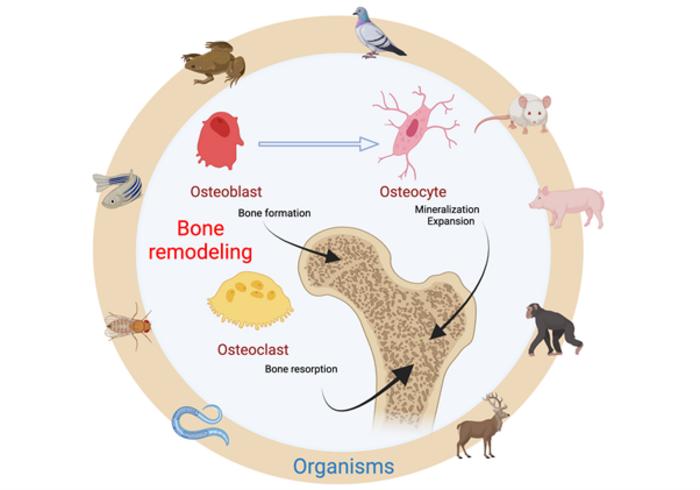
The Phylobone project, image

Credit: PhyloBone project, University of Turku

A new study of the PhyloBone project of the University of Turku, Finland, identifies hundreds of non-collagenous proteins in the bone matrix that may play regulatory roles in bone formation and regeneration. The study opens the door to new treatments and preventive measures for bone regeneration and osteoporosis research.

Osteoporosis is one of the most common bone problems in the elderly population worldwide. Approximately 9 million fractures per year — on average, one every three seconds — are caused by osteoporosis, which contributes significantly to morbidity and mortality rates in developed countries. Given that life expectancy is increasing globally, osteoporosis has become an emerging topic, as it significantly affects the quality of life of individuals in most countries.

“Our PhyloBone project utilises a novel approach, based on evolutionary biology principles, to study bone formation, that will substantially contribute to the identification of molecular mechanisms and novel drug targets”, says Dr. Pere Puigbò, co-principal investigator of the PhyloBone project.

Since the bone matrix, which forms most of the mass of the bone, plays both structural and regulatory roles, non-collagenous organic components have a key function in bone regulation. It is known for example that few non-collagenous proteins, such as osteopontin, play a major role in bone formation. However, the bone matrix is composed of hundreds of proteins that are poorly understood and may play a major regulatory role in bone regeneration and osteoporosis.

“Our project has identified 255 proteins in 30 species of vertebrates. The goal of the project is to serve as a valuable resource for further investigations in the areas of bone regeneration, osteoporosis, and related fields”, says Dr. Puigbò.

The PhyloBone project’s database has been published in the journal Bone Research. This project, funded by the Sigrid Jusélius Foundation and the Japan Society for the Promotion of Science, provides  the most comprehensive resource of bone matrix proteins in human and model organisms, and will have an impact in research fields such as bone regeneration, osteoporosis, and mechanobiology.

“Our study indicates that several non-collagenous proteins are determinants to regulate bone formation and regeneration”, says Dr. Miho Nakamura, co-principal investigator of the PhyloBone project.

“In future developments of the project, we expect to have experimental evidence on the regulatory role of several bone proteins in bone regeneration and osteoporosis”, Dr. Nakamura adds.


Journal

Bone Research

DOI

10.1038/s41413-023-00281-w

Article Title

) Phylobone: A comprehensive database of bone extracellular matrix proteins in human and model organisms

Article Publication Date

15-Aug-2023

Share12Tweet8Share2ShareShareShare2

Related Posts

Transforming Microalgae Waste into High-Performance Membranes for Enhanced Municipal Wastewater Treatment — Chemistry

Transforming Microalgae Waste into High-Performance Membranes for Enhanced Municipal Wastewater Treatment

May 29, 2026
Hydrochar Transforms Agricultural Waste into a Potent Solution for Healthier, Carbon-Rich Soils — Chemistry

Hydrochar Transforms Agricultural Waste into a Potent Solution for Healthier, Carbon-Rich Soils

May 29, 2026

FAPESP Aims to Strengthen Scientific Collaboration Between São Paulo and the United Kingdom

May 29, 2026

Mild Ketone-to-Ketyl Conversion Enables Redox-Neutral Coupling

May 29, 2026

POPULAR NEWS

  • ESMO 2025: mRNA COVID Vaccines Enhance Efficacy of Cancer Immunotherapy

    319 shares
    Share 128 Tweet 80
  • Multi-Hospital Study Reveals Long Covid Burden Is Twice as High as Current Estimates

    81 shares
    Share 32 Tweet 20
  • Common Food Preservatives Associated with Elevated Blood Pressure and Increased Heart Disease Risk

    56 shares
    Share 22 Tweet 14
  • AI-Powered Atlas Uncovers Extensive Whole-Body Damage Linked to Obesity

    53 shares
    Share 21 Tweet 13

About

We bring you the latest biotechnology news from best research centers and universities around the world. Check our website.

Follow us

Recent News

Impact of Immigration Restrictions on the US Healthcare Workforce

Study Reveals Cancer Diagnostic Delays Linked to Population-Based Screening Using Cell-Free DNA Multicancer Early Detection Test

Innovative AI Technique Predicts Radiation Dosage Prior to Treatment in Advanced Prostate Cancer

Subscribe to Blog via Email

Enter your email address to subscribe to this blog and receive notifications of new posts by email.

Join 82 other subscribers
  • Contact Us

Bioengineer.org © Copyright 2023 All Rights Reserved.

Welcome Back!

Login to your account below

Forgotten Password?

Retrieve your password

Please enter your username or email address to reset your password.

Log In
No Result
View All Result
  • Homepages
    • Home Page 1
    • Home Page 2
  • News
  • National
  • Business
  • Health
  • Lifestyle
  • Science

Bioengineer.org © Copyright 2023 All Rights Reserved.