Long-lived quantum state points the way to solving a mystery in radioactive nuclei
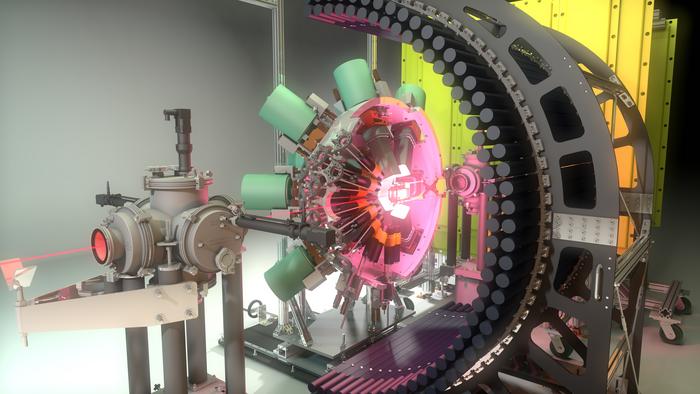
Credit: Gary Hollenhead, Toby King and Adam Malin/ORNL, U.S. Dept. of Energy
Long-lived quantum state points the way to solving a mystery in radioactive nuclei
Timothy Gray of the Department of Energy’s Oak Ridge National Laboratory led a study that may have revealed an unexpected change in the shape of an atomic nucleus. The surprise finding could affect our understanding of what holds nuclei together, how protons and neutrons interact and how elements form.
“We used radioactive beams of excited sodium-32 nuclei to test our understanding of nuclear shapes far from stability and found an unexpected result that raises questions about how nuclear shapes evolve,” said Gray, a nuclear physicist. The results are published in Physical Review Letters.
The shapes and energies of atomic nuclei can shift over time between different configurations. Typically, nuclei live as quantum entities that have either spherical or deformed shapes. The former look like basketballs, and the latter resemble American footballs.
How shapes and energy levels relate is a major open question for the scientific community. Nuclear structure models have trouble extrapolating to regions with little experimental data.
For some exotic radioactive nuclei, the shapes predicted by traditional models are the opposite of those observed. Radioactive nuclei that were expected to be spherical in their ground states, or lowest-energy configurations, turned out to be deformed.
What can turn a quantum state on its head?
In principle, the energy of an excited deformed state can drop below that of a spherical ground state, making the spherical shape the high-energy one. Unexpectedly, this role reversal appears to be happening for some exotic nuclei when the natural ratio of neutrons to protons becomes unbalanced. Yet, the post-reversal excited spherical states have never been found. It is as though once the ground state becomes deformed, all the excited states do, too.
Many examples exist of nuclei with spherical ground states and deformed excited states. Similarly, plenty of nuclei have deformed ground states and subsequent excited states that are also deformed — sometimes with different amounts or kinds of deformation. However, nuclei with both deformed ground states and spherical excited states are much more elusive.
Using data collected in 2022 from the first experiment at the Facility for Rare Isotope Beams, or FRIB, a DOE Office of Science user facility at Michigan State University, Gray’s team discovered a long-lived excited state of radioactive sodium-32. The newly observed excited state has an unusually long lifetime of 24 microseconds — about a million times longer than a typical nuclear excited state.
Long-lived excited states are called isomers. A long lifetime indicates that something unanticipated is going on. For example, if the excited state is spherical, a difficulty in returning to a deformed ground state could account for its long life.
The study involved 66 participants from 20 universities and national laboratories. Co-principal investigators came from Lawrence Berkeley National Laboratory, Florida State University, Mississippi State University, the University of Tennessee, Knoxville, and ORNL.
The 2022 experiment that generated the data used for the 2023 result employed the FRIB Decay Station initiator, or FDSi, a modular multidetector system that is extremely sensitive to rare isotope decay signatures.
“FDSi’s versatile combination of detectors shows that the long-lived excited state of sodium-32 is delivered within the FRIB beam and that it then decays internally by emitting gamma rays to the ground state of the same nucleus,” said ORNL’s Mitch Allmond, a co-author of the paper who manages the FDSi project.
To stop FRIB’s highly energetic radioactive beam, which travels at about 50% of the speed of light, an implantation detector built by UT Knoxville was positioned at FDSi’s center. North of the beam line was a gamma-ray detector array called DEGAi, comprising 11 germanium clover-style detectors and 15 fast-timing lanthanum bromide detectors. South of the beam line were 88 modules of a detector called NEXTi to measure time of flight of neutrons emitted in radioactive decay.
A beam of excited sodium-32 nuclei stopped in the detector and decayed to the deformed ground state by emitting gamma rays. Analysis of gamma-ray spectra to discern the time difference between beam implantation and gamma-ray emission revealed how long the excited state existed. The new isomer’s 24-microsecond existence was the longest lifetime seen among isomers with 20 to 28 neutrons that decay by gamma-ray emission. Approximately 1.8% of the sodium-32 nuclei were observed to be the new isomer.
“We can come up with two different models that equally well explain the energies and lifetime that we’ve observed in the experiment,” Gray said.
An experiment with higher beam power is needed to determine whether the excited state in sodium-32 is spherical. If it is, then the state would have six quantized units of angular momentum, which is a quality of a nucleus related to its whole-body rotation or the orbital motion of its individual protons and/or neutrons about the center of mass. However, if the excited state in sodium-32 is deformed, then the state would have zero quantized units of angular momentum.
A planned upgrade to FRIB will provide more power, increasing the number of nuclei in the beam. Data from the more intense beam will enable an experiment that distinguishes between the two possibilities.
“We’d characterize correlations between the angles of two gamma rays that are emitted in a cascade,” Gray said. “The two possibilities have very different angular correlations between the gamma rays. If we have enough statistics, we could disentangle the pattern that reveals a clear answer.”
The title of the paper is “Microsecond Isomer at the N=20 Island of Shape Inversion Observed at FRIB.”
DOE’s Office of Science supported the work.
UT-Battelle manages ORNL for DOE’s Office of Science, the single largest supporter of basic research in the physical sciences in the United States. The Office of Science is working to address some of the most pressing challenges of our time. For more information, please visit energy.gov/science. — Dawn Levy
Journal
Physical Review Letters
DOI
10.1103/PhysRevLett.130.242501
Method of Research
Data/statistical analysis
Subject of Research
Not applicable
Article Title
Microsecond Isomer at the N = 20 Island of Shape Inversion Observed at FRIB
Article Publication Date
13-Jun-2023