A new study of mice and lab-grown human colon “organoids” indicates that an experimental drug developed by Johns Hopkins Medicine researchers can substantially reduce symptoms of inflammatory bowel disease (IBD) in pre-clinical models.
Credit: Image reproduced with permission from authors
A new study of mice and lab-grown human colon “organoids” indicates that an experimental drug developed by Johns Hopkins Medicine researchers can substantially reduce symptoms of inflammatory bowel disease (IBD) in pre-clinical models.
The experimental drug, given orally, inhibits a gut enzyme that is overproduced in people and in animal models of IBD, a disorder estimated by the U.S. Centers for Disease Control and Prevention to afflict more than 3 million adult Americans.
A report on the new study was published Aug. 9 in Science Translational Medicine.
IBD, a disease category that includes Crohn’s disease and ulcerative colitis, is an autoimmune disorder marked by immune system cells that overreact and attack healthy tissue. The process results in chronic inflammation of the gut, abdominal pain, diarrhea, weight loss and rectal bleeding. Current treatments rely mostly on anti-inflammatory drugs such as steroids, along with other immune system suppressors, diet and lifestyle changes, or surgery to remove or bypass diseased intestinal tissue. However, many people with IBD experience debilitating symptoms even with treatment.
“There is a huge need to develop new therapies for IBD patients because about 40% are not benefiting from current treatments,” says Barbara Slusher, Ph.D., M.A.S., director of the Johns Hopkins Drug Discovery program, professor of neurology at the Johns Hopkins University School of Medicine, and the study’s senior and corresponding author. “The idea that we’ve discovered a brand new therapeutic target and successfully developed a well-tolerated and efficacious pill to inhibit the target is really exciting.”
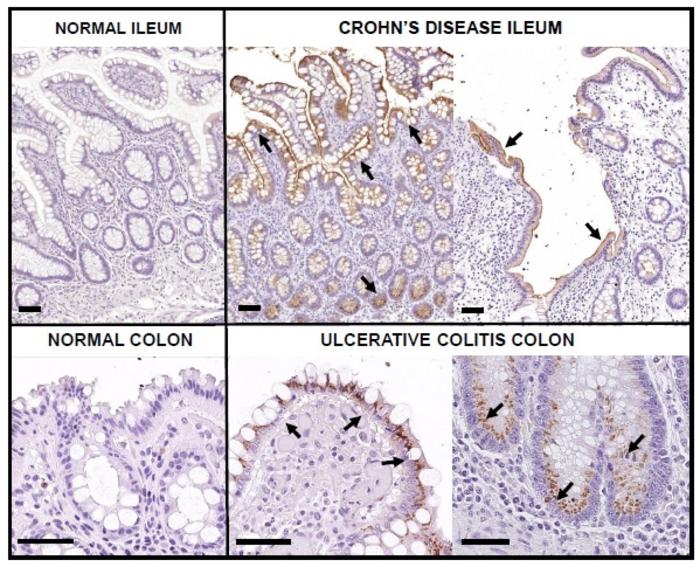
Slusher explains that the activity of the target enzyme, gastrointestinal glutamate carboxypeptidase II (GCPII), is highly upregulated in patients with IBD compared to people without the disorder.
“Our new GCPII inhibitor drug was designed to be gut restricted, meaning it stays in the gut with minimal exposure to the rest of the body when given orally,” says Rana Rais, Ph.D., associate professor of neurology and the director of drug metabolism and pharmacokinetics for Johns Hopkins Drug Discovery. “This targets gastrointestinal GCPII while limiting systemic side effects.”.
In the new studies, (S)-IBD3540, the experimental GCPII-inhibiting drug Slusher and her team developed, was tested in two mouse models of colitis. Results showed that the drug blocked about 75% of the colon GCPII activity. As a result, the treated animals showed improved stool consistency, less rectal bleeding and decreased colon inflammation, with no apparent adverse side effects. The drug also showed protective results when tested in a human colon organoid injury model grown from patient biopsy tissues.
“This is the first demonstration of an oral GCPII inhibitor protecting gut function,” says Diane Peters, D.V.M., Ph.D., M.S., assistant professor of pharmacology and molecular sciences and first author of the study. “(S)-IBD3540’s efficacy in mice and human pre-clinical models, with no evidence of toxicity, is highly encouraging.”
In a 2016 study, a Johns Hopkins University team led by Slusher was the first to identify that GCPII enzymatic activity in the gut was elevated up to 4,100% in patients with IBD, and that inhibiting the excess activity was robustly therapeutic in multiple murine IBD models.
“While we are still trying to understand exactly why this enzyme is upregulated in IBD patients, we are hopeful our robust efficacy results in mice and human organoids will translate to people with IBD,” says Slusher.
Slusher says the researchers are conducting more pre-clinical studies in order to move (S)-IBD3540 into clinical studies.
Other researchers are Lauren Norris, Lukas Tenora, IvanŠnajdr, Andras Ponti, Xiaolei Zhu, Shinji Sakamoto, Vijayabhaskar Veeravalli, Manisha Pradhan, Arindom Pal, Ajit Thomas, Pavel Majer and Christine McDonald.
Funding for this research came from the Crohn’s & Colitis Foundation, the National Institutes of Health and Cure 4 IBD.
The Slusher Lab is also working with Blackbird Laboratories, a non-profit technology development platform based in Baltimore, Maryland that supports the formation and growth of startup companies. The collaboration with Blackbird Labs will support additional preclinical studies to advance (S)-IBD3540.
Authors Slusher and Rais are inventors on a Johns Hopkins patent application covering the use of GCPII inhibitors as IBD therapeutics (PCT/US2015/044025). Authors Slusher, Rais, Majer, Tenora, Šnajdr and Peters are listed as inventors on a composition of matter patent application covering (S)-IBD3540 (PCT/US2021/015732). This arrangement has been reviewed and approved by The Johns Hopkins University in accordance with its conflict-of-interest policies.
Journal
Science Translational Medicine