• HOME
  • NEWS
  • EXPLORE
    • CAREER
      • Companies
      • Jobs
    • EVENTS
    • iGEM
      • News
      • Team
    • PHOTOS
    • VIDEO
    • WIKI
  • BLOG
  • COMMUNITY
    • FACEBOOK
    • INSTAGRAM
    • TWITTER
Monday, August 31, 2026
BIOENGINEER.ORG
No Result
View All Result
  • Login
  • HOME
  • NEWS
  • EXPLORE
    • CAREER
      • Companies
      • Jobs
        • Lecturer
        • PhD Studentship
        • Postdoc
        • Research Assistant
    • EVENTS
    • iGEM
      • News
      • Team
    • PHOTOS
    • VIDEO
    • WIKI
  • BLOG
  • COMMUNITY
    • FACEBOOK
    • INSTAGRAM
    • TWITTER
  • HOME
  • NEWS
  • EXPLORE
    • CAREER
      • Companies
      • Jobs
        • Lecturer
        • PhD Studentship
        • Postdoc
        • Research Assistant
    • EVENTS
    • iGEM
      • News
      • Team
    • PHOTOS
    • VIDEO
    • WIKI
  • BLOG
  • COMMUNITY
    • FACEBOOK
    • INSTAGRAM
    • TWITTER
No Result
View All Result
Bioengineer.org
No Result
View All Result
Home NEWS Science News Chemistry

Course correction keeps Parker Solar Probe on track for Venus flyby

Bioengineer by Bioengineer
August 10, 2023
in Chemistry
Reading Time: 2 mins read
0
Parker Solar Probe
Share on FacebookShare on TwitterShare on LinkedinShare on RedditShare on Telegram

NASA’s Parker Solar Probe executed a short maneuver on Aug. 3, 2023, that kept the spacecraft on track to hit the aim point for the mission’s sixth Venus flyby on Monday, Aug. 21, 2023. ​
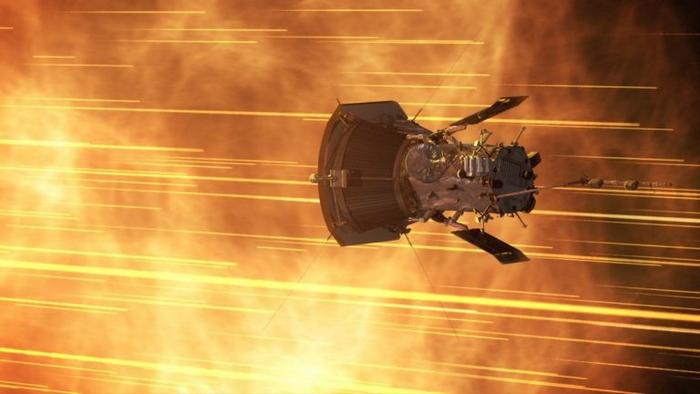
Parker Solar Probe

Credit: NASA’s Goddard Space Flight Center

NASA’s Parker Solar Probe executed a short maneuver on Aug. 3, 2023, that kept the spacecraft on track to hit the aim point for the mission’s sixth Venus flyby on Monday, Aug. 21, 2023. ​

Operating on preprogrammed commands from mission control at the Johns Hopkins Applied Physics Laboratory (APL) in Laurel, Maryland, Parker fired its small thrusters for 4.5 seconds, enough to adjust its trajectory by 77 miles and speed up – by 1.4 seconds – its closest approach to Venus. The precise timing and position are critical to that flyby, the sixth of seven approaches in which Parker uses the planet’s gravity to tighten its orbit around the Sun.

“Parker’s velocity is about 8.7 miles per second, so in terms of changing the spacecraft’s speed and direction, this trajectory correction maneuver may seem insignificant,” said Yanping Guo, mission design and navigation manager at APL. “However, the maneuver is critical to get us the desired gravity assist at Venus, which will significantly change Parker’s speed and distance to the Sun”.

Parker Solar Probe will be moving 394,742 miles per hour when it comes within just 4.5 million miles from the Sun’s surface – breaking its own record for speed and solar distance – on Sept. 27, 2023. Follow the spacecraft’s journey through the inner solar system on the Parker Solar Probe website.

By Michael Buckley
Johns Hopkins Applied Physics Laboratory



Share12Tweet8Share2ShareShareShare2

Related Posts

β-Sitosterol from Ipomoea carnea Jacq. As a promising anti-inflammatory agent: Evidence from in silico modeling and in vitro validation

β-Sitosterol from Ipomoea carnea Jacq. As a promising anti-inflammatory agent: Evidence from in silico modeling and in vitro validation

August 31, 2026
Graded membranes point to a sustainable route for refining complex petroleum

Graded membranes point to a sustainable route for refining complex petroleum

August 31, 2026

Round-robin tests quantify catalyst activity and deactivation in CO2 hydrogenation modelling

August 30, 2026

Researchers reveal guiding principles for electrochemical synthesis of multimetallic nanocrystals

August 30, 2026

POPULAR NEWS

  • β-Sitosterol from Ipomoea carnea Jacq. As a promising anti-inflammatory agent: Evidence from in silico modeling and in vitro validation

    29 shares
    Share 12 Tweet 7
  • Design, fabrication and characterization of a wearable Fiber Bragg grating sensor for cardiorespiratory monitoring using finger plethysmography

    29 shares
    Share 12 Tweet 7
  • KAIST opens the era of industrial-scale microbial foods, proposing growth strategies for the next-generation protein market

    29 shares
    Share 12 Tweet 7
  • Virologist awarded $2 million NIH grant to investigate how virus-infected cells live and die

    29 shares
    Share 12 Tweet 7

About

We bring you the latest biotechnology news from best research centers and universities around the world. Check our website.

Follow us

Recent News

β-Sitosterol from Ipomoea carnea Jacq. As a promising anti-inflammatory agent: Evidence from in silico modeling and in vitro validation

Design, fabrication and characterization of a wearable Fiber Bragg grating sensor for cardiorespiratory monitoring using finger plethysmography

KAIST opens the era of industrial-scale microbial foods, proposing growth strategies for the next-generation protein market

Subscribe to Blog via Email

Enter your email address to subscribe to this blog and receive notifications of new posts by email.

Join 85 other subscribers
  • Contact Us

Bioengineer.org © Copyright 2023 All Rights Reserved.

Welcome Back!

Login to your account below

Forgotten Password?

Retrieve your password

Please enter your username or email address to reset your password.

Log In
No Result
View All Result
  • Homepages
    • Home Page 1
    • Home Page 2
  • News
  • National
  • Business
  • Health
  • Lifestyle
  • Science

Bioengineer.org © Copyright 2023 All Rights Reserved.