As Canadian wildfire smoke continues to impact large swaths of the United States, resulting in poor air quality and negative health outcomes for millions of Americans, more people than ever are feeling the effects of longer fire seasons and a changing climate. Now, researchers at Washington University in St. Louis have discovered that wildfires may have even bigger climate impacts than previously thought.
Credit: Steve Brown, NOAA
As Canadian wildfire smoke continues to impact large swaths of the United States, resulting in poor air quality and negative health outcomes for millions of Americans, more people than ever are feeling the effects of longer fire seasons and a changing climate. Now, researchers at Washington University in St. Louis have discovered that wildfires may have even bigger climate impacts than previously thought.
In a new study published Aug. 7 in Nature Geoscience, researchers led by Rajan Chakrabarty, the Harold D. Jolley Career Development Associate Professor in the Department of Energy, Environmental & Chemical Engineering in the McKelvey School of Engineering, found that wildfires are causing a much greater warming effect than has been accounted for by climate scientists. The work, which focuses on the role of “dark brown carbon” — an abundant but previously unknown class of particles emitted as part of wildfire smoke — highlights an urgent need to revise climate models and update approaches for the changing environment.
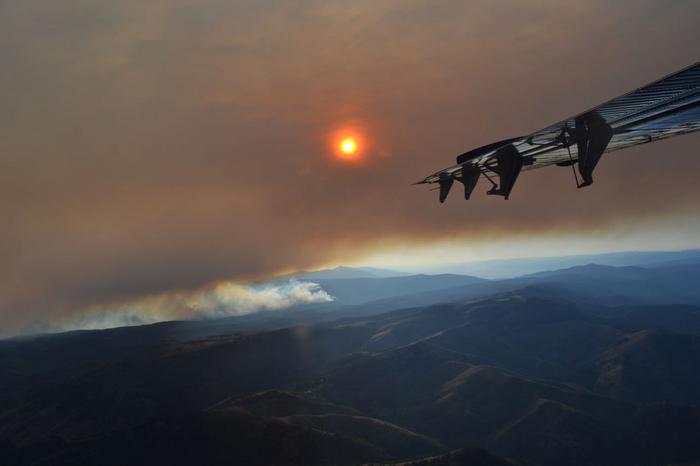
To conduct a comprehensive analysis of what makes up wildfire smoke plumes, Chakrabarty’s team spent 45 days traveling to different wildfire locations in the western United States, where they sampled gaseous smoke and aerosol species and analyzed their chemical and optical properties. This research was conducted as part of the Fire Influence on Regional to Global Environments and Air Quality (FIREX-AQ) field campaign, a joint venture led by the National Aeronatics and Space Administration and the National Oceanic and Atmospheric Administration.
“The conventional understanding has been that dark plumes of wildfire smoke contain black carbon soot, which absorbs solar radiation, while lighter plumes contain mostly organic carbon that scatters sunlight, meaning it offsets the absorption or warming effect of soot,” Chakrabarty said. “Typically, climate models ignore or dismiss organic carbon as insignificant compared to black carbon when it comes to warming, but that is not what field observations reveal.
“This is not a binary picture. Instead, we are looking at an entire continuum where there is strong light absorption by organic carbon, or dark brown carbon, similar to black carbon,” he said.
During their sampling of ground and airborne smoke from largescale wildfires, Chakrabarty’s team encountered an abnormally strong light absorber in plumes that wasn’t black carbon, yet it accounted for more than half of observed total absorption.
Chakrabarty turned to Rohan Mishra, associate professor of mechanical engineering and materials science, to investigate this unknown material and its properties. Arashdeep Thind, who earned a doctorate in materials science and engineering in 2021 while working in Mishra’s lab, used a sophisticated electron microscope — housed at the Center for Nanophase Materials Sciences, a U.S. Department of Energy user facility at Oak Ridge National Laboratory (ORNL) — to measure the optical properties of individual particles from the smoke samples Chakrabarty’s team collected.
“We knew there was something unusual with this material in its composition, structure and absorption spectrum,” Mishra said. “By looking at the local atomic structure of the dark brown particles — that are the size of only a few tens of nanometers — and simultaneously measuring their optical properties using the electron microscope at ORNL, we were able to decipher that these particles are similar to black carbon. It’s likely that they form similarly to soot in the high-temperature flames along the leading edges of wildfires.”
Mishra and Chakrabarty found that dark brown carbon absorbs slightly less light than black carbon on a per particle basis, but it is four times more abundant in plumes. This means that stealthy dark brown carbon particles in wildfires probably result in much more climate warming than previously recognized.
They also noted that these particles absorb wavelengths of light from ultraviolet to near infrared, covering the entire visible spectrum. Surprisingly, this potent brown carbon is resistant to sunlight-driven photochemical bleaching that makes light-absorbing organic aerosols lose their absorptivity in the atmosphere.
The team’s findings have broad implications. With wildfires predicted to rise globally in the coming decades, the role of dark brown carbon produced in fires will be even more impactful. Chakrabarty and Mishra say this underscores the need to harness multidisciplinary collaboration to revise existing climate models to account for the unexpected effects of brown carbon in wildfire smoke. Without this critical adjustment, they said, there is the risk of underestimating the global warming effects of wildfires, and thus, the urgency of climate change mitigation efforts.
Chakrabarty RK, Shetty NJ, Thind AS, Beeler P, Sumlin BJ, Zhang C, Liu P, Idrobo JC, Adachi K, Wagner NL, Schwarz JP, Ahern A, Sedlacek III AJ, Lambe A, Daube C, Lyu M, Liu C, Herndon S, Onasch TB, Mishra R. Shortwave absorption by wildfire smoke dominated by dark brown carbon. Nature Geoscience, Aug. 7, 2023. DOI: 10.1038/s41561-023-01237-9
This research was supported by NASA (80NSSC18K1414 and NNH20ZDA001N-ACCDAM), National Oceanic and Atmospheric Administration (NA16OAR4310104), National Science Foundation (AGS-1455215 and AGS-1926817), and US Department of Energy (DE-SC0021011).
Journal
Nature Geoscience
DOI
10.1038/s41561-023-01237-9
Method of Research
Experimental study
Subject of Research
Not applicable
Article Title
Short-wave absorption by wildfire smoke dominated by dark brown carbon
Article Publication Date
7-Aug-2023