Scientists are looking for ways to use the low-value energy widely distributed in natural environments to generate electricity. A research team has created a power generator that collects the natural atmospheric humidity and produces continuous electrical signals. This is the first humidity generator designed using a nano-sized material called polyoxometalates. It holds the potential of being a new research direction for polyoxometalates in the sustainable utilization of low-value energy.
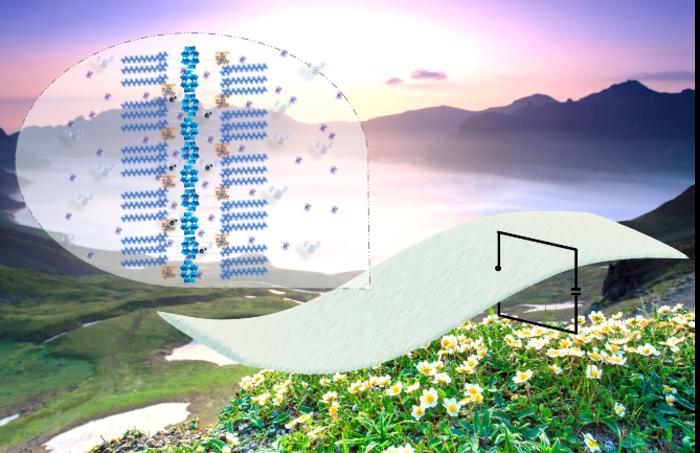
Credit: Nana Research, Tsinghua University Press
Scientists are looking for ways to use the low-value energy widely distributed in natural environments to generate electricity. A research team has created a power generator that collects the natural atmospheric humidity and produces continuous electrical signals. This is the first humidity generator designed using a nano-sized material called polyoxometalates. It holds the potential of being a new research direction for polyoxometalates in the sustainable utilization of low-value energy.
The team’s work is published in the journal Nano Research on August 01.
The team set out to solve the problem of the discontinuity in the operation of energy conversion devices. They sought to address the shortage of atmospheric humidity power generation materials and the limited designable performance of materials. “We wanted to understand the conversion process of atmospheric humidity energy to electrical energy and the role of polyoxometalates in the atmospheric humidity power generation,” said Weilin Chen, a professor in the Department of Chemistry at Northeast Normal University.
Polyoxometalates, known as POMs, have special morphology and functional properties, which make them very useful in controllable synthesis, assembly, and performance research. They are a versatile class of inorganic molecular materials. POM nanomaterials can self-assemble to form microporous structures that are capable of collecting atmospheric humidity. They are also environmentally friendly, with great stability in light, heat, and chemical environments. Scientists expect that POM nanomaterials are the materials with the potential to effectively utilize atmospheric humidity.
The team constructed POMs into organic ammonium-polyoxoanion clusters. The clusters were assembled into thin films power generators with tiny, nano-sized pores called micropores, that are capable of working in atmospheric humidity. Their tiny POM generator produced a voltage of 0.68 V, was stable, and worked continuously under almost all-natural environments, with atmospheric humidity ranging from 10 percent to 90 percent.
The POM atmospheric humidity generator works as the POM nanoclusters spontaneously absorb atmospheric humidity with the micropores in POM nanowires films. They form a distribution gradient of water which is the structural basis of power generation. The POM generator has proven to have high stability and continuous power generation performance.
The team determined that the POM power generator can effectively collect the natural atmospheric humidity and produce continuous electrical signals by the uneven distribution and directional movement of ions. This work provides new ideas for the continuous use of low-value energy and a new research angle for polyoxometalate chemistry.
There has been an urgent need to develop a continuous low-value energy in a natural environment. In past research, scientists have created devices that collect and use low-value energy. But these devices have been limited because low-value energy is intermittent and unstable. In recent years, scientists have made progress in their use of atmospheric humidity energy. But the team’s POM generator is the first humidity generator to produce continuous power.
This POM generator has many potential applications, such as the detection of human respiratory processes; the detection, recording, and alarm of environmental humidity; the integration with electrical appliances to achieve continuous power supply of equipment; and meeting the electricity needs of multiple scenarios.
“The most important message is that continuous power generation using atmospheric humidity has been achieved through the design and modification of POMs nanomaterials, and the mechanism of atmospheric humidity power generation has been deeply understood by using the characteristics of POMs nanomaterials,” said Chen.
Looking ahead, the team hopes to improve the efficiency of atmospheric humidity power generation by screening and optimizing materials. They want to achieve a deeper understanding the atmospheric humidity power generation process.
“The ultimate goal is achieving the efficient use of humidity generators to promote sustainable development of energy and the environment by exploring the mechanism that optimizes the efficiency of the humidity generator,” said Chen.
The Chinese research team includes Tuo Ji and Weilin Chen from the Northeast Normal University; Zhenhui Kang from Soochow University; and Liming Zhang from the Chinese Academy of Sciences.
The research is funded by the National Natural Science Foundation of China, Science and Technology Research Project of the Education Department of Jilin Province, and the Natural Science Foundation of Jilin Province.
##
About Nano Research
Nano Research is a peer-reviewed, international and interdisciplinary research journal, publishes all aspects of nano science and technology, featured in rapid review and fast publishing, sponsored by Tsinghua University and the Chinese Chemical Society. It offers readers an attractive mix of authoritative and comprehensive reviews and original cutting-edge research papers. After 15 years of development, it has become one of the most influential academic journals in the nano field. In 2023 InCites Journal Citation Reports, Nano Research has an Impact Factor of 9.9, the total cites reached 35645, ranking first in China’s international academic journals, and the number of highly cited papers reached 194, ranked among the top 1.8% of 8769 academic journals.
About Tsinghua University Press
Established in 1980, belonging to Tsinghua University, Tsinghua University Press (TUP) is a leading comprehensive higher education and professional publisher in China. Committed to building a top-level global cultural brand, after 42 years of development, TUP has established an outstanding managerial system and enterprise structure, and delivered multimedia and multi-dimensional publications covering books, audio, video, electronic products, journals and digital publications. In addition, TUP actively carries out its strategic transformation from educational publishing to content development and service for teaching & learning and was named First-class National Publisher for achieving remarkable results.
Journal
Nano Research
DOI
10.1007/s12274-023-5959-5
Article Title
Polyoxometalates for continuous power generation by atmospheric humidity
Article Publication Date
1-Aug-2023