It’s an elegant solution: Remove the habitat of a parasite-carrying aquatic snail and reduce the level of infection in the local community; all while generating more feed and compost for local farmers.
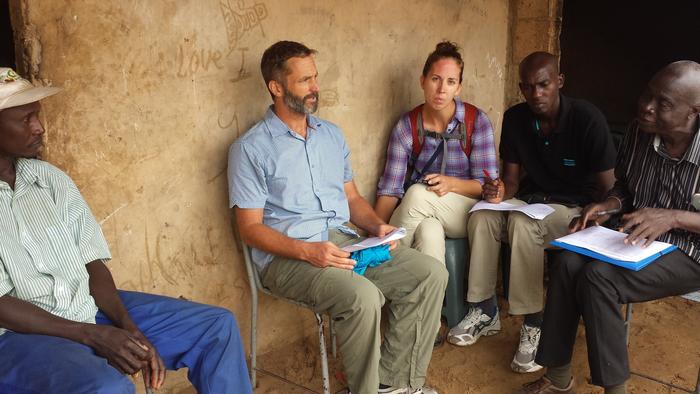
Credit: Courtesy Credit
It’s an elegant solution: Remove the habitat of a parasite-carrying aquatic snail and reduce the level of infection in the local community; all while generating more feed and compost for local farmers.
A collaboration of scientists from the United States and Senegal focused on doing just that by removing overgrown aquatic vegetation from areas upstream of the Diama Dam in northeastern Senegal. In doing so, they generated positive impacts to the local communities’ health and economies.
“It is rare and gratifying when we can find a potential win-win solution to both human health and livelihoods,” said UC Santa Barbara geography professor David López-Carr, a co-author of a paper that appears in the journal Nature. In it, the researchers provide proof for a hypothesis that agricultural activities, including the use of fertilizers, contribute to parasitic infections by fueling the growth of aquatic vegetation. “The results suggest a simple solution to positively impact society at the intersections of health, society and economy of northern Senegal, with implications for the over 700 million people globally in schistosomiasis endemic areas.”
Since the construction of the Diama Dam in 1986, local farmers have had better access to fresh water to irrigate their fields. However, the presence of the new infrastructure also has increased the prevalence of the schistosoma parasite, a tiny freshwater flatworm commonly found in Africa, South America and Southeast Asia. Nearly 250 million people around the world are estimated to be infected with this parasite.
As far as tropical diseases go, schistosomiasis (also known as bilharzia or snail fever) isn’t immediately fatal or even transmissible between people. But in the long term, the condition is debilitating.
“The disease is most prevalent in poor communities lacking potable water and adequate sanitation,” said López-Carr, an anthropogeographer who specializes in human-environment dynamics in the developing world. Adult worms take up residence in blood vessels and lay eggs in tissue, causing reactions and generally wreaking havoc on organs. Long-term effects include increased risk for cancer and infertility, and those infected are less able to work and go to school, keeping them in the cycle of poverty. “Poor farmers can lose up to half of their yields due to infection,” he said.
Health agencies and organizations have been fighting these infections with drugs that work well, however, the medicine does not prevent reinfection, which can happen as soon as the individual encounters contaminated water. Previous research has also focused on using the snails’ natural predators — prawns — which were cut off by the dam.
In their effort to get ahead of the disease, the collaboration took a close look at the habitat that supports the worms’ intermediate host, a small snail that lives in the Senegal River and its tributaries. They found that a common aquatic plant called Ceratophyllum demersum — also known as hornwort — can hold up to 99% of these snails, with which they have a mutualistic relationship.
Exacerbated by fertilizer runoff from agricultural operations farther upstream, c. demersum and other aquatic plants tend to proliferate in local waterways, which impedes access for daily activities such as cooking, irrigation and washing clothes.
For their experiment, the researchers conducted a three-year randomized control trial in 16 communities, to see if and how much nuisance vegetation removal in about half of the communities would affect the presence of the snails. They measured baseline infection rates, administered antiparasitic drugs, removed the vegetation and then measured reinfection rates in more than 1,400 schoolchildren. In total, the research teams took out an estimated 430 metric tons (wet) of aquatic vegetation from water access points.
“In our randomized controlled trial, control sites — places where we didn’t remove submerged vegetation from water access points — had 124% higher intestinal schistosoma reinfection rates,” López-Carr said. In addition to lowered infection rates where they removed the vegetation, the researchers found that the removed material could be used to feed livestock, or turned into compost for growing crops, lowering costs dramatically and increasing yields for local farmers. In this way, according to López-Carr “the approach yielded an economic incentive to remove nuisance vegetation from waterways and return nutrients from aquatic plants back to the soil and for livestock feed with the promise of severing poverty-disease traps while lowering infectious burden at the same time.”
“A broader benefit is the hope that this example can set for enhancing win-win planetary health research and solutions that improve livelihoods while also reducing infectious morbidity and mortality,” he added.
Having conducted these trials, the researchers hope that this study is implemented elsewhere in other similar regions to replicate the same kind of health and economic outcomes.
And, it might not be just a solution for developing countries. “Perhaps vegetation growth resulting from excess nutrients could also be used as livestock feed in more developed countries as well,” López-Carr said.
Journal
Nature
Article Title
A planetary health innovation for disease, food and water challenges in Africa
Article Publication Date
12-Jul-2023