A research team led by Prof. Yossi Paltiel at the Hebrew University of Jerusalem with groups from HUJI, Weizmann and IST Austria new study reveals the influence of nuclear spin on biological processes. This discovery challenges long-held assumptions and opens up exciting possibilities for advancements in biotechnology and quantum biology.
Credit: PNAS
A research team led by Prof. Yossi Paltiel at the Hebrew University of Jerusalem with groups from HUJI, Weizmann and IST Austria new study reveals the influence of nuclear spin on biological processes. This discovery challenges long-held assumptions and opens up exciting possibilities for advancements in biotechnology and quantum biology.
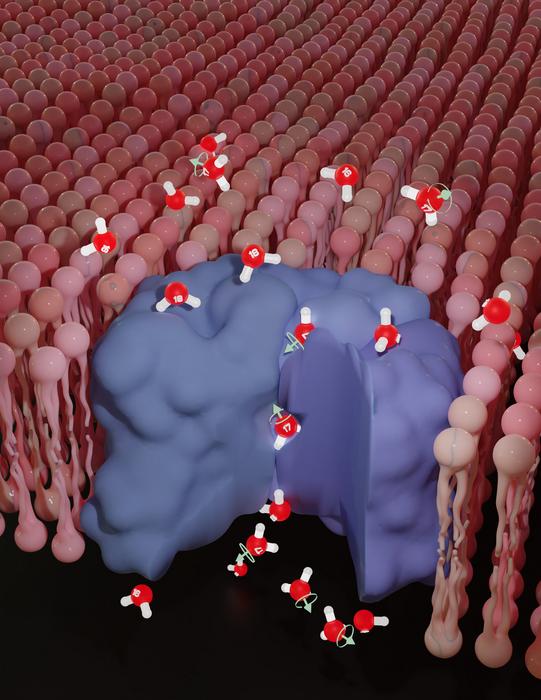
Scientists have long believed that nuclear spin had no impact on biological processes. However, recent research has shown that certain isotopes behave differently due to their nuclear spin. The team focused on stable oxygen isotopes (16O, 17O, 18O) and found that nuclear spin significantly affects oxygen dynamics in chiral environments, particularly in its transport.
The findings, published in the prestigious Proceedings of the National Academy of Sciences (PNAS), have potential implications for controlled isotope separation and could revolutionize nuclear magnetic resonance (NMR) technology.
Prof. Yossi Paltiel, the lead researcher, expressed excitement about the significance of these findings. He stated, “Our research demonstrates that nuclear spin plays a crucial role in biological processes, suggesting that its manipulation could lead to groundbreaking applications in biotechnology and quantum biology. This could potentially revolutionize isotopic fractionation processes and unlock new possibilities in fields such as NMR.”
The story in detail
Researchers have been studying the “strange” behavior of tiny particles in living things, funding some places where quantum effects change biological processes. For example studying bird navigation quantum effects may help some birds find their way in long journeys. In plants efficiently using sunlight for energy is affected by quantum effects.
This connection between the tiny world of particles and living beings likely goes back billions of years when life began and molecules with a special shape called chirality appeared. Chirality is important because only molecules with the right shape can do the jobs they need to in living things.
The link between chirality quantum mechanics was found in “spin,” which is like a tiny magnetic property. Chiral molecules can interact differently with particles based on their spin, creating something called Chiral Induced Spin Selectivity (CISS).
Scientists have found that spin affects tiny particles, like electrons, in living processes involving chiral molecules. They wanted to see if spin also affects larger particles, like ions and molecules which supply the base for biological transport. So, they did experiments with water particles that have different spins. The results showed that spin influences how water behaves in cells, entering at different speeds and reacting in a unique way when chiral molecules are involved.
This study highlights the importance of spin in the processes of life. Understanding and controlling spin could have a big impact on how living things work. It might also help improve medical imaging and create new ways to treat illnesses.
The research was a collaborative effort among scientists from various institutions, including the Institute of Earth Sciences and Life Sciences in Hebrew and the Weizmann Institute, with the study led by the Department of Applied Physics at Hebrew University.
Funding: NMS acknowledges the support of the Ministry of Energy, Israel, as part of the scholarship program for graduate students in the fields of energy. ML acknowledges support by the European Research Council (ERC) Starting Grant No. 801770 (ANGULON).
The team includes: Yossi Paltiel, Ofek Vardi, Yuval Kolodny, Stav Ferrera, Naama Maroudas-Sklare, Nir Yuran, Shira Yochelis. Department of Applied Physics, Hebrew University of Jerusalem; Nir Keren, Silberman Institute of Life Sciences, Hebrew University of Jerusalem; Artem Volosniev, Areg Ghazarya, Mikhail Lemeshko, IST Austria (Institute of Science and Technology Austria; Amijai Saragovi, The Hebrew University Medical School; Nir Galili, Itay Halevye ,Weizmann Institute of Science; Hagit P. Affek, Boaz Luz, Yonaton Goldsmith, Institute of Earth Sciences, Hebrew University of Jerusalem
The Hebrew University of Jerusalem is Israel’s premier academic and research institution. With over 25,000 students from 90 countries, it is a hub for advancing scientific knowledge and holds a significant role in Israel’s civilian scientific research output, accounting for nearly 40% of it and has received over 11,000 patents. The university’s faculty and alumni have earned eight Nobel Prizes and a Fields Medal, underscoring their contributions to ground-breaking discoveries. In the global arena, the Hebrew University ranks 77th according to the Shanghai Ranking, making it the top-ranked Israeli institution. To learn more about the university’s academic programs, research initiatives, and achievements, visit the official website at http://new.huji.ac.il/en
Journal
Proceedings of the National Academy of Sciences
DOI
10.1073/pnas.2300828120
Method of Research
Experimental study
Subject of Research
Cells
Article Title
Nuclear spin effects in biological processes
Article Publication Date
4-Aug-2023