URBANA, Ill. – Common beans are important food sources with high nutritional content. Bean seeds also contain phenolic compounds, which have antioxidant and anti-inflammatory properties that promote health. A study from the University of Illinois Urbana-Champaign and CIATEJ in Guadalajara, Mexico, explored the composition of seed coat extracts from black and pinto bean varieties unique to the Chiapas region of Southern Mexico.
Credit: College of ACES
URBANA, Ill. – Common beans are important food sources with high nutritional content. Bean seeds also contain phenolic compounds, which have antioxidant and anti-inflammatory properties that promote health. A study from the University of Illinois Urbana-Champaign and CIATEJ in Guadalajara, Mexico, explored the composition of seed coat extracts from black and pinto bean varieties unique to the Chiapas region of Southern Mexico.
“These beans are preserved among Mayan communities and grown by indigenous farmers. They are heirlooms from past generations and are important because of their cultural significance and contribution to biodiversity,” explained study co-author Elvira de Mejia, professor in the Department of Food Science and Human Nutrition (FSHN), part of the College of Agricultural, Consumer and Environmental Sciences (ACES) at U. of I.
The research team selected two varieties among several collected in the Chiapas region because of their high phenolic content, present in the seed coat pigment that gives the beans their dark red or black coloring.
“These phenolic compounds have the capability of keeping oxidation and inflammation under control, which could help decrease the risk of chronic health issues such as cardiovascular disease, cancer, and diabetes,” de Mejia said.
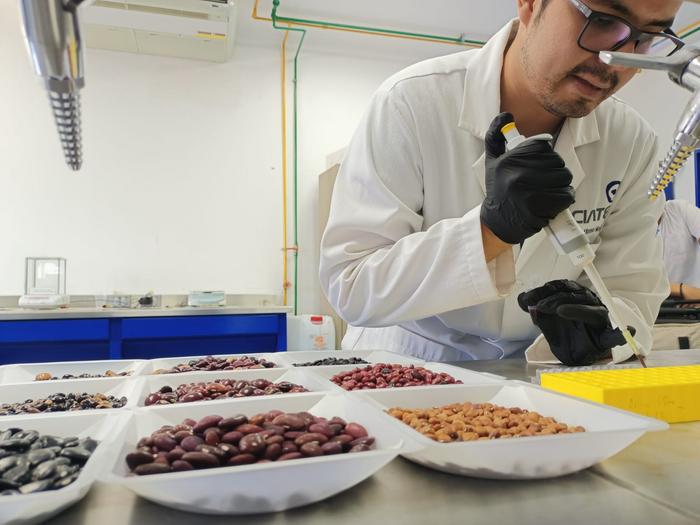
First, the researchers removed the bean seed coat and ground it for processing. Then they analyzed the chemical composition of a crude extract, as well as an enriched extract that was purified to concentrate the phenolic content. They also measured the bean extracts’ antioxidant capacity and ability to inhibit free radicals through biochemical assays and in silico molecular docking, a type of computer simulation.
“We found the black beans had high quantities of anthocyanin, in particular delphinidin, petunidin, and malvidin glucosides, which have antioxidative properties. The pinto beans had the highest total content of phenolic compounds and showed great potential for inhibiting enzymes that contribute to inflammation,” said David Fonseca Hernández, a doctoral student at CIATEJ, and lead author of the paper. Fonseca conducted the research as a visiting scholar in FSHN at U. of I.
The seed coat extracts can be used as additives in the food industry or in cosmetics, Fonseca explained.
“My research focuses on skin health, because there is a lot of interest in new ingredients with bioactive properties to use in formulations for creams. One of the main issues with aging skin is the oxidative stress that results from environmental factors. When the skin is exposed to air pollution and sunlight, it produces higher quantities of free radicals and inflammation pathways are activated,” he stated.
“We tested some markers related to inflammation, such as cyclooxygenase and inducible nitric oxide synthase. We had really good results showing the extracts, especially from pinto beans, could inhibit and reduce the activity of these enzymes.”
The researchers also found that the process of enriching the extracts can further concentrate the anthocyanins and phenolic compounds, which is useful both for industry and research purposes.
The study is part of a large project supported by CONAHCYT, Mexico’s National Science Foundation, explained study co-author Luis Mojica, research professor at CIATEJ and Fonseca’s advisor.
“One of the project’s goals was to find cultivars with an interesting profile to be used as a source of phytochemicals for the cosmetic industry. This industry is growing very fast, and there is a demand for natural products to treat skin-related diseases or aging,” he said. “In our research, we compared around 60 cultivars of common beans from the south of Mexico, and these two varieties are three or four times higher than others in phenolic compounds and anthocyanins. These beans are very interesting for health; they are also high in other nutrients such as proteins, fiber, and oligosaccharides.”
The project can help provide regional support by increasing wellness and developing Mexico’s southern region by preserving these unique bean varieties, the researchers stated.
Following up on the study’s significant laboratory findings, the next steps will be to test the extracts on cell tissue cultures and eventually in clinical trials.
Fonseca attended the U. of I. through I-MMAS, a program created to increase recruitment of Mexican and Mexican-American students within the University of Illinois System.
“Our collaboration with Dr. Mojica’s research group through I-MMAS is meaningful because there is a large number of migrants from Guadalajara in Illinois, but also because of the quality of their work. Dr. Mojica’s lab conducts basic research, but they also work with industry to apply the knowledge to solve practical problems. Dr. Mojica completed his doctorate degree in FSHN at U. of I. Both he and David were very productive and successful students during their time here, and we are very happy to continue our work with them,” de Mejia concluded.
The paper, “Black and pinto beans (Phaseolus vulgaris L.) unique mexican varieties exhibit antioxidant and anti-inflammatory potential,” is published in Food Research International [DOI: 10.1016/j.foodres.2023.112816]. Authors are David Fonseca Hernández, Luis Mojica, Mark A. Berhow, Korey Brownstein, Eugenia Lugo Cervantes, and Elvira Gonzalez de Mejia.
Funding for this research was provided by the Consejo Nacional de Humanidades Ciencias y Tecnologías CONAHCYT-Mexico, number 901000 and FORDECYT grant number 292474, and by the U.S. Department of Agriculture, Agricultural Research Service.
The College of Agricultural, Consumer and Environmental Sciences (ACES) at the University of Illinois has top-ranked programs, dedicated students, and world-renowned faculty and alumni who are developing solutions to the world’s most critical challenges to provide abundant food and energy, a healthy environment, and successful families and communities.
Journal
Food Research International
DOI
10.1016/j.foodres.2023.112816
Method of Research
Computational simulation/modeling
Subject of Research
Not applicable
Article Title
Black and pinto beans (Phaseolus vulgaris L.) unique mexican varieties exhibit antioxidant and anti-inflammatory potential
Article Publication Date
14-Apr-2023